

[2025] Verified API-577 Dumps Q&As - 1 Year Free & Quickly Updates
Latest 2025 Realistic Verified API-577 Dumps - 100% Free API-577 Exam Dumps
NEW QUESTION # 57
Which of the following is the test that can measure most aspects of weldability?
- A. Weld tension tests
- B. There is no single test
- C. Impact testing
- D. Bend testing
Answer: B
NEW QUESTION # 58
Which of the following statements is true?
- A. One PQR may support several WPSs.
- B. All PQRs must be qualified with impact testing.
- C. Welding procedures must be supported by more than one PQR.
- D. PQRs qualified on P8 materials also qualify for P1 materials.
Answer: A
NEW QUESTION # 59
When verifying that the filler metal selection is appropriate for the base metal being welded, an inspector should consider:
- A. Tensile strength to be higher than the base metal.
- B. Need for postweld heat treatment (PWHT).
- C. Acceptability of physical properties.
- D. Chemical composition.
Answer: D
NEW QUESTION # 60
The carbon equivalent formula indicates:
- A. The theoretical carbon content of a steel.
- B. Whether preheat will be needed.
- C. Whether postweld heat treatment (PWHT) will be needed.
- D. The weldability of a steel, based on carbon content.
Answer: D
NEW QUESTION # 61
What is the liquid flow rate range that should be maintained in piping to be hot tapped?
- A. 2.3 - 3.3 ft./sec (0.70 - 1.00 m/sec)
- B. 1.3 - 4.0 ft./sec (0.40 - 1.20 m/sec)
- C. 0.05 - 2.7 ft./sec (0.015 - 0.82 m/sec)
- D. 4.1 - 5.5 ft./sec (1.25 - 1.68 m/sec)
Answer: B
NEW QUESTION # 62
Refer to the following diagram: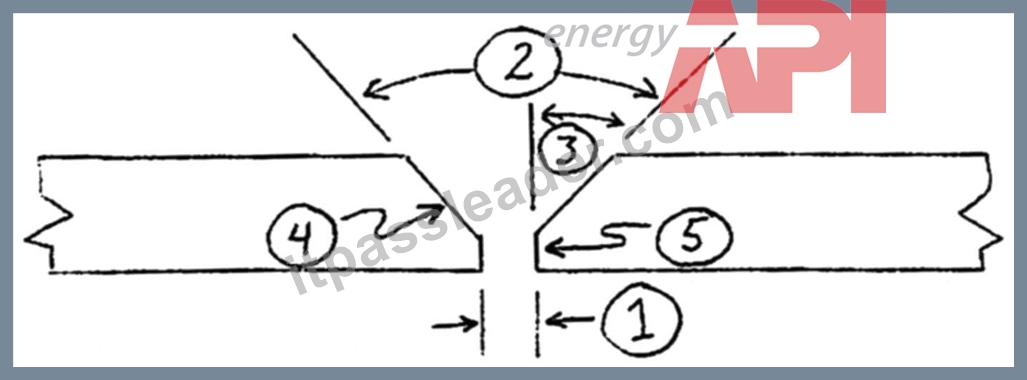
Item#1 represents:
- A. root opening.
- B. groove weld size.
- C. root weld size.
- D. root face.
Answer: A
NEW QUESTION # 63
For GMAW welding, the last number of the electrode identifies the:
- A. Coating characteristics.
- B. Operating characteristics.
- C. Strength of the electrode.
- D. Chemical composition.
Answer: B
NEW QUESTION # 64
What is a sensitized microstructure in austenitic stainless steels?
- A. The microstructure of the weld that has been melted and will therefore have properties more like a casting than the base metal.
- B. The high residual stress zone adjacent to the weld fusion line that will have higher hardness than the weld or base material.
- C. An area near the heat-affected zone affected by welding that may experience intergranular corrosion.
- D. An area next to the heat-affected zone that has suffered some softening and loss of strength.
Answer: C
NEW QUESTION # 65
What is the maximum temperature at which ACFM may be used?
- A. 900°F (480°C)
- B. 500°F (260°C)
- C. 300°F (150°C)
- D. 1000°F (540°C)
Answer: B
NEW QUESTION # 66
Base metals are assigned P-numbers by the ASME Code, Section IX to reduce the number of:
- A. Required mechanical tests.
- B. Required welding procedure specifications.
- C. Required welding procedure qualifications.
- D. Required procedure and performance qualifications.
Answer: D
NEW QUESTION # 67
Which of the following can result from residual magnetism left in a partially completed weld?
- A. Excessive distortion
- B. Solidification cracking
- C. Deflection of the weld arc
- D. Tendency of weld pool to be sluggish
Answer: C
NEW QUESTION # 68
What is a discontinuity?
- A. An imperfection which is detectable with NDE.
- B. A departure of a quality characteristic from its intended condition.
- C. The response or evidence from the application of NDE.
- D. An interruption in the normal physical structure of a material.
Answer: D
NEW QUESTION # 69
Which of the following is not usually an essential variable on a WPS form?
- A. Base metal
- B. Groove design
- C. Welding technique
- D. Welding position
Answer: C
NEW QUESTION # 70
The distance the weld metal extends from the weld face into a joint, exclusive of weld reinforcement is called:
- A. The weld body
- B. Complete penetration
- C. Groove angle
- D. Joint penetration
Answer: D
NEW QUESTION # 71
Exposed film that allows 1% of the incident light to pass through has a film density of:
- A. 4.0
- B. 1.0
- C. 3.0
- D. 2.0
Answer: C
NEW QUESTION # 72
How much should each pass of the transducer overlap the previous path during a weld scan?
- A. 5% of the transducer element dimension.
- B. 15% of the transducer element dimension.
- C. 10% of the transducer element dimension.
- D. 20% of the transducer element dimension.
Answer: C
NEW QUESTION # 73
Codes/standards sometimes specify impact testing of weldments at minimum design metal temperatures to:
- A. Assure that the welded material has sufficient tensile strength to avoid failure at design loads.
- B. Assure that the welded material has sufficient ductility to assist brittle fracture.
- C. Assure that the welded material has sufficient yield strength to avoid brittle fracture.
- D. Assure that the welded material has sufficient toughness to resist brittle fracture.
Answer: D
NEW QUESTION # 74
What term is used to describe the mechanical working of metals using impact blows?
- A. Needle gunning
- B. Hammering
- C. Peening
- D. Mechanical stress relieving
Answer: C
NEW QUESTION # 75
Eddy current can be used to measure the:
- A. Thickness of surface coatings or cladding thickness.
- B. Extent of bonding of coatings or claddings.
- C. Thickness of parent metal below alloy metal claddings.
- D. Holidays in coatings or claddings.
Answer: A
NEW QUESTION # 76
Refer to the following diagram: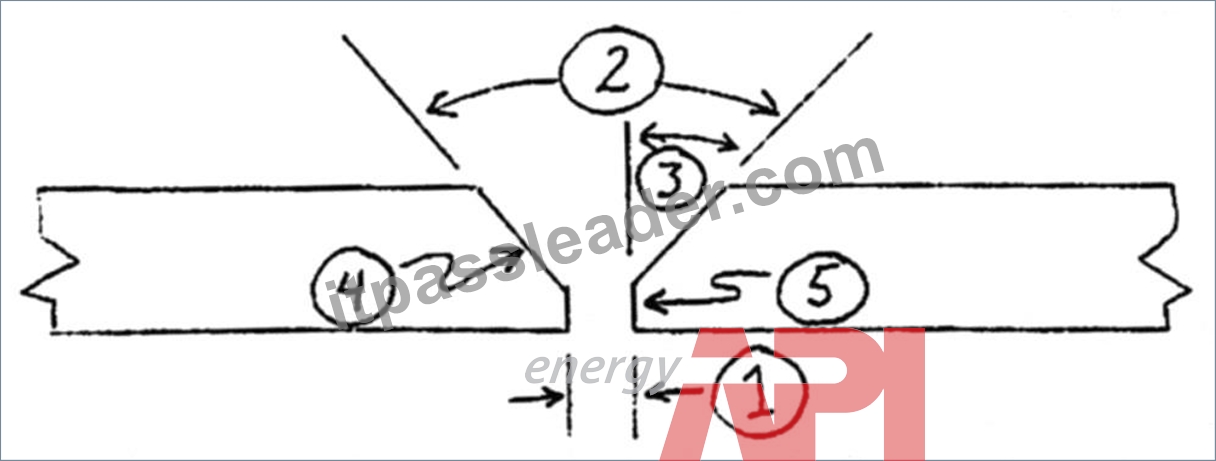
Item#4 represents:
- A. bevel angle.
- B. groove face.
- C. bevel face.
- D. groove angle.
Answer: A
NEW QUESTION # 77
A limitation of a stud arc welding (SW) process is:
- A. Weld is not visible during the welding process.
- B. Process is limited to a flat position.
- C. Welding rates are significantly lower than those obtained with SMAW.
- D. Process is primarily suitable for only carbon steel and low alloy steels.
Answer: B
NEW QUESTION # 78
The direction of magnetic flux can be confirmed by the use of a:
- A. Calibration gauge.
- B. Magnetic-field-sensitive crayon.
- C. Flux line sensitizer.
- D. Pie gauge.
Answer: D
NEW QUESTION # 79
A welding engineer or inspector should be notified when a weld has failed a weld quality test more than how many times in order to help determine the cause of the test failure?
- A. THREE TIMES
- B. TWICE
- C. FOUR TIMES
- D. ONCE
Answer: B
NEW QUESTION # 80
One of the main differences between welding nickel alloys and austenitic stainless steels is that with nickel alloys:
- A. There is less susceptibility to cracking from contaminants.
- B. Interpass temperature control is not needed.
- C. There is less susceptibility to lack of fusion.
- D. The weld pool tends to be sluggish.
Answer: D
NEW QUESTION # 81
......
API API-577 Exam Syllabus Topics:
| Topic | Details |
|---|---|
| Topic 1 |
|
| Topic 2 |
|
| Topic 3 |
|
| Topic 4 |
|
| Topic 5 |
|
| Topic 6 |
|
| Topic 7 |
|
| Topic 8 |
|
| Topic 9 |
|
API-577 Dumps PDF and Test Engine Exam Questions: https://www.itpassleader.com/API/API-577-dumps-pass-exam.html