

[Dec-2025] AZ-305 Dumps are Available for Instant Access using ITPassLeader
AZ-305 Dumps 2025 - New Microsoft AZ-305 Exam Questions
NEW QUESTION # 212
Case Study 1 - Litware
Existing Environment
Azure Environment
Litware has 10 Azure subscriptions that are linked to the Litware.com tenant and five Azure subscriptions that are linked to the dev.litware.com tenant. All the subscriptions are in an Enterprise Agreement (EA).
The litware.com tenant contains a custom Azure role-based access control (Azure RBAC) role named Role1 that grants the DataActions read permission to the blobs and files in Azure Storage.
On-Premises Environment
The on-premises network of Litware contains the resources shown in the following table.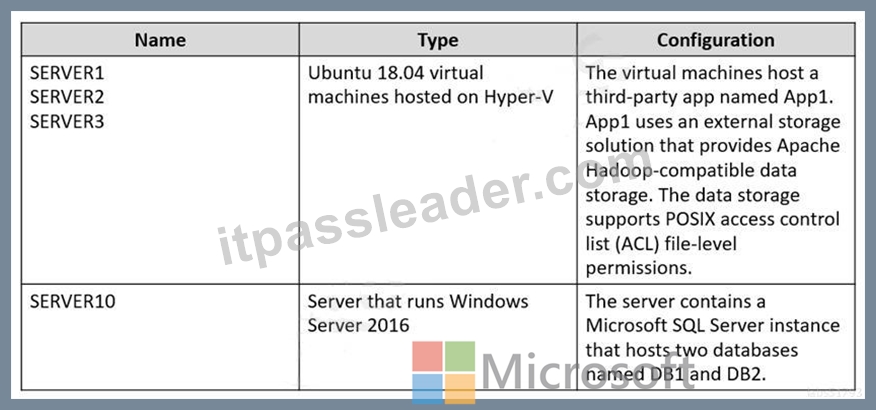
Network Environment
Litware has ExpressRoute connectivity to Azure.
Planned Changes and Requirements
Litware plans to implement the following changes:
* Migrate DB1 and DB2 to Azure.
* Migrate App1 to Azure virtual machines.
* Migrate the external storage used by App1 to Azure Storage.
* Deploy the Azure virtual machines that will host App1 to Azure dedicated hosts.
Authentication and Authorization Requirements
Litware identifies the following authentication and authorization requirements:
* Only users that manage the production environment by using the Azure portal must connect from a hybrid Azure AD-joined device and authenticate by using Azure Multi-Factor Authentication (MFA).
* The Network Contributor built-in RBAC role must be used to grant permissions to the network administrators for all the virtual networks in all the Azure subscriptions.
* To access the resources in Azure, App1 must use the managed identity of the virtual machines that will host the app.
* RBAC roles must be applied at the highest level possible.
Resiliency Requirements
Litware identifies the following resiliency requirements:
* Once migrated to Azure, DB1 and DB2 must meet the following requirements:
- Maintain availability if two availability zones in the local Azure region fail.
- Fail over automatically.
- Minimize I/O latency.
* App1 must meet the following requirements:
- Be hosted in an Azure region that supports availability zones.
- Be hosted on Azure virtual machines that support automatic scaling.
- Maintain availability if two availability zones in the local Azure region fail.
Security and Compliance Requirements
Litware identifies the following security and compliance requirements:
* Once App1 is migrated to Azure, you must ensure that new data can be written to the app, and the modification of new and existing data is prevented for a period of three years.
* On-premises users and services must be able to access the Azure Storage account that will host the data in App1.
* Access to the public endpoint of the Azure Storage account that will host the App1 data must be prevented.
* All Azure SQL databases in the production environment must have Transparent Data Encryption (TDE) enabled.
* App1 must NOT share physical hardware with other workloads.
Business Requirements
Litware identifies the following business requirements:
* Minimize administrative effort.
* Minimize costs.
You plan to migrate App1 to Azure. The solution must meet the authentication and authorization requirements.
Which type of endpoint should App1 use to obtain an access token?
- A. Azure Service Management
- B. Azure AD
- C. Azure Instance Metadata Service (IMDS)
- D. Microsoft identity platform
Answer: D
Explanation:
Scenario: To access the resources in Azure, App1 must use the managed identity of the virtual machines that will host the app.
Managed identities provide an identity for applications to use when connecting to resources that support Azure Active Directory (Azure AD) authentication. Applications may use the managed identity to obtain Azure AD tokens.
Reference:
https://docs.microsoft.com/en-us/azure/active-directory/managed-identities-azure- resources/overview
NEW QUESTION # 213
You have several Azure App Service web apps that use Azure Key Vault to store data encryption keys.
Several departments have the following requests to support the web app:
Which service should you recommend for each department's request? To answer, configure the appropriate options in the answer area.
NOTE: Each correct selection is worth one point.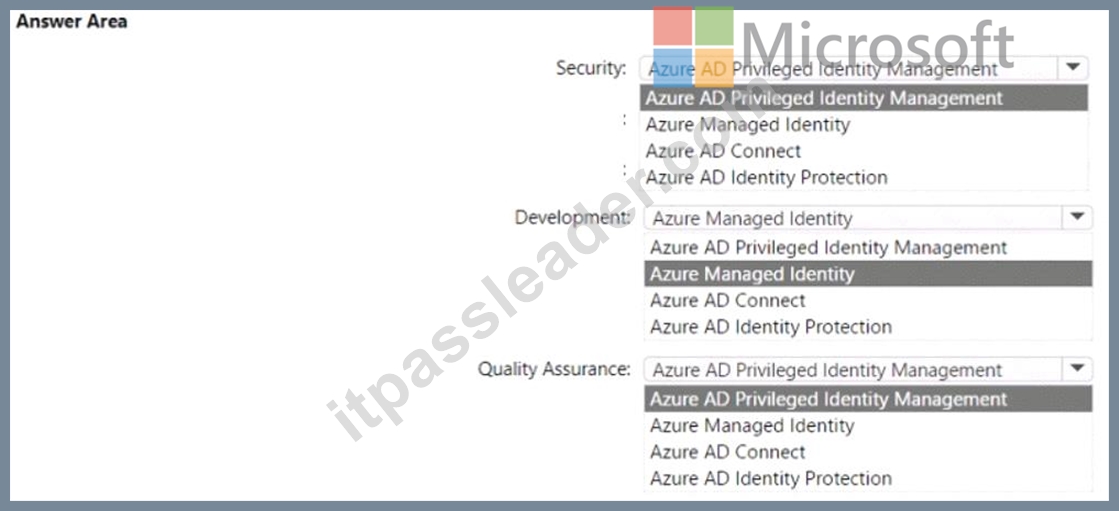
Answer:
Explanation: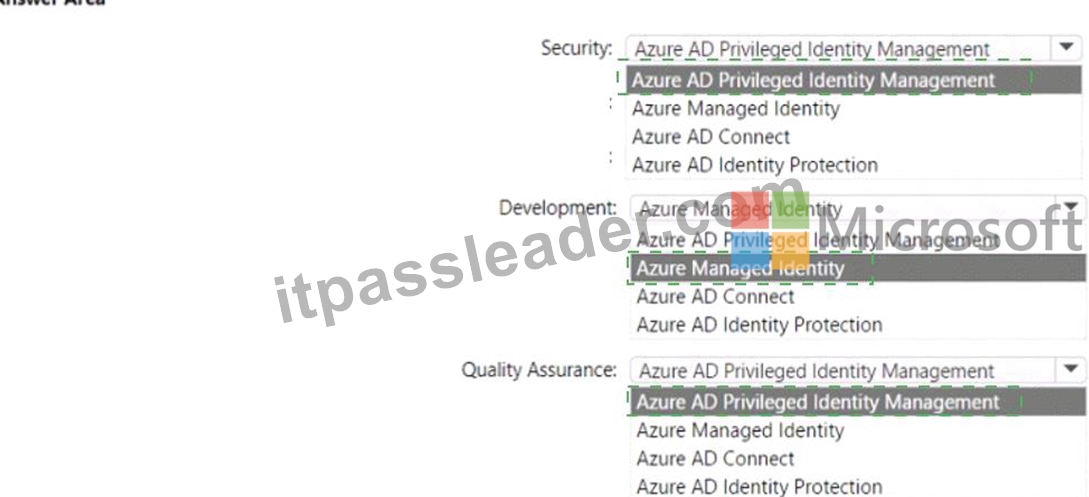
Explanation
Graphical user interface, text, application Description automatically generated
NEW QUESTION # 214
You have a resource group named RG1 that contains the objects shown in the following table.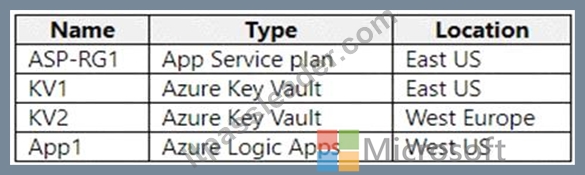
You need to configure permissions so that App1 can copy all the secrets from KV1 to KV2. App1 currently has the Get permission for the secrets in KV1.
Which additional permissions should you assign to App1? To answer, select the appropriate options in the answer area.
NOTE:Each correct selection is worth one point.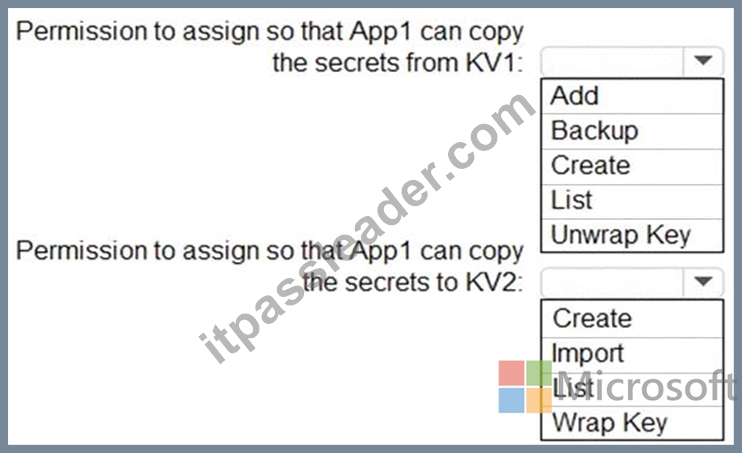
Answer:
Explanation: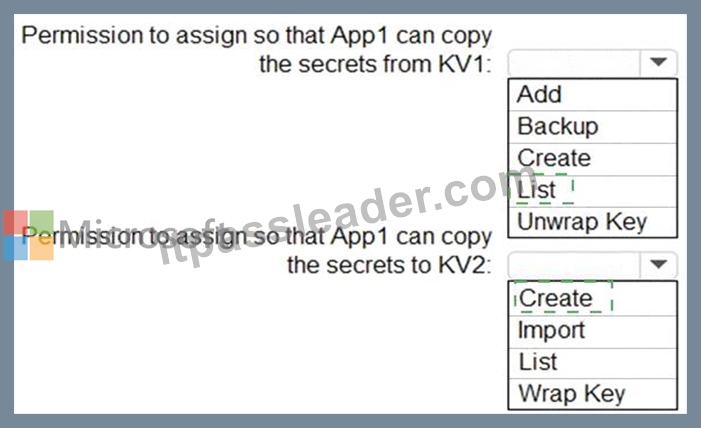
Explanation
Graphical user interface, text, application Description automatically generated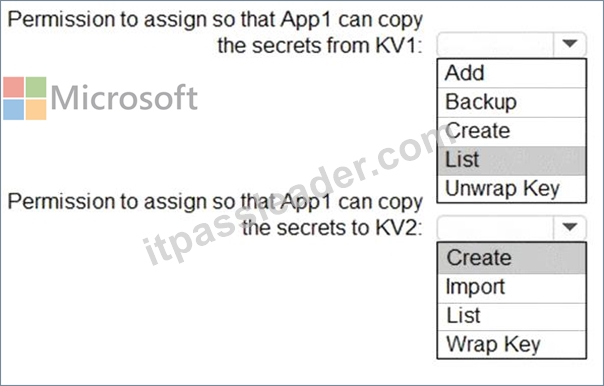
Box 1: List
Get: Gets the specified Azure key vault.
List: The List operation gets information about the vaults associated with the subscription.
Box 2: Create
Create Or Update: Create or update a key vault in the specified subscription.
Reference:
https://docs.microsoft.com/en-us/rest/api/keyvault/
NEW QUESTION # 215
You are designing a cost-optimized solution that uses Azure Batch to run two types of jobs on Linux nodes.
The first job type will consist of short-running tasks for a development environment. The second job type will consist of long-running Message Passing Interface (MPI) applications for a production environment that requires timely job completion.
You need to recommend the pool type and node type for each job type. The solution must minimize compute charges and leverage Azure Hybrid Benefit whenever possible.
What should you recommend? To answer, select the appropriate options in the answer area.
NOTE: Each correct selection is worth one point.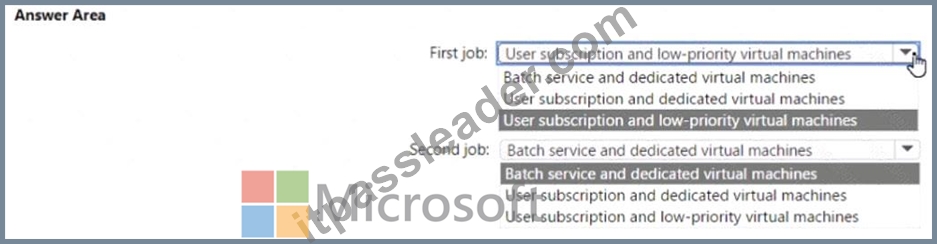
Answer:
Explanation: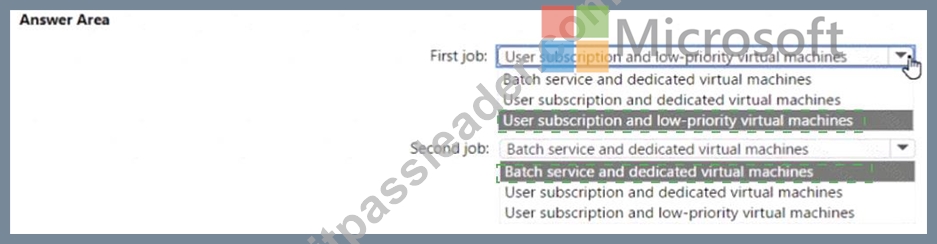
Explanation
Graphical user interface, text, application Description automatically generated
NEW QUESTION # 216
You are designing an order processing system in Azure that will contain the Azure resources shown in the following table.
The order processing system will have the following transaction flow:
* A customer will place an order by using App1.
* When the order is received, App1 will generate a message to check for product availability at vendor 1 and vendor 2.
* An integration component will process the message, and then trigger either Function1 or Function2 depending on the type of order.
* Once a vendor confirms the product availability, a status message for App1 will be generated by Function1 or Function2.
* All the steps of the transaction will be logged to storage1.
Which type of resource should you recommend for the integration component?
D18912E1457D5D1DDCBD40AB3BF70D5D
Which type of resource should you recommend for the integration component?
- A. an Azure Data Factory pipeline
- B. an Azure Event Hubs capture
- C. an Azure Service Bus queue
- D. an Azure Event Grid domain
Answer: A
Explanation:
A data factory can have one or more pipelines. A pipeline is a logical grouping of activities that together perform a task.
The activities in a pipeline define actions to perform on your data.
Data Factory has three groupings of activities: data movement activities, data transformation activities, and control activities.
Azure Functions is now integrated with Azure Data Factory, allowing you to run an Azure function as a step in your data factory pipelines.
Reference:
https://docs.microsoft.com/en-us/azure/data-factory/concepts-pipelines-activities
NEW QUESTION # 217
You have an Azure subscription.
You need to deploy an Azure Kubernetes Service (AKS) solution that will use Windows Server 2019 nodes.
The solution must meet the following requirements:
Minimize the time it takes to provision compute resources during scale-out operations.
Support autoscaling of Windows Server containers.
Which scaling option should you recommend?
- A. Kubernetes version 1.20.2 or newer
- B. Virtual nodes with Virtual Kubelet ACI
- C. horizontal pod autoscaler
- D. cluster autoscaler
Answer: B
Explanation:
Azure Container Instances (ACI) lets you quickly deploy container instances without additional infrastructure overhead. When you connect with AKS, ACI becomes a secured, logical extension of your AKS cluster. The virtual nodes component, which is based on Virtual Kubelet, is installed in your AKS cluster that presents ACI as a virtual Kubernetes node. Kubernetes can then schedule pods that run as ACI instances through virtual nodes, not as pods on VM nodes directly in your AKS cluster.
Your application requires no modification to use virtual nodes. Deployments can scale across AKS and ACI and with no delay as cluster autoscaler deploys new nodes in your AKS cluster.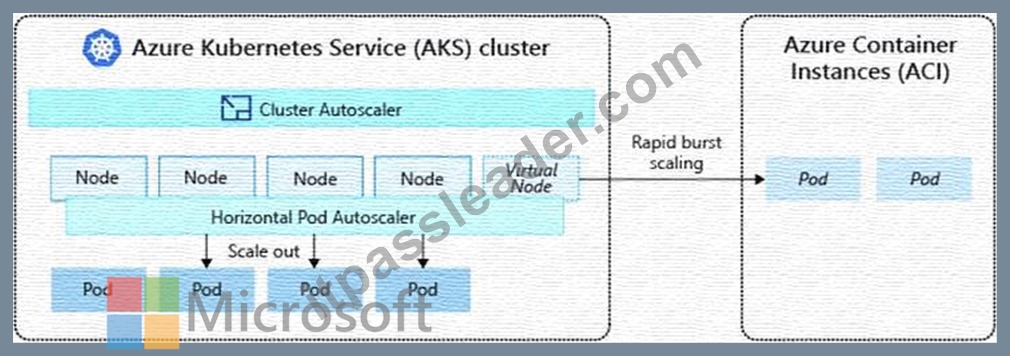
Note: AKS clusters can scale in one of two ways:
* The cluster autoscaler watches for pods that can't be scheduled on nodes because of resource constraints.
The cluster then automatically increases the number of nodes.
* The horizontal pod autoscaler uses the Metrics Server in a Kubernetes cluster to monitor the resource demand of pods. If an application needs more resources, the number of pods is automatically increased to meet the demand.
Reference:
https://docs.microsoft.com/en-us/azure/aks/concepts-scale5
NEW QUESTION # 218
Note: This section contains one or more sets of questions with the same scenario and problem. Each question presents a unique solution to the problem. You must determine whether the solution meets the stated goals.
More than one solution in the set might solve the problem. It is also possible that none of the solutions in the set solve the problem.
After you answer a question in this section, you will NOT be able to return. As a result, these questions do not appear on the Review Screen.
Your company, named Contoso, Ltd., has a Microsoft Entra tenant named contoso.com that uses Privileged Identity Management (PIM) and is linked to an Azure subscription named Sub1.
You use Azure Backup to back up all the resources in Sub! to a Recovery Services vault named Vault1.
An external company named Fabrikam, Inc. provides security management services to Contoso. Fabrikam has a Microsoft Entra tenant named fabrikam.com and an Azure subscription.
You need to prevent a compromised administiator account in contoso.com from modifying backup policies in and deleting backups from Sub1.
Solution: You configure Multi-user authorization (MUA) in Sub1 by using a Resource Guard from fabiikam.
com. Does this meet the goal?
- A. Yes
- B. No
Answer: B
NEW QUESTION # 219
You have an Azure App Service web app that uses a system-assigned managed identity.
You need to recommend a solution to store their settings of the web app as secrets in an Azure key vault The solution must meet the following requirements:
* Minimize changes to the app code,
* Use the principle of least privilege.
What should you include in the recommendation? To answer, select the appropriate options in the answer area.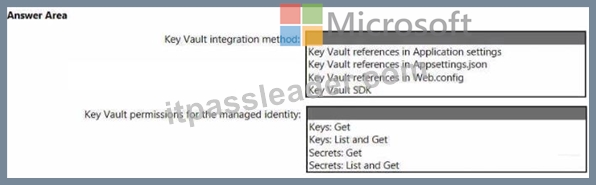
Answer:
Explanation: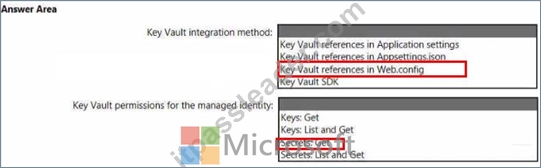
NEW QUESTION # 220
You plan to import data from your on-premises environment to Azure. The data Is shown in the following table.
What should you recommend using to migrate the data? To answer, drag the appropriate tools to the correct data sources-Each tool may be used once, more than once, or not at all. You may need to drag the split bar between panes or scroll to view content.
NOTE: Each correct selection is worth one point.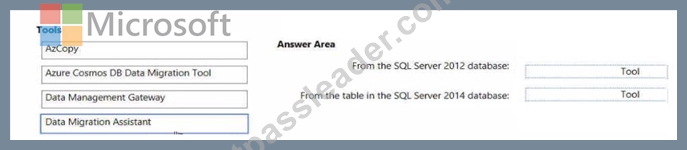
Answer:
Explanation: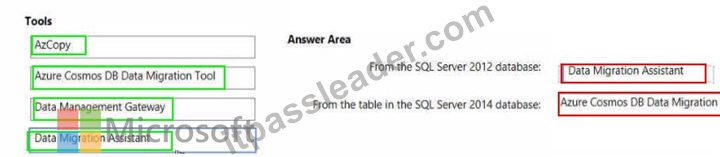
Reference:
https://docs.microsoft.com/en-us/azure/dms/tutorial-sql-server-to-azure-sql
https://docs.microsoft.com/en-us/azure/cosmos-db/import-data
NEW QUESTION # 221
You plan to migrate App1 to Azure.
You need to estimate the compute costs for App1 in Azure. The solution must meet the security and compliance requirements.
What should you use to estimate the costs, and what should you implement to minimize the costs? To answer, select the appropriate options in the answer area.
NOTE: Each correct selection is worth one point.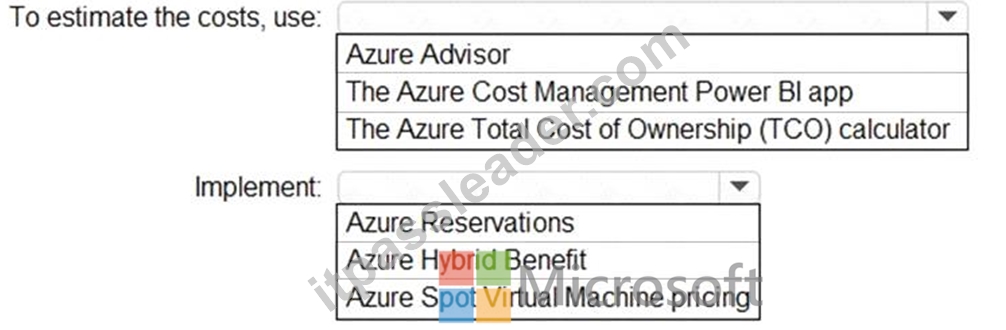
Answer:
Explanation: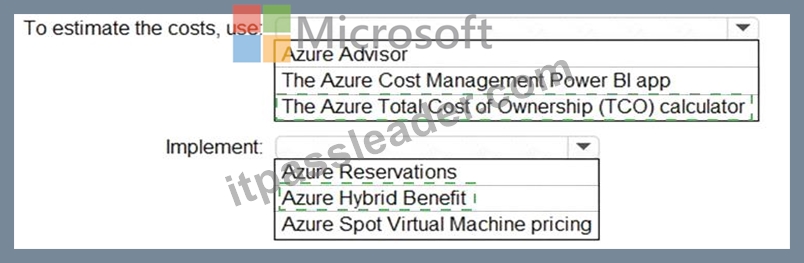
Explanation:
Text Description automatically generated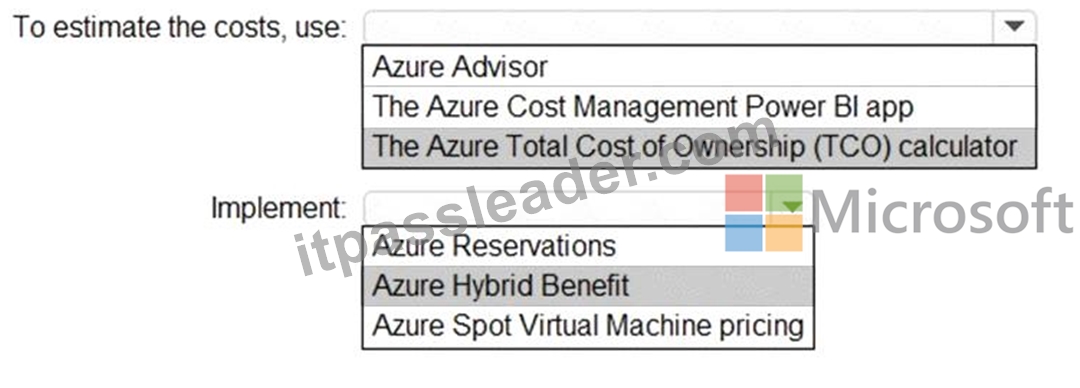
Box 1: The Azure Total Cost of Ownership (TCO) Calculator
The Total Cost of Ownership (TCO) Calculator estimates the cost savings you can realize by migrating your workloads to Azure.
Note: The TCO Calculator recommends a set of equivalent services in Azure that will support your applications. Our analysis will show each cost area with an estimate of your on-premises spend versus your spend in Azure. There are several cost categories that either decrease or go away completely when you move workloads to the cloud.
Box 2: Azure Hybrid Benefit
Azure Hybrid Benefit is a licensing benefit that helps you to significantly reduce the costs of running your workloads in the cloud. It works by letting you use your on-premises Software Assurance-enabled Windows Server and SQL Server licenses on Azure. And now, this benefit applies to RedHat and SUSE Linux subscriptions, too.
Scenario:
Litware identifies the following security and compliance requirements:
Once App1 is migrated to Azure, you must ensure that new data can be written to the app, and the modification of new and existing data is prevented for a period of three years.
On-premises users and services must be able to access the Azure Storage account that will host the data in App1.
Access to the public endpoint of the Azure Storage account that will host the App1 data must be prevented.
All Azure SQL databases in the production environment must have Transparent Data Encryption (TDE) enabled.
App1 must not share physical hardware with other workloads.
Reference:
https://azure.microsoft.com/en-us/pricing/tco/
https://azure.microsoft.com/en-us/pricing/hybrid-benefit/
NEW QUESTION # 222
A company is planning on deploying a set of applications onto a set of Azure Kubernetes clusters.
The clusters would be distributed across various Azure regions. You have to recommend a storage solution for the application container images. The update container images need to be automatically replicated across all AKS clusters. Which of the following would you implement for this requirement?
- A. Azure Cache for Redis
- B. Geo-redundant storage account
- C. Azure Content Delivery Network
- D. Azure Container Registry - Premium SKU
Answer: D
Explanation:
For this requirement, you can Azure Container Registry - Premium SKU. It provides the feature of automatic distribution of images across regions.
The Microsoft documentation mentions the following: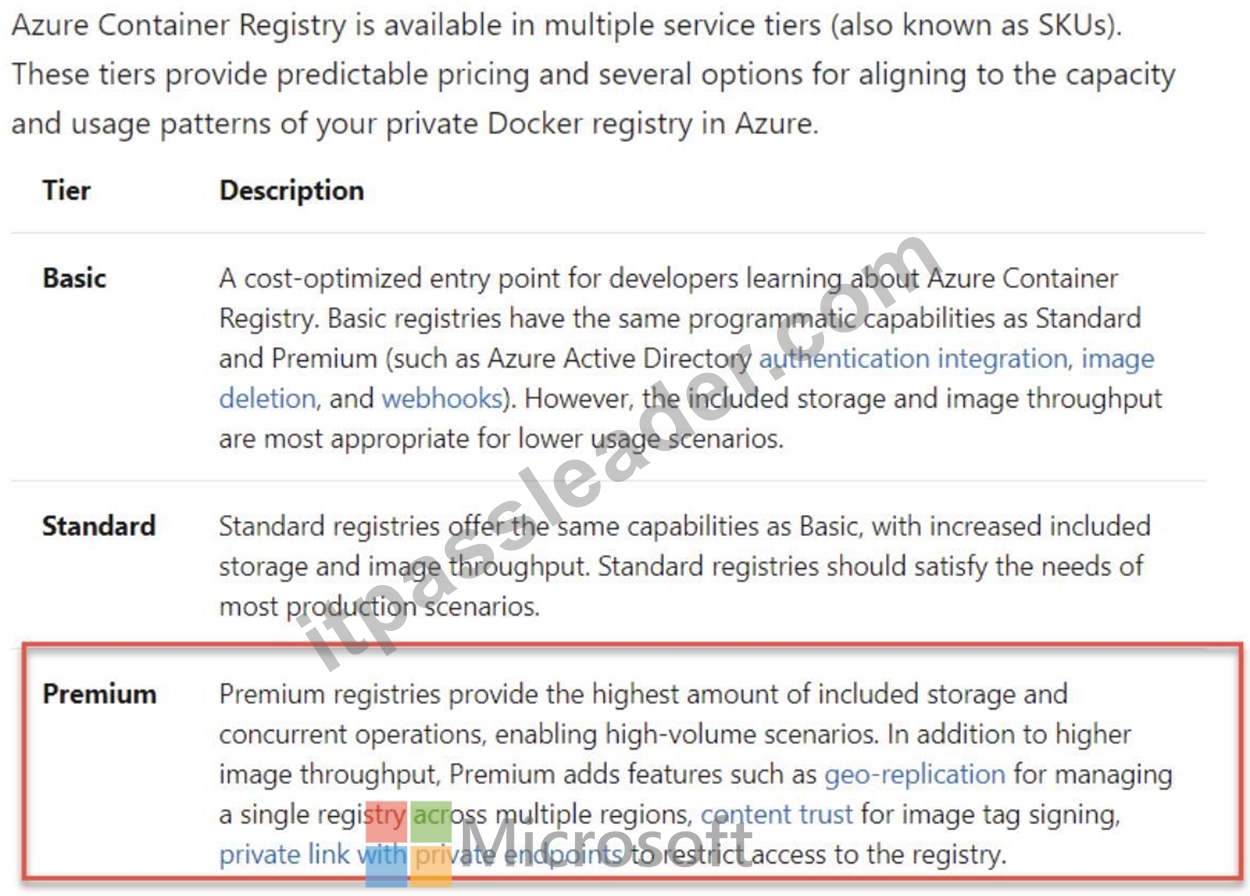
Reference:
https://docs.microsoft.com/en-us/azure/container-registry/container-registry-skus
NEW QUESTION # 223
You have the resources shown in the following table.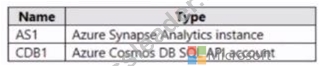
CDB1 hosts a container that stores continuously updated operational data You are designing a solution that will use AS1 to analyze the operational data dairy.
You need to recommend a solution to analyze the data without affecting the performance of the operational data store.
What should you include in the recommendation?
- A. Azure Cosmos DB change feed
- B. Azure Data Factory with Azure Cosmos DB and Azure Synapse Analytics connectors
- C. Azure Synapse Analytics with PolyBase data loading
Answer: C
NEW QUESTION # 224
You have an Azure subscription. The subscription contains 100 virtual machine that am Windows Server.
You need to recommend a solution that will provide monitoring and an audit trail of the following modifications:
* Changes to the Windows registry on the virtual machines
* Changes to the DNS settings of the virtual machines
The solution must minimize administrative effort.
What should you recommend using for each change? To answer, select the appropriate options in the answer area.
NOTE: Each correct selection is worth one point.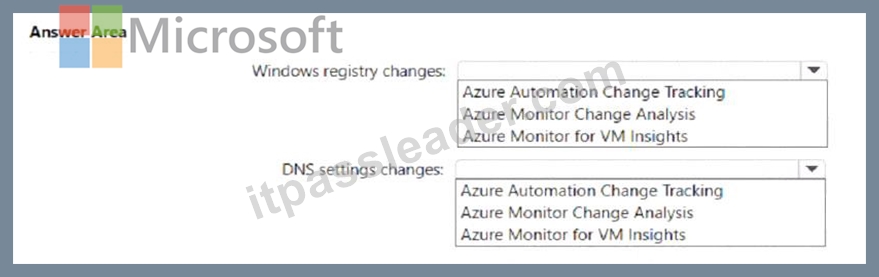
Answer:
Explanation: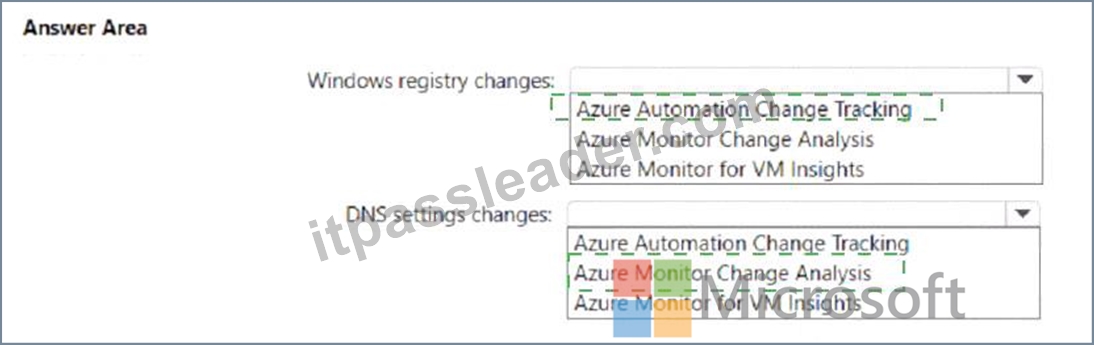
Explanation:
NEW QUESTION # 225
You plan to migrate data to Azure.
The IT department at your company identifies the following requirements:
* The storage must support 1 PB of data.
* The data must be stored in blob storage.
* The storage must support three levels of subfolders.
* The storage must support access control lists (ACLs).
You need to meet the requirements.
What should you use?
- A. a premium storage account that is configured for block blobs
- B. a premium storage account that is configured for page blobs
- C. a premium storage account that is configured for files shares and supports large file shares
- D. a general purpose v2 storage account that has hierarchical namespace enabled
Answer: D
Explanation:
Explanation
Microsoft recommends that you use a GPv2 storage account for most scenarios. It supports up to 5 PB, and blob storage including Data Lake storage.
Note: A key mechanism that allows Azure Data Lake Storage Gen2 to provide file system performance at object storage scale and prices is the addition of a hierarchical namespace. This allows the collection of objects/files within an account to be organized into a hierarchy of directories and nested subdirectories in the same way that the file system on your computer is organized. With a hierarchical namespace enabled, a storage account becomes capable of providing the scalability and cost-effectiveness of object storage, with file system semantics that are familiar to analytics engines and frameworks.
References:
https://docs.microsoft.com/en-us/azure/storage/common/storage-account-overview
https://docs.microsoft.com/en-us/azure/storage/blobs/data-lake-storage-namespace
NEW QUESTION # 226
You manage a database environment for a Microsoft Volume Licensing customer named Contoso, Ltd. Contoso uses License Mobility through Software Assurance.
You need to deploy 50 databases. The solution must meet the following requirements:
Support automatic scaling.
Minimize Microsoft SQL Server licensing costs.
What should you include in the solution? To answer, select the appropriate options in the answer area.
NOTE: Each correct selection is worth one point.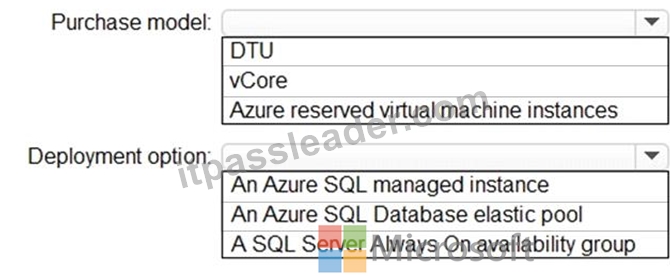
Answer:
Explanation: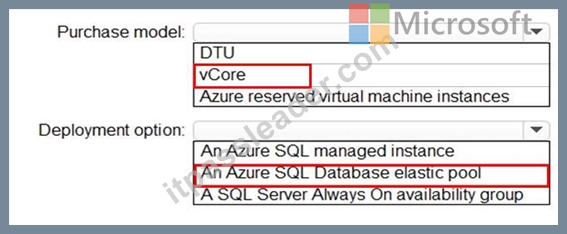
Reference:
https://docs.microsoft.com/en-us/azure/azure-sql/database/purchasing-models
NEW QUESTION # 227
To meet the authentication requirements of Fabrikam, what should you include in the solution? To answer, select the appropriate options in the answer area.
NOTE: Each correct selection is worth one point.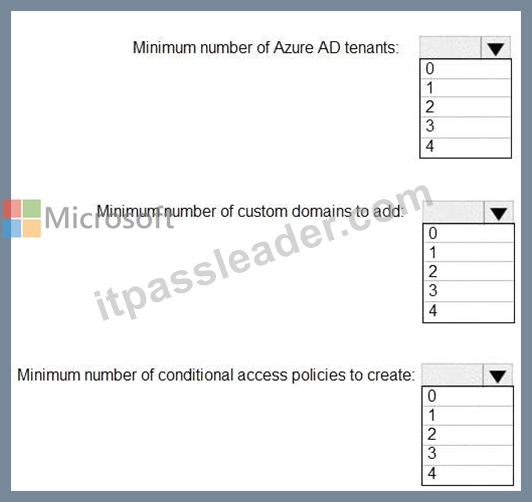
Answer:
Explanation: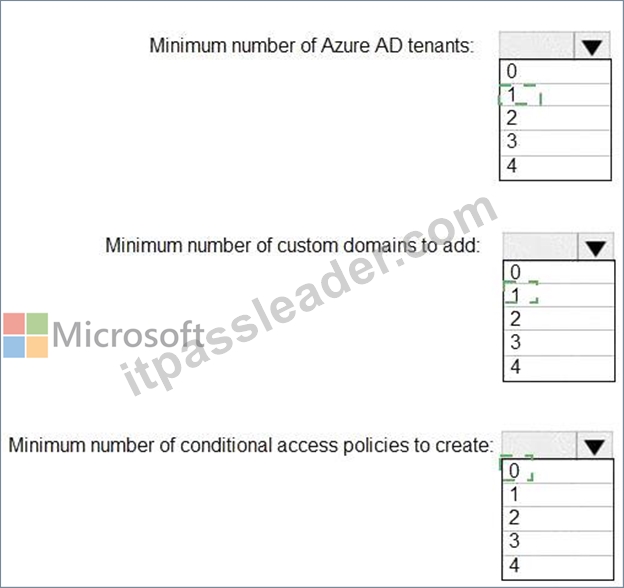
Explanation:
1
1
0
NEW QUESTION # 228
You are designing an Azure web app.
You plan to deploy the web app to the North Europe Azure region and the West Europe Azure region.
You need to recommend a solution for the web app. The solution must meet the following requirements:
Users must always access the web app from the North Europe region, unless the region fails.
The web app must be available to users if an Azure region is unavailable.
Deployment costs must be minimized.
What should you include in the recommendation? To answer, select the appropriate options in the answer area.
NOTE: Each correct selection is worth one point.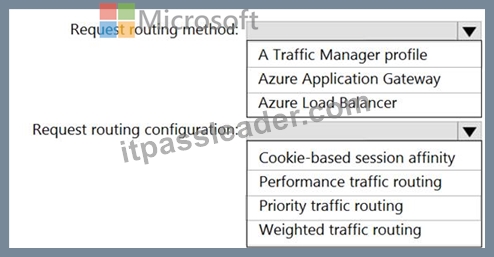
Answer:
Explanation: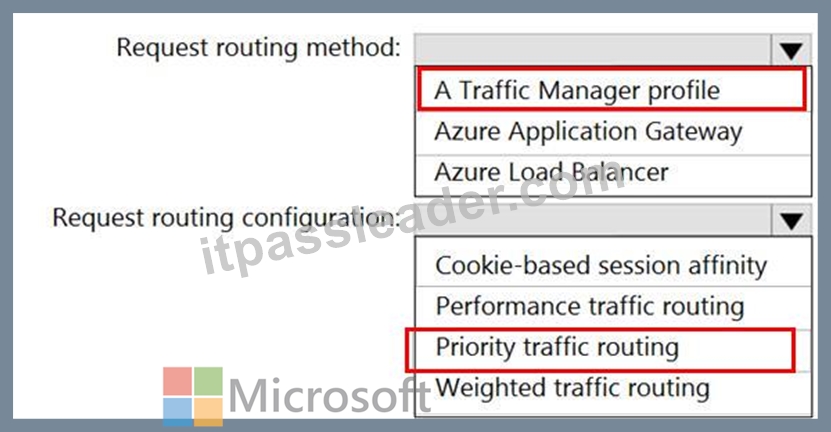
NEW QUESTION # 229
You have an Azure subscription that contains a Basic Azure virtual WAN named Virtual/WAN1 and the virtual hubs shown in the following table.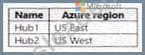
You have an ExpressRoute circuit in the US East region.
You need to create an ExpressRoute association to VirtualWAN1.
What should you do first?
- A. Upgrade VirtualWAN1 to Standard.
- B. Enable the ExpressRoute premium add-on.
- C. Create a hub virtual network in US East.
- D. Create a gateway on Hub1.
Answer: A
Explanation:
US East and US West are in the same geopolitical region so there is no need for enabling ExpressRoute premium add-on https://docs.microsoft.com/en-us/azure/virtual-wan/virtual-wan-about#basicstandard The current config of virtual WAN is only Basic as given, so it can connect to only site to site VPN, to connect to express route it needs to be upgraded from basic to standard. https://docs.microsoft.com/en-us/azure
/virtual-wan/virtual-wan-about
https://docs.microsoft.com/en-us/azure/virtual-wan/virtual-wan-about
NEW QUESTION # 230
You need to implement the Azure RBAC role assignment. The solution must meet the authentication and authorization requirements.
How many assignment should you configure for the Network Contributor role for Role1? To answer, select appropriate in the answer area.
NOTE: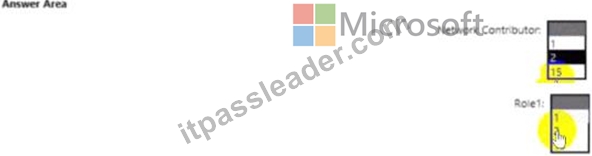
Answer:
Explanation: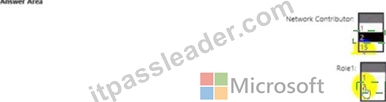
Explanation
A screenshot of a computer Description automatically generated with medium confidence
NEW QUESTION # 231
You need to design an architecture to capture the creation of users and the assignment of roles. The captured data must be stored in Azure Cosmos DB.
Which Azure services should you include in the design? To answer, drag the appropriate services to the correct targets. Each service may be used once, more than once, or not at all. You may need to drag the split bar between panes or scroll to view content.
NOTE:Each correct selection is worth one point.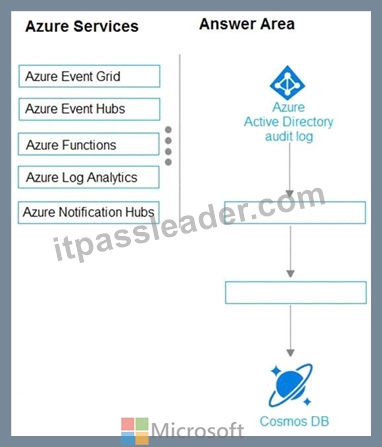
Answer:
Explanation: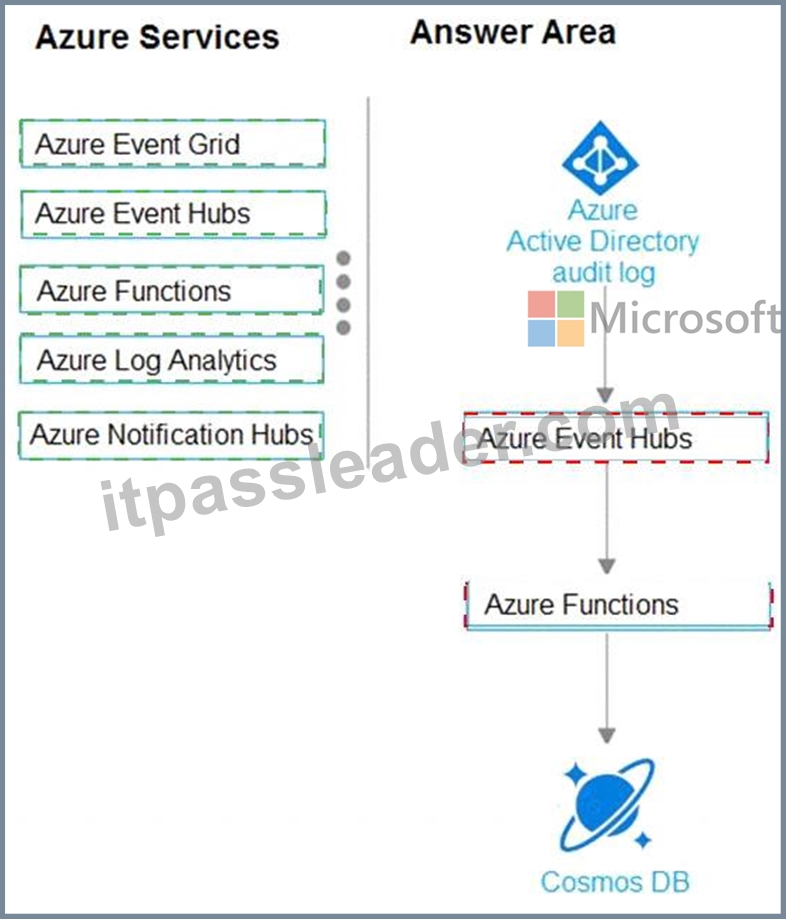
Explanation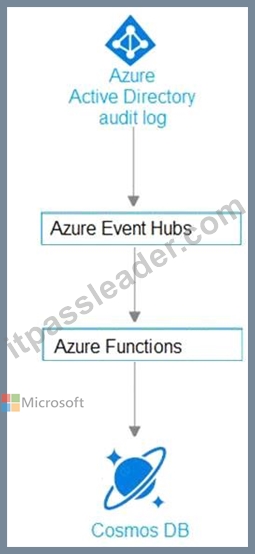
Diagram Description automatically generated
1. AAD audit log -> Event Hub (other two choices, LAW, storage, but not available in this question)
https://docs.microsoft.com/en-us/azure/active-directory/reports-monitoring/tutorial-azure-monitor-stream-logs-to
2. Azure function has the Event hub trigger and Cosmos output binding
a. Event Hub trigger for function
https://docs.microsoft.com/en-us/azure/azure-functions/functions-bindings-event-hubs-trigger?tabs=csharp
NEW QUESTION # 232
You have an Azure subscription.
You are designing a solution for containerized apps. The solution must meet the following requirements:
* Automatically scale the apps by creating additional instances.
* Minimize administrative effort to maintain nodes and clusters.
* Ensure that containerized apps are highly available across multiple availability zones.
* Provide a central location for the lifecycle management and storage of container images.
What should you include in the solution? To answer, select the appropriate options in the answer area.
NOTE: Each correct selection is worth one point.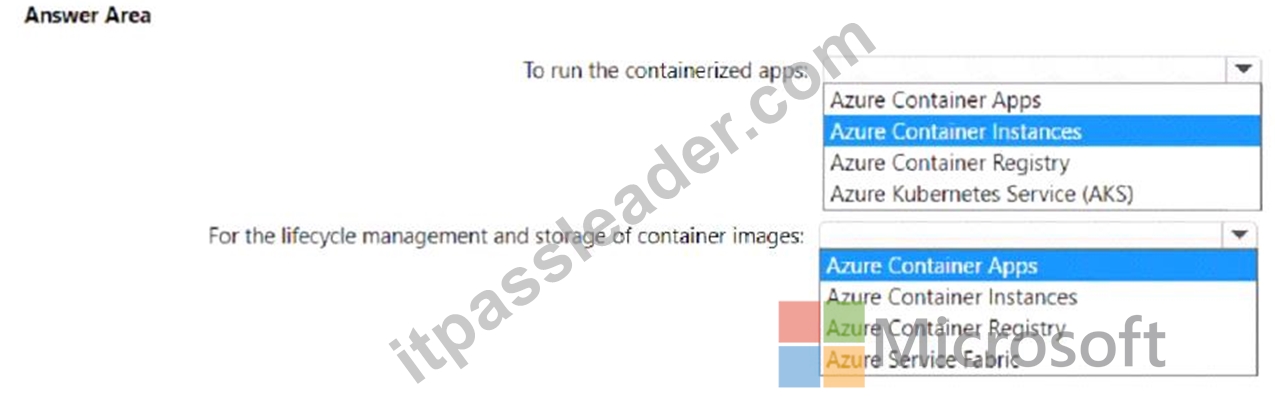
Answer:
Explanation: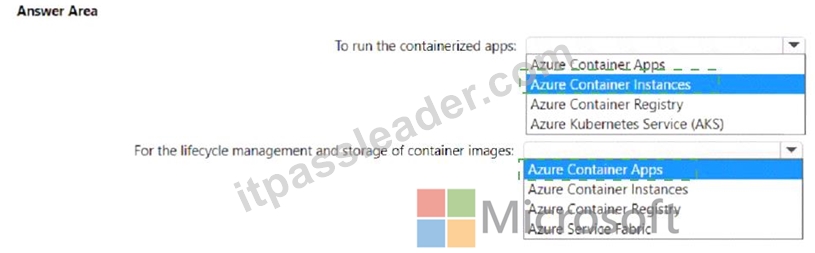
Explanation
NEW QUESTION # 233
You plan to develop a new app that will store business critical dat
a. The app must meet the following requirements:
Prevent new data from being modified for one year.
Minimize read latency.
Maximize data resiliency.
You need to recommend a storage solution for the app.
What should you recommend? To answer, select the appropriate options in the answer area.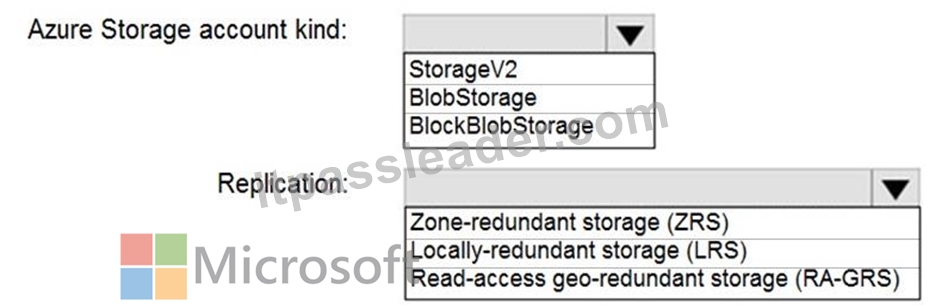
Answer:
Explanation: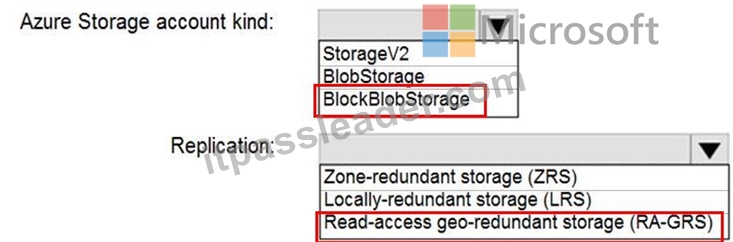
Reference:
https://docs.microsoft.com/en-us/azure/storage/common/storage-account-overview
https://docs.microsoft.com/en-us/azure/storage/common/storage-redundancy?toc=/azure/storage/blobs/toc.json
NEW QUESTION # 234
You need to design an architecture to capture the creation of users and the assignment of roles. The captured data must be stored in Azure Cosmos DB.
Which Azure services should you include in the design? To answer, drag the appropriate services to the correct targets. Each service may be used once, more than once, or not at all. You may need to drag the split bar between panes or scroll to view content.
NOTE: Each correct selection is worth one point.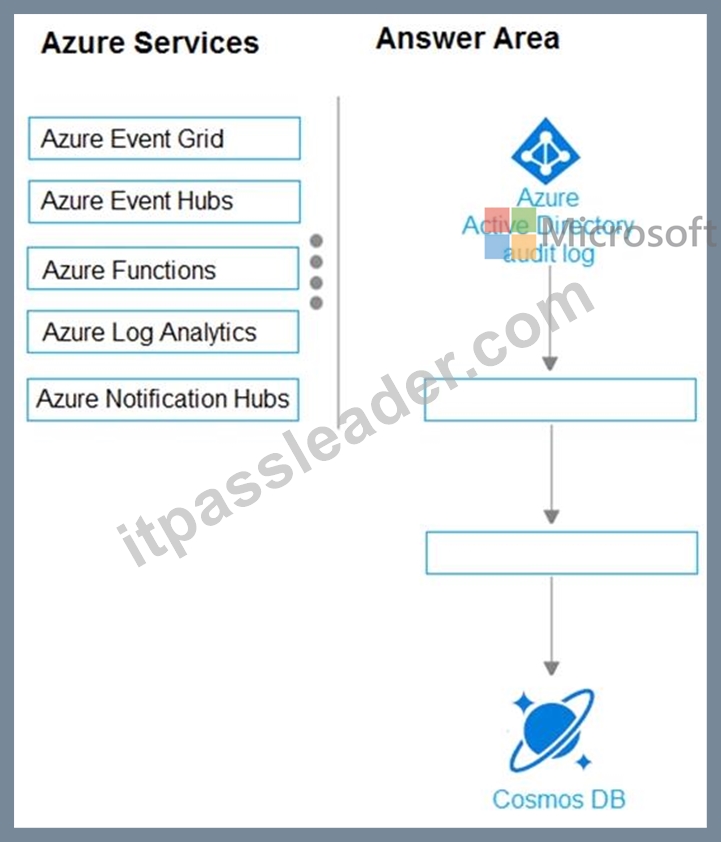
Answer:
Explanation: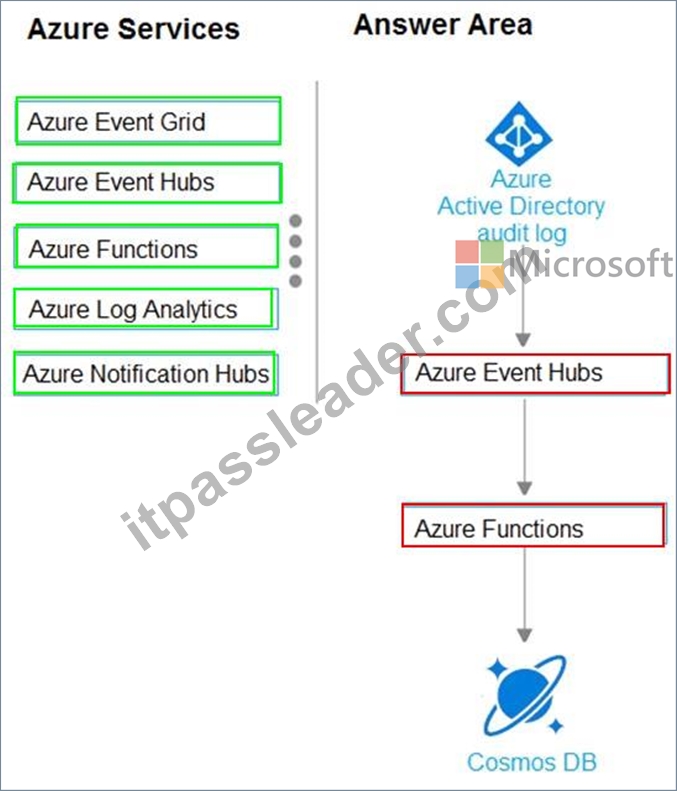
NEW QUESTION # 235
You have an Azure subscription that contains a Basic Azure virtual WAN named Virtual/WAN1 and the virtual hubs shown in the following table.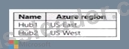
You have an ExpressRoute circuit in the US East region.
You need to create an ExpressRoute association to VirtualWAN1.
What should you do first?
- A. Upgrade VirtualWAN1 to Standard.
- B. Enable the ExpressRoute premium add-on.
- C. Create a hub virtual network in US East.
- D. Create a gateway on Hub1.
Answer: A
Explanation:
Explanation
US East and US West are in the same geopolitical region so there is no need for enabling ExpressRoute premium add-onhttps://docs.microsoft.com/en-us/azure/virtual-wan/virtual-wan-about#basicstandard The current config of virtual WAN is only Basic as given, so it can connect to only site to site VPN, to connect to express route it needs to be upgraded from basic to standard.https://docs.microsoft.com/en-us/azure/virtual-wan/virtual-wan-about
https://docs.microsoft.com/en-us/azure/virtual-wan/virtual-wan-about
NEW QUESTION # 236
You have 12 Azure subscriptions and three projects. Each project uses resources across multiple subscriptions.
You need to use Microsoft Cost Management to monitor costs on a per project basis. The solution must minimize administrative effort.
Which two components should you include in the solution? Each correct answer presents part of the solution.
NOTE: Each correct selection is worth one point.
- A. Azure boards
- B. custom role-based access control (RBAC) roles
- C. resource tags
- D. management groups
- E. budgets
Answer: C,E
Explanation:
A few examples of what you can do in Cost Management include:
- Report on and analyze costs in the Azure portal, Microsoft 365 admin center, or Power BI.
- Monitor costs proactively with budget, anomaly, reservation utilization, and scheduled alerts.
- Enable tag inheritance and split shared costs with cost allocation rules.
- Automate business processes or integrate cost into external tools by exporting data.
Budgets in Cost Management help you plan for and drive organizational accountability. They help you proactively inform others about their spending to manage costs and monitor how spending progresses over time.
NEW QUESTION # 237
......
Microsoft AZ-305 Exam is a comprehensive certification exam designed for professionals who want to pursue a career in designing Azure infrastructure solutions. AZ-305 exam focuses on testing the knowledge and skills required for designing, implementing, and monitoring Azure solutions.
Microsoft AZ-305 Exam Practice Test Questions: https://www.itpassleader.com/Microsoft/AZ-305-dumps-pass-exam.html
Free AZ-305 Braindumps Download Updated: https://drive.google.com/open?id=1L81bIzFybGD4wrFXPU5tC3d-eapTXuwa