

Easily To Pass New Databricks Databricks-Generative-AI-Engineer-Associate Dumps with 63 Questions
Latest Databricks-Generative-AI-Engineer-Associate Study Guides 2025 - With Test Engine PDF
NEW QUESTION # 13
A Generative AI Engineer has created a RAG application which can help employees retrieve answers from an internal knowledge base, such as Confluence pages or Google Drive. The prototype application is now working with some positive feedback from internal company testers. Now the Generative Al Engineer wants to formally evaluate the system's performance and understand where to focus their efforts to further improve the system.
How should the Generative AI Engineer evaluate the system?
- A. Curate a dataset that can test the retrieval and generation components of the system separately. Use MLflow's built in evaluation metrics to perform the evaluation on the retrieval and generation components.
- B. Use an LLM-as-a-judge to evaluate the quality of the final answers generated.
- C. Use cosine similarity score to comprehensively evaluate the quality of the final generated answers.
- D. Benchmark multiple LLMs with the same data and pick the best LLM for the job.
Answer: A
Explanation:
* Problem Context: After receiving positive feedback for the RAG application prototype, the next step is to formally evaluate the system to pinpoint areas for improvement.
* Explanation of Options:
* Option A: While cosine similarity scores are useful, they primarily measure similarity rather than the overall performance of an RAG system.
* Option B: This option provides a systematic approach to evaluation by testing both retrieval and generation components separately. This allows for targeted improvements and a clear understanding of each component's performance, using MLflow's metrics for a structured and standardized assessment.
* Option C: Benchmarking multiple LLMs does not focus on evaluating the existing system's components but rather on comparing different models.
* Option D: Using an LLM as a judge is subjective and less reliable for systematic performance evaluation.
OptionBis the most comprehensive and structured approach, facilitating precise evaluations and improvements on specific components of the RAG system.
NEW QUESTION # 14
A Generative Al Engineer is developing a RAG application and would like to experiment with different embedding models to improve the application performance.
Which strategy for picking an embedding model should they choose?
- A. Pick an embedding model trained on related domain knowledge
- B. Pick the most recent and most performant open LLM released at the time
- C. Pick an embedding model with multilingual support to support potential multilingual user questions
- D. pick the embedding model ranked highest on the Massive Text Embedding Benchmark (MTEB) leaderboard hosted by HuggingFace
Answer: A
Explanation:
The task involves improving a Retrieval-Augmented Generation (RAG) application's performance by experimenting with embedding models. The choice of embedding model impacts retrieval accuracy,which is critical for RAG systems. Let's evaluate the options based on Databricks Generative AI Engineer best practices.
* Option A: Pick an embedding model trained on related domain knowledge
* Embedding models trained on domain-specific data (e.g., industry-specific corpora) produce vectors that better capture the semantics of the application's context, improving retrieval relevance. For RAG, this is a key strategy to enhance performance.
* Databricks Reference:"For optimal retrieval in RAG systems, select embedding models aligned with the domain of your data"("Building LLM Applications with Databricks," 2023).
* Option B: Pick the most recent and most performant open LLM released at the time
* LLMs are not embedding models; they generate text, not embeddings for retrieval. While recent LLMs may be performant for generation, this doesn't address the embedding step in RAG. This option misunderstands the component being selected.
* Databricks Reference: Embedding models and LLMs are distinct in RAG workflows:
"Embedding models convert text to vectors, while LLMs generate responses"("Generative AI Cookbook").
* Option C: Pick the embedding model ranked highest on the Massive Text Embedding Benchmark (MTEB) leaderboard hosted by HuggingFace
* The MTEB leaderboard ranks models across general tasks, but high overall performance doesn't guarantee suitability for a specific domain. A top-ranked model might excel in generic contexts but underperform on the engineer's unique data.
* Databricks Reference: General performance is less critical than domain fit:"Benchmark rankings provide a starting point, but domain-specific evaluation is recommended"("Databricks Generative AI Engineer Guide").
* Option D: Pick an embedding model with multilingual support to support potential multilingual user questions
* Multilingual support is useful only if the application explicitly requires it. Without evidence of multilingual needs, this adds complexity without guaranteed performance gains for the current use case.
* Databricks Reference:"Choose features like multilingual support based on application requirements"("Building LLM-Powered Applications").
Conclusion: Option A is the best strategy because it prioritizes domain relevance, directly improving retrieval accuracy in a RAG system-aligning with Databricks' emphasis on tailoring models to specific use cases.
NEW QUESTION # 15
A Generative AI Engineer is tasked with deploying an application that takes advantage of a custom MLflow Pyfunc model to return some interim results.
How should they configure the endpoint to pass the secrets and credentials?
- A. Add credentials using environment variables
- B. Pass the secrets in plain text
- C. Pass variables using the Databricks Feature Store API
- D. Use spark.conf.set ()
Answer: A
Explanation:
Context: Deploying an application that uses an MLflow Pyfunc model involves managing sensitive information such as secrets and credentials securely.
Explanation of Options:
* Option A: Use spark.conf.set(): While this method can pass configurations within Spark jobs, using it for secrets is not recommended because it may expose them in logs or Spark UI.
* Option B: Pass variables using the Databricks Feature Store API: The Feature Store API is designed for managing features for machine learning, not for handling secrets or credentials.
* Option C: Add credentials using environment variables: This is a common practice for managing credentials in a secure manner, as environment variables can be accessed securely by applications without exposing them in the codebase.
* Option D: Pass the secrets in plain text: This is highly insecure and not recommended, as it exposes sensitive information directly in the code.
Therefore,Option Cis the best method for securely passing secrets and credentials to an application, protecting them from exposure.
NEW QUESTION # 16
A Generative Al Engineer wants their (inetuned LLMs in their prod Databncks workspace available for testing in their dev workspace as well. All of their workspaces are Unity Catalog enabled and they are currently logging their models into the Model Registry in MLflow.
What is the most cost-effective and secure option for the Generative Al Engineer to accomplish their gAi?
- A. Use an external model registry which can be accessed from all workspaces
- B. Setup a duplicate training pipeline in dev, so that an identical model is available in dev.
- C. Setup a script to export the model from prod and import it to dev.
- D. Use MLflow to log the model directly into Unity Catalog, and enable READ access in the dev workspace to the model.
Answer: D
Explanation:
The goal is to make fine-tuned LLMs from a production (prod) Databricks workspace available for testing in a development (dev) workspace, leveraging Unity Catalog and MLflow, while ensuring cost-effectiveness and security. Let's analyze the options.
* Option A: Use an external model registry which can be accessed from all workspaces
* An external registry adds cost (e.g., hosting fees) and complexity (e.g., integration, security configurations) outside Databricks' native ecosystem, reducing security compared to Unity Catalog's governance.
* Databricks Reference:"Unity Catalog provides a centralized, secure model registry within Databricks"("Unity Catalog Documentation," 2023).
* Option B: Setup a script to export the model from prod and import it to dev
* Export/import scripts require manual effort, storage for model artifacts, and repeated execution, increasing operational cost and risk (e.g., version mismatches, unsecured transfers). It's less efficient than a native solution.
* Databricks Reference: Manual processes are discouraged when Unity Catalog offers built-in sharing:"Avoid redundant workflows with Unity Catalog's cross-workspace access"("MLflow with Unity Catalog").
* Option C: Setup a duplicate training pipeline in dev, so that an identical model is available in dev
* Duplicating the training pipeline doubles compute and storage costs, as it retrains the model from scratch. It's neither cost-effective nor necessary when the prod model can be reused securely.
* Databricks Reference:"Re-running training is resource-intensive; leverage existing models where possible"("Generative AI Engineer Guide").
* Option D: Use MLflow to log the model directly into Unity Catalog, and enable READ access in the dev workspace to the model
* Unity Catalog, integrated with MLflow, allows models logged in prod to be centrally managed and accessed across workspaces with fine-grained permissions (e.g., READ for dev). This is cost- effective (no extra infrastructure or retraining) and secure (governed by Databricks' access controls).
* Databricks Reference:"Log models to Unity Catalog via MLflow, then grant access to other workspaces securely"("MLflow Model Registry with Unity Catalog," 2023).
Conclusion: Option D leverages Databricks' native tools (MLflow and Unity Catalog) for a seamless, cost- effective, and secure solution, avoiding external systems, manual scripts, or redundant training.
NEW QUESTION # 17
A Generative Al Engineer is building a RAG application that answers questions about internal documents for the company SnoPen AI.
The source documents may contain a significant amount of irrelevant content, such as advertisements, sports news, or entertainment news, or content about other companies.
Which approach is advisable when building a RAG application to achieve this goal of filtering irrelevant information?
- A. Keep all articles because the RAG application needs to understand non-company content to avoid answering questions about them.
- B. Include in the system prompt that the application is not supposed to answer any questions unrelated to SnoPen Al.
- C. Include in the system prompt that any information it sees will be about SnoPenAI, even if no data filtering is performed.
- D. Consolidate all SnoPen AI related documents into a single chunk in the vector database.
Answer: B
Explanation:
In a Retrieval-Augmented Generation (RAG) application built to answer questions about internal documents, especially when the dataset contains irrelevant content, it's crucial to guide the system to focus on the right information. The best way to achieve this is byincluding a clear instruction in the system prompt(option C).
* System Prompt as Guidance:The system prompt is an effective way to instruct the LLM to limit its focus to SnoPen AI-related content. By clearly specifying that the model should avoid answering questions unrelated to SnoPen AI, you add an additional layer of control that helps the model stay on- topic, even if irrelevant content is present in the dataset.
* Why This Approach Works:The prompt acts as a guiding principle for the model, narrowing its focus to specific domains. This prevents the model from generating answers based on irrelevant content, such as advertisements or news unrelated to SnoPen AI.
* Why Other Options Are Less Suitable:
* A (Keep All Articles): Retaining all content, including irrelevant materials, without any filtering makes the system prone to generating answers based on unwanted data.
* B (Include in the System Prompt about SnoPen AI): This option doesn't address irrelevant content directly, and without filtering, the model might still retrieve and use irrelevant data.
* D (Consolidating Documents into a Single Chunk): Grouping documents into a single chunk makes the retrieval process less efficient and won't help filter out irrelevant content effectively.
Therefore, instructing the system in the prompt not to answer questions unrelated to SnoPen AI (option C) is the best approach to ensure the system filters out irrelevant information.
NEW QUESTION # 18
When developing an LLM application, it's crucial to ensure that the data used for training the model complies with licensing requirements to avoid legal risks.
Which action is NOT appropriate to avoid legal risks?
- A. Reach out to the data curators directly before you have started using the trained model to let them know.
- B. Use any available data you personally created which is completely original and you can decide what license to use.
- C. Only use data explicitly labeled with an open license and ensure the license terms are followed.
- D. Reach out to the data curators directly after you have started using the trained model to let them know.
Answer: D
Explanation:
* Problem Context: When using data to train a model, it's essential to ensure compliance with licensing to avoid legal risks. Legal issues can arise from using data without permission, especially when it comes from third-party sources.
* Explanation of Options:
* Option A: Reaching out to data curatorsbeforeusing the data is an appropriate action. This allows you to ensure you have permission or understand the licensing terms before starting to use the data in your model.
* Option B: Usingoriginal datathat you personally created is always a safe option. Since you have full ownership over the data, there are no legal risks, as you control the licensing.
* Option C: Using data that is explicitly labeled with an open license and adhering to the license terms is a correct and recommended approach. This ensures compliance with legal requirements.
* Option D: Reaching out to the data curatorsafteryou have already started using the trained model isnot appropriate. If you've already used the data without understanding its licensing terms, you may have already violated the terms of use, which could lead to legal complications. It's essential to clarify the licensing termsbeforeusing the data, not after.
Thus,Option Dis not appropriate because it could expose you to legal risks by using the data without first obtaining the proper licensing permissions.
NEW QUESTION # 19
What is an effective method to preprocess prompts using custom code before sending them to an LLM?
- A. Rather than preprocessing prompts, it's more effective to postprocess the LLM outputs to align the outputs to desired outcomes
- B. Directly modify the LLM's internal architecture to include preprocessing steps
- C. Write a MLflow PyFunc model that has a separate function to process the prompts
- D. It is better not to introduce custom code to preprocess prompts as the LLM has not been trained with examples of the preprocessed prompts
Answer: C
Explanation:
The most effective way to preprocess prompts using custom code is to write a custom model, such as an MLflow PyFunc model. Here's a breakdown of why this is the correct approach:
* MLflow PyFunc Models:MLflow is a widely used platform for managing the machine learning lifecycle, including experimentation, reproducibility, and deployment. APyFuncmodel is a generic Python function model that can implement custom logic, which includes preprocessing prompts.
* Preprocessing Prompts:Preprocessing could include various tasks like cleaning up the user input, formatting it according to specific rules, or augmenting it with additional context before passing it to the LLM. Writing this preprocessing as part of a PyFunc model allows the custom code to be managed, tested, and deployed easily.
* Modular and Reusable:By separating the preprocessing logic into a PyFunc model, the system becomes modular, making it easier to maintain and update without needing to modify the core LLM or retrain it.
* Why Other Options Are Less Suitable:
* A (Modify LLM's Internal Architecture): Directly modifying the LLM's architecture is highly impractical and can disrupt the model's performance. LLMs are typically treated as black-box models for tasks like prompt processing.
* B (Avoid Custom Code): While it's true that LLMs haven't been explicitly trained with preprocessed prompts, preprocessing can still improve clarity and alignment with desired input formats without confusing the model.
* C (Postprocessing Outputs): While postprocessing the output can be useful, it doesn't address the need for clean and well-formatted inputs, which directly affect the quality of the model's responses.
Thus, using an MLflow PyFunc model allows for flexible and controlled preprocessing of prompts in a scalable way, making it the most effective method.
NEW QUESTION # 20
A Generative AI Engineer has been asked to build an LLM-based question-answering application. The application should take into account new documents that are frequently published. The engineer wants to build this application with the least cost and least development effort and have it operate at the lowest cost possible.
Which combination of chaining components and configuration meets these requirements?
- A. For the question-answering application, prompt engineering and an LLM are required to generate answers.
- B. The LLM needs to be frequently with the new documents in order to provide most up-to-date answers.
- C. For the application a prompt, a retriever, and an LLM are required. The retriever output is inserted into the prompt which is given to the LLM to generate answers.
- D. For the application a prompt, an agent and a fine-tuned LLM are required. The agent is used by the LLM to retrieve relevant content that is inserted into the prompt which is given to the LLM to generate answers.
Answer: C
Explanation:
Problem Context: The task is to build an LLM-based question-answering application that integrates new documents frequently with minimal costs and development efforts.
Explanation of Options:
* Option A: Utilizes a prompt and a retriever, with the retriever output being fed into the LLM. This setup is efficient because it dynamically updates the data pool via the retriever, allowing the LLM to provide up-to-date answers based on the latest documents without needing tofrequently retrain the model. This method offers a balance of cost-effectiveness and functionality.
* Option B: Requires frequent retraining of the LLM, which is costly and labor-intensive.
* Option C: Only involves prompt engineering and an LLM, which may not adequately handle the requirement for incorporating new documents unless it's part of an ongoing retraining or updating mechanism, which would increase costs.
* Option D: Involves an agent and a fine-tuned LLM, which could be overkill and lead to higher development and operational costs.
Option Ais the most suitable as it provides a cost-effective, minimal development approach while ensuring the application remains up-to-date with new information.
NEW QUESTION # 21
Which indicator should be considered to evaluate the safety of the LLM outputs when qualitatively assessing LLM responses for a translation use case?
- A. The latency of the response and the length of text generated
- B. The similarity to the previous language
- C. The ability to generate responses in code
- D. The accuracy and relevance of the responses
Answer: D
Explanation:
* Problem Context: When assessing the safety and effectiveness of LLM outputs in a translation use case, it is essential to ensure that the translations accurately and relevantly convey the intended message. The evaluation should focus on how well the LLM understands and processes different languages and contexts.
* Explanation of Options:
* Option A: The ability to generate responses in code- This is not relevant to translation quality or safety.
* Option B: The similarity to the previous language- While ensuring that translations preserve the original's intent is important, this doesn't directly address the overall quality or safety of the translation.
* Option C: The latency of the response and the length of text generated- These operational metrics are less critical in assessing the qualitative aspects of translation safety.
* Option D: The accuracy and relevance of the responses- This is crucial in translation to ensure that the translated content is true to the original in meaning and appropriateness. Accuracy and relevance directly impact the effectiveness and safety of translations, especially in sensitive or nuanced contexts.
Thus,Option Dis the most important indicator when evaluating the safety of LLM outputs in translation, focusing on the core aspects that determine the utility and trustworthiness of translated content.
NEW QUESTION # 22
A Generative Al Engineer is responsible for developing a chatbot to enable their company's internal HelpDesk Call Center team to more quickly find related tickets and provide resolution. While creating the GenAI application work breakdown tasks for this project, they realize they need to start planning which data sources (either Unity Catalog volume or Delta table) they could choose for this application. They have collected several candidate data sources for consideration:
call_rep_history: a Delta table with primary keys representative_id, call_id. This table is maintained to calculate representatives' call resolution from fields call_duration and call start_time.
transcript Volume: a Unity Catalog Volume of all recordings as a *.wav files, but also a text transcript as *.txt files.
call_cust_history: a Delta table with primary keys customer_id, cal1_id. This table is maintained to calculate how much internal customers use the HelpDesk to make sure that the charge back model is consistent with actual service use.
call_detail: a Delta table that includes a snapshot of all call details updated hourly. It includes root_cause and resolution fields, but those fields may be empty for calls that are still active.
maintenance_schedule - a Delta table that includes a listing of both HelpDesk application outages as well as planned upcoming maintenance downtimes.
They need sources that could add context to best identify ticket root cause and resolution.
Which TWO sources do that? (Choose two.)
- A. maintenance_schedule
- B. call_rep_history
- C. call_cust_history
- D. call_detail
- E. transcript Volume
Answer: D,E
Explanation:
In the context of developing a chatbot for a company's internal HelpDesk Call Center, the key is to select data sources that provide the most contextual and detailed information about the issues being addressed. This includes identifying the root cause and suggesting resolutions. The two most appropriate sources from the list are:
* Call Detail (Option D):
* Contents: This Delta table includes a snapshot of all call details updated hourly, featuring essential fields like root_cause and resolution.
* Relevance: The inclusion of root_cause and resolution fields makes this source particularly valuable, as it directly contains the information necessary to understand and resolve the issues discussed in the calls. Even if some records are incomplete, the data provided is crucial for a chatbot aimed at speeding up resolution identification.
* Transcript Volume (Option E):
* Contents: This Unity Catalog Volume contains recordings in .wav format and text transcripts in .txt files.
* Relevance: The text transcripts of call recordings can provide in-depth context that the chatbot can analyze to understand the nuances of each issue. The chatbot can use natural language processing techniques to extract themes, identify problems, and suggest resolutions based on previous similar interactions documented in the transcripts.
Why Other Options Are Less Suitable:
* A (Call Cust History): While it provides insights into customer interactions with the HelpDesk, it focuses more on the usage metrics rather than the content of the calls or the issues discussed.
* B (Maintenance Schedule): This data is useful for understanding when services may not be available but does not contribute directly to resolving user issues or identifying root causes.
* C (Call Rep History): Though it offers data on call durations and start times, which could help in assessing performance, it lacks direct information on the issues being resolved.
Therefore, Call Detail and Transcript Volume are the most relevant data sources for a chatbot designed to assist with identifying and resolving issues in a HelpDesk Call Center setting, as they provide direct and contextual information related to customer issues.
NEW QUESTION # 23
A Generative AI Engineer is developing a patient-facing healthcare-focused chatbot. If the patient's question is not a medical emergency, the chatbot should solicit more information from the patient to pass to the doctor' s office and suggest a few relevant pre-approved medical articles for reading. If the patient's question is urgent, direct the patient to calling their local emergency services.
Given the following user input:
"I have been experiencing severe headaches and dizziness for the past two days." Which response is most appropriate for the chatbot to generate?
- A. Here are a few relevant articles for your browsing. Let me know if you have questions after reading them.
- B. Headaches can be tough. Hope you feel better soon!
- C. Please provide your age, recent activities, and any other symptoms you have noticed along with your headaches and dizziness.
- D. Please call your local emergency services.
Answer: D
Explanation:
* Problem Context: The task is to design responses for a healthcare-focused chatbot that appropriately addresses the urgency of a patient's symptoms.
* Explanation of Options:
* Option A: Suggesting articles might be suitable for less urgent inquiries but is inappropriate for symptoms that could indicate a serious condition.
* Option B: Given the description of severe symptoms like headaches and dizziness, directing the patient to emergency services is prudent. This aligns with medical guidelines that recommend immediate professional attention for such severe symptoms.
* Option C: Offering well-wishes does not address the potential seriousness of the symptoms and lacks appropriate action.
* Option D: While gathering more information is part of a detailed assessment, the immediate need here suggests a more urgent response.
Given the potential severity of the described symptoms,Option Bis the most appropriate, ensuring the chatbot directs patients to seek urgent care when needed, potentially saving lives.
NEW QUESTION # 24
After changing the response generating LLM in a RAG pipeline from GPT-4 to a model with a shorter context length that the company self-hosts, the Generative AI Engineer is getting the following error:
What TWO solutions should the Generative AI Engineer implement without changing the response generating model? (Choose two.)
- A. Reduce the maximum output tokens of the new model
- B. Decrease the chunk size of embedded documents
- C. Use a smaller embedding model to generate
- D. Retrain the response generating model using ALiBi
- E. Reduce the number of records retrieved from the vector database
Answer: B,E
Explanation:
* Problem Context: After switching to a model with a shorter context length, the error message indicating that the prompt token count has exceeded the limit suggests that the input to the model is too large.
* Explanation of Options:
* Option A: Use a smaller embedding model to generate- This wouldn't necessarily address the issue of prompt size exceeding the model's token limit.
* Option B: Reduce the maximum output tokens of the new model- This option affects the output length, not the size of the input being too large.
* Option C: Decrease the chunk size of embedded documents- This would help reduce the size of each document chunk fed into the model, ensuring that the input remains within the model's context length limitations.
* Option D: Reduce the number of records retrieved from the vector database- By retrieving fewer records, the total input size to the model can be managed more effectively, keeping it within the allowable token limits.
* Option E: Retrain the response generating model using ALiBi- Retraining the model is contrary to the stipulation not to change the response generating model.
OptionsCandDare the most effective solutions to manage the model's shorter context length without changing the model itself, by adjusting the input size both in terms of individual document size and total documents retrieved.
NEW QUESTION # 25
Generative AI Engineer at an electronics company just deployed a RAG application for customers to ask questions about products that the company carries. However, they received feedback that the RAG response often returns information about an irrelevant product.
What can the engineer do to improve the relevance of the RAG's response?
- A. Assess the quality of the retrieved context
- B. Use a different LLM to improve the generated response
- C. Implement caching for frequently asked questions
- D. Use a different semantic similarity search algorithm
Answer: A
Explanation:
In a Retrieval-Augmented Generation (RAG) system, the key to providing relevant responses lies in the quality of the retrieved context. Here's why option A is the most appropriate solution:
* Context Relevance:The RAG model generates answers based on retrieved documents or context. If the retrieved information is about an irrelevant product, it suggests that the retrieval step is failing to select the right context. The Generative AI Engineer must first assess the quality of what is being retrieved and ensure it is pertinent to the query.
* Vector Search and Embedding Similarity:RAG typically uses vector search for retrieval, where embeddings of the query are matched against embeddings of product descriptions. Assessing the semantic similarity searchprocess ensures that the closest matches are actually relevant to the query.
* Fine-tuning the Retrieval Process:By improving theretrieval quality, such as tuning the embeddings or adjusting the retrieval strategy, the system can return more accurate and relevant product information.
* Why Other Options Are Less Suitable:
* B (Caching FAQs): Caching can speed up responses for frequently asked questions but won't improve the relevance of the retrieved content for less frequent or new queries.
* C (Use a Different LLM): Changing the LLM only affects the generation step, not the retrieval process, which is the core issue here.
* D (Different Semantic Search Algorithm): This could help, but the first step is to evaluate the current retrieval context before replacing the search algorithm.
Therefore, improving and assessing the quality of the retrieved context (option A) is the first step to fixing the issue of irrelevant product information.
NEW QUESTION # 26
A Generative AI Engineer is tasked with deploying an application that takes advantage of a custom MLflow Pyfunc model to return some interim results.
How should they configure the endpoint to pass the secrets and credentials?
- A. Add credentials using environment variables
- B. Pass the secrets in plain text
- C. Pass variables using the Databricks Feature Store API
- D. Use spark.conf.set ()
Answer: A
Explanation:
Context: Deploying an application that uses an MLflow Pyfunc model involves managing sensitive information such as secrets and credentials securely.
Explanation of Options:
* Option A: Use spark.conf.set(): While this method can pass configurations within Spark jobs, using it for secrets is not recommended because it may expose them in logs or Spark UI.
* Option B: Pass variables using the Databricks Feature Store API: The Feature Store API is designed for managing features for machine learning, not for handling secrets or credentials.
* Option C: Add credentials using environment variables: This is a common practice for managing credentials in a secure manner, as environment variables can be accessed securely by applications without exposing them in the codebase.
* Option D: Pass the secrets in plain text: This is highly insecure and not recommended, as it exposes sensitive information directly in the code.
Therefore,Option Cis the best method for securely passing secrets and credentials to an application, protecting them from exposure.
NEW QUESTION # 27
A Generative AI Engineer is designing a chatbot for a gaming company that aims to engage users on its platform while its users play online video games.
Which metric would help them increase user engagement and retention for their platform?
- A. Randomness
- B. Diversity of responses
- C. Lack of relevance
- D. Repetition of responses
Answer: B
Explanation:
In the context of designing a chatbot to engage users on a gaming platform,diversity of responses(option B) is a key metric to increase user engagement and retention. Here's why:
* Diverse and Engaging Interactions:A chatbot that provides varied and interesting responses will keep users engaged, especially in an interactive environment like a gaming platform. Gamers typically enjoy dynamic and evolving conversations, anddiversity of responseshelps prevent monotony, encouraging users to interact more frequently with the bot.
* Increasing Retention:By offering different types of responses to similar queries, the chatbot can create a sense of novelty and excitement, which enhances the user's experience and makes them more likely to return to the platform.
* Why Other Options Are Less Effective:
* A (Randomness): Random responses can be confusing or irrelevant, leading to frustration and reducing engagement.
* C (Lack of Relevance): If responses are not relevant to the user's queries, this will degrade the user experience and lead to disengagement.
* D (Repetition of Responses): Repetitive responses can quickly bore users, making the chatbot feel uninteresting and reducing the likelihood of continued interaction.
Thus,diversity of responses(option B) is the most effective way to keep users engaged and retain them on the platform.
NEW QUESTION # 28
A Generative Al Engineer is setting up a Databricks Vector Search that will lookup news articles by topic within 10 days of the date specified An example query might be "Tell me about monster truck news around January 5th 1992". They want to do this with the least amount of effort.
How can they set up their Vector Search index to support this use case?
- A. Split articles by 10 day blocks and return the block closest to the query.
- B. pass the query directly to the vector search index and return the best articles.
- C. Create separate indexes by topic and add a classifier model to appropriately pick the best index.
- D. Include metadata columns for article date and topic to support metadata filtering.
Answer: D
Explanation:
The task is to set up a Databricks Vector Search index for news articles, supporting queries like "monster truck news around January 5th, 1992," with minimal effort. The index must filter by topic and a 10-day date range. Let's evaluate the options.
* Option A: Split articles by 10-day blocks and return the block closest to the query
* Pre-splitting articles into 10-day blocks requires significant preprocessing and index management (e.g., one index per block). It's effort-intensive and inflexible for dynamic date ranges.
* Databricks Reference:"Static partitioning increases setup complexity; metadata filtering is preferred"("Databricks Vector Search Documentation").
* Option B: Include metadata columns for article date and topic to support metadata filtering
* Adding date and topic as metadata in the Vector Search index allows dynamic filtering (e.g., date
± 5 days, topic = "monster truck") at query time. This leverages Databricks' built-in metadata filtering, minimizing setup effort.
* Databricks Reference:"Vector Search supports metadata filtering on columns like date or category for precise retrieval with minimal preprocessing"("Vector Search Guide," 2023).
* Option C: Pass the query directly to the vector search index and return the best articles
* Passing the full query (e.g., "Tell me about monster truck news around January 5th, 1992") to Vector Search relies solely on embeddings, ignoring structured filtering for date and topic. This risks inaccurate results without explicit range logic.
* Databricks Reference:"Pure vector similarity may not handle temporal or categorical constraints effectively"("Building LLM Applications with Databricks").
* Option D: Create separate indexes by topic and add a classifier model to appropriately pick the best index
* Separate indexes per topic plus a classifier model adds significant complexity (index creation, model training, maintenance), far exceeding "least effort." It's overkill for this use case.
* Databricks Reference:"Multiple indexes increase overhead; single-index with metadata is simpler"("Databricks Vector Search Documentation").
Conclusion: Option B is the simplest and most effective solution, using metadata filtering in a single Vector Search index to handle date ranges and topics, aligning with Databricks' emphasis on efficient, low-effort setups.
NEW QUESTION # 29
A Generative AI Engineer has a provisioned throughput model serving endpoint as part of a RAG application and would like to monitor the serving endpoint's incoming requests and outgoing responses. The current approach is to include a micro-service in between the endpoint and the user interface to write logs to a remote server.
Which Databricks feature should they use instead which will perform the same task?
- A. Lakeview
- B. Inference Tables
- C. DBSQL
- D. Vector Search
Answer: B
Explanation:
Problem Context: The goal is to monitor theserving endpointfor incoming requests and outgoing responses in aprovisioned throughput model serving endpointwithin aRetrieval-Augmented Generation (RAG) application. The current approach involves using a microservice to log requests and responses to a remote server, but the Generative AI Engineer is looking for a more streamlined solution within Databricks.
Explanation of Options:
* Option A: Vector Search: This feature is used to perform similarity searches within vector databases.
It doesn't provide functionality for logging or monitoring requests and responses in a serving endpoint, so it's not applicable here.
* Option B: Lakeview: Lakeview is not a feature relevant to monitoring or logging request-response cycles for serving endpoints. It might be more related to viewing data in Databricks Lakehouse but doesn't fulfill the specific monitoring requirement.
* Option C: DBSQL: Databricks SQL (DBSQL) is used for running SQL queries on data stored in Databricks, primarily for analytics purposes. It doesn't provide the direct functionality needed to monitor requests and responses in real-time for an inference endpoint.
* Option D: Inference Tables: This is the correct answer.Inference Tablesin Databricks are designed to store the results and metadata of inference runs. This allows the system to logincoming requests and outgoing responsesdirectly within Databricks, making it an ideal choice for monitoring the behavior of a provisioned serving endpoint. Inference Tables can be queried and analyzed, enabling easier monitoring and debugging compared to a custom microservice.
Thus,Inference Tablesare the optimal feature for monitoring request and response logs within the Databricks infrastructure for a model serving endpoint.
NEW QUESTION # 30
A Generative AI Engineer is building a Generative AI system that suggests the best matched employee team member to newly scoped projects. The team member is selected from a very large team. Thematch should be based upon project date availability and how well their employee profile matches the project scope. Both the employee profile and project scope are unstructured text.
How should the Generative Al Engineer architect their system?
- A. Create a tool for finding team member availability given project dates, and another tool that uses an LLM to extract keywords from project scopes. Iterate through available team members' profiles and perform keyword matching to find the best available team member.
- B. Create a tool for finding available team members given project dates. Embed all project scopes into a vector store, perform a retrieval using team member profiles to find the best team member.
- C. Create a tool for finding available team members given project dates. Embed team profiles into a vector store and use the project scope and filtering to perform retrieval to find the available best matched team members.
- D. Create a tool to find available team members given project dates. Create a second tool that can calculate a similarity score for a combination of team member profile and the project scope. Iterate through the team members and rank by best score to select a team member.
Answer: C
Explanation:
* Problem Context: The problem involves matching team members to new projects based on two main factors:
* Availability: Ensure the team members are available during the project dates.
* Profile-Project Match: Use the employee profiles (unstructured text) to find the best match for a project's scope (also unstructured text).
The two main inputs are theemployee profilesandproject scopes, both of which are unstructured. This means traditional rule-based systems (e.g., simple keyword matching) would be inefficient, especially when working with large datasets.
* Explanation of Options: Let's break down the provided options to understand why D is the most optimal answer.
* Option Asuggests embedding project scopes into a vector store and then performing retrieval using team member profiles. While embedding project scopes into a vector store is a valid technique, it skips an important detail: the focus should primarily be on embedding employee profiles because we're matching the profiles to a new project, not the other way around.
* Option Binvolves using a large language model (LLM) to extract keywords from the project scope and perform keyword matching on employee profiles. While LLMs can help with keyword extraction, this approach is too simplistic and doesn't leverage advanced retrieval techniques like vector embeddings, which can handle the nuanced and rich semantics of unstructured data. This approach may miss out on subtle but important similarities.
* Option Csuggests calculating a similarity score between each team member's profile and project scope. While this is a good idea, it doesn't specify how to handle the unstructured nature of data efficiently. Iterating through each member's profile individually could be computationally expensive in large teams. It also lacks the mention of using a vector store or an efficient retrieval mechanism.
* Option Dis the correct approach. Here's why:
* Embedding team profiles into a vector store: Using a vector store allows for efficient similarity searches on unstructured data. Embedding the team member profiles into vectors captures their semantics in a way that is far more flexible than keyword-based matching.
* Using project scope for retrieval: Instead of matching keywords, this approach suggests using vector embeddings and similarity search algorithms (e.g., cosine similarity) to find the team members whose profiles most closely align with the project scope.
* Filtering based on availability: Once the best-matched candidates are retrieved based on profile similarity, filtering them by availability ensures that the system provides a practically useful result.
This method efficiently handles large-scale datasets by leveragingvector embeddingsandsimilarity search techniques, both of which are fundamental tools inGenerative AI engineeringfor handling unstructured text.
* Technical References:
* Vector embeddings: In this approach, the unstructured text (employee profiles and project scopes) is converted into high-dimensional vectors using pretrained models (e.g., BERT, Sentence-BERT, or custom embeddings). These embeddings capture the semantic meaning of the text, making it easier to perform similarity-based retrieval.
* Vector stores: Solutions likeFAISSorMilvusallow storing and retrieving large numbers of vector embeddings quickly. This is critical when working with large teams where querying through individual profiles sequentially would be inefficient.
* LLM Integration: Large language models can assist in generating embeddings for both employee profiles and project scopes. They can also assist in fine-tuning similarity measures, ensuring that the retrieval system captures the nuances of the text data.
* Filtering: After retrieving the most similar profiles based on the project scope, filtering based on availability ensures that only team members who are free for the project are considered.
This system is scalable, efficient, and makes use of the latest techniques inGenerative AI, such as vector embeddings and semantic search.
NEW QUESTION # 31
A Generative AI Engineer I using the code below to test setting up a vector store: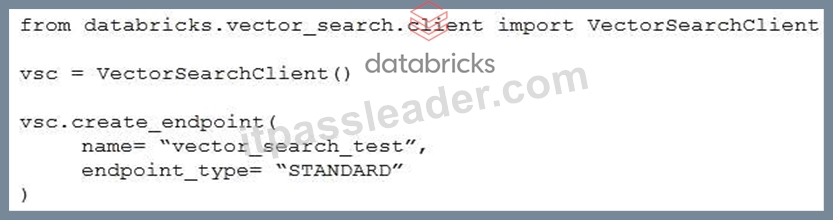
Assuming they intend to use Databricks managed embeddings with the default embedding model, what should be the next logical function call?
- A. vsc.get_index()
- B. vsc.similarity_search()
- C. vsc.create_delta_sync_index()
- D. vsc.create_direct_access_index()
Answer: C
Explanation:
Context: The Generative AI Engineer is setting up a vector store using Databricks' VectorSearchClient. This is typically done to enable fast and efficient retrieval of vectorized data for tasks like similarity searches.
Explanation of Options:
* Option A: vsc.get_index(): This function would be used to retrieve an existing index, not create one, so it would not be the logical next step immediately after creating an endpoint.
* Option B: vsc.create_delta_sync_index(): After setting up a vector store endpoint, creating an index is necessary to start populating and organizing the data. The create_delta_sync_index() function specifically creates an index that synchronizes with a Delta table, allowing automatic updates as the data changes. This is likely the most appropriate choice if the engineer plans to use dynamic data that is updated over time.
* Option C: vsc.create_direct_access_index(): This function would create an index that directly accesses the data without synchronization. While also a valid approach, it's less likely to be the next logical step if the default setup (typically accommodating changes) is intended.
* Option D: vsc.similarity_search(): This function would be used to perform searches on an existing index; however, an index needs to be created and populated with data before any search can be conducted.
Given the typical workflow in setting up a vector store, the next step after creating an endpoint is to establish an index, particularly one that synchronizes with ongoing data updates, henceOption B.
NEW QUESTION # 32
A Generative AI Engineer just deployed an LLM application at a digital marketing company that assists with answering customer service inquiries.
Which metric should they monitor for their customer service LLM application in production?
- A. Energy usage per query
- B. Number of customer inquiries processed per unit of time
- C. HuggingFace Leaderboard values for the base LLM
- D. Final perplexity scores for the training of the model
Answer: B
Explanation:
When deploying an LLM application for customer service inquiries, the primary focus is on measuring the operational efficiency and quality of the responses. Here's whyAis the correct metric:
* Number of customer inquiries processed per unit of time: This metric tracks the throughput of the customer service system, reflecting how many customer inquiries the LLM application can handle in a given time period (e.g., per minute or hour). High throughput is crucial in customer service applications where quick response times are essential to user satisfaction and business efficiency.
* Real-time performance monitoring: Monitoring the number of queries processed is an important part of ensuring that the model is performing well under load, especially during peak traffic times. It also helps ensure the system scales properly to meet demand.
Why other options are not ideal:
* B. Energy usage per query: While energy efficiency is a consideration, it is not the primary concern for a customer-facing application where user experience (i.e., fast and accurate responses) is critical.
* C. Final perplexity scores for the training of the model: Perplexity is a metric for model training, but it doesn't reflect the real-time operational performance of an LLM in production.
* D. HuggingFace Leaderboard values for the base LLM: The HuggingFace Leaderboard is more relevant during model selection and benchmarking. However, it is not a direct measure of the model's performance in a specific customer service application in production.
Focusing on throughput (inquiries processed per unit time) ensures that the LLM application is meeting business needs for fast and efficient customer service responses.
NEW QUESTION # 33
A Generative AI Engineer is building a Generative AI system that suggests the best matched employee team member to newly scoped projects. The team member is selected from a very large team. Thematch should be based upon project date availability and how well their employee profile matches the project scope. Both the employee profile and project scope are unstructured text.
How should the Generative Al Engineer architect their system?
- A. Create a tool for finding team member availability given project dates, and another tool that uses an LLM to extract keywords from project scopes. Iterate through available team members' profiles and perform keyword matching to find the best available team member.
- B. Create a tool for finding available team members given project dates. Embed all project scopes into a vector store, perform a retrieval using team member profiles to find the best team member.
- C. Create a tool for finding available team members given project dates. Embed team profiles into a vector store and use the project scope and filtering to perform retrieval to find the available best matched team members.
- D. Create a tool to find available team members given project dates. Create a second tool that can calculate a similarity score for a combination of team member profile and the project scope. Iterate through the team members and rank by best score to select a team member.
Answer: C
NEW QUESTION # 34
......
Databricks Databricks-Generative-AI-Engineer-Associate Exam Syllabus Topics:
| Topic | Details |
|---|---|
| Topic 1 |
|
| Topic 2 |
|
| Topic 3 |
|
| Topic 4 |
|
Databricks-Generative-AI-Engineer-Associate Dumps and Exam Test Engine: https://www.itpassleader.com/Databricks/Databricks-Generative-AI-Engineer-Associate-dumps-pass-exam.html
Get New Databricks-Generative-AI-Engineer-Associate Practice Test Questions Answers: https://drive.google.com/open?id=1k3RKtSD12Wuj5fm-hZCCdEFNUwJM3vNv