

Free 2026 GES-C01 Dumps 100 Pass Guarantee With Latest Demo
Prepare GES-C01 Question Answers Free Update With 100% Exam Passing Guarantee [2026]
NEW QUESTION # 79
A data engineering team needs to implement a highly accurate, low-latency solution for classifying specialized technical documents into 50 distinct categories. They are considering fine-tuning a Large Language Model (LLM) within Snowflake Cortex for this task. Which of the following considerations are critical for optimizing the fine-tuned model's performance and minimizing inference latency for production use? (Select all that apply)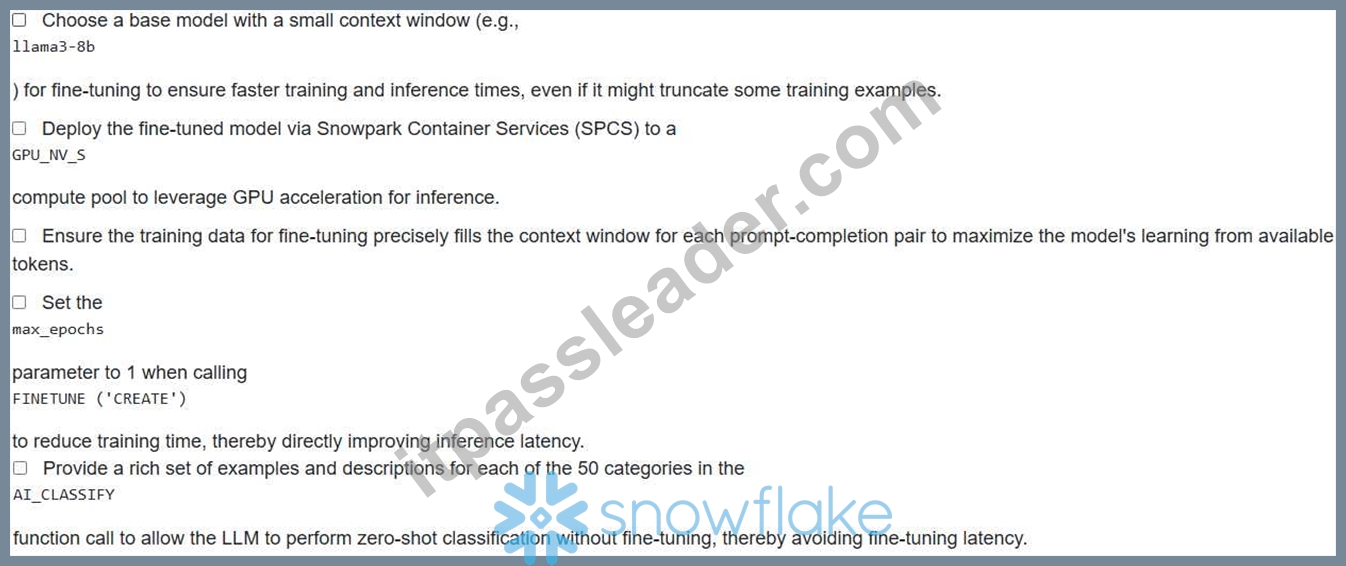
- A. Option A
- B. Option B
- C. Option E
- D. Option C
- E. Option D
Answer: A,B
Explanation:
To optimize a fine-tuned model's performance and minimize inference latency: * Smaller models (like *llama3-8b' with an 8k context window, supporting 6k for prompt and 2k for completion) generally have lower latency for both training and inference. While exceeding the context window results in truncation which can negatively impact quality, for specific tasks, a smaller, fine-tuned model can achieve the required accuracy with better performance. * **B:** Deploying a fine-tuned model to a Snowpark Container Services (SPCS) compute pool with GPU instances (e.g., or is crucial for leveraging GPU acceleration. This is explicitly optimized for intensive GPU usage scenarios like LLMsA/LMs, which significantly reduces inference latency and increases throughput. * It is important to ensure that prompt and completion pairs do not *exceed* the context window to prevent truncation and negative impact on model quality. However, *precisely filling* the context window is not a requirement or an optimization strategy; the focus should be on providing relevant and high-quality data within the model's limits. * '*D:" Setting 'max_epochs' to 1 reduces the *training time*. However, training time does not directly improve *inference* latency for the deployed model. Inference latency depends on the model's architecture, deployment hardware, and runtime optimizations. Furthermore, too few epochs can lead to a poorly performing model, failing the accuracy requirement. * E: This describes using the 'AI CLASSIFY managed function for zero-shot classification, which is an alternative to fine-tuning. While it might avoid the latency associated with fine-tuning *training*, the question is specifically about optimizing the performance of a *fine-tuned model* for a specialized task, implying that fine-tuning is chosen for its potential to achieve higher accuracy for that niche use case compared to zero-shot approaches.
NEW QUESTION # 80
A data analytics team is building a self-service analytics application using Snowflake Cortex Analyst to allow business users to query sales data with natural language. They are defining a semantic model in YAML to ensure accurate text-to-SQL generation. Which of the following is the most crucial aspect of the semantic model's configuration for Cortex Analyst to effectively translate natural language into SQL for structured data?
- A. Utilizing advanced data types like 'VARIANT' and 'OBJECT for all dimensions to accommodate semi-structured data without complex transformations.
- B. Providing detailed 'name', 'description' , and 'synonyms' for logical tables, dimensions, and facts to bridge the gap between business terminology and the underlying database schema.
- C. Specifying a dedicated 'CORTEX SEARCH SERVICE for every dimension to pre-compute all possible literal values, optimizing response time.
- D. Configuring the 'base_table' parameter to directly reference a dynamic table, ensuring real-time data ingestion and processing before SQL generation.
- E. Defining a comprehensive 'verified_queries' section with a high volume of example natural language questions and their exact SQL translations to handle all potential user queries.
Answer: B
Explanation:
Option C is correct because the primary purpose of a semantic model in Cortex Analyst is to provide semantic information about your data, bridging the gap between business users' natural language and the technical database schema. This includes using descriptive names, synonyms, and descriptions for logical tables, dimensions, and facts, which is essential for Cortex Analyst to reliably generate accurate SQL from natural language questions. Option A is incorrect; while Cortex Search Services can improve literal matching for dimensions, it's an enhancement and not the most crucial foundational aspect of the semantic model for general text-to-SQL translation, nor is it required for 'every' dimension. Option B is incorrect because while 'verified_queries' improve accuracy for similar questions, a high volume of examples for 'all' potential queries is not feasible or the most crucial initial configuration; the core mapping (Option C) is more fundamental. Option D is incorrect as the 'base_table' must refer to a physical table or view, not directly to a dynamic table. Furthermore, Cortex functions do not support dynamic tables directly. Option E is incorrect because 'VARIANT, 'OBJECT, 'GEOGRAPHY , and 'ARRAY data types are explicitly not supported for dimension, fact, or metric columns in a semantic model.
NEW QUESTION # 81
A financial analyst is concerned about the rising costs of their Document AI pipeline, which uses to extract data from daily financial reports. They observe that their assigned 'LARGE virtual warehouse is running continuously, even during periods of low document ingestion, contributing significantly to their bill. They want to investigate how to reduce costs effectively for their existing Document AI setup.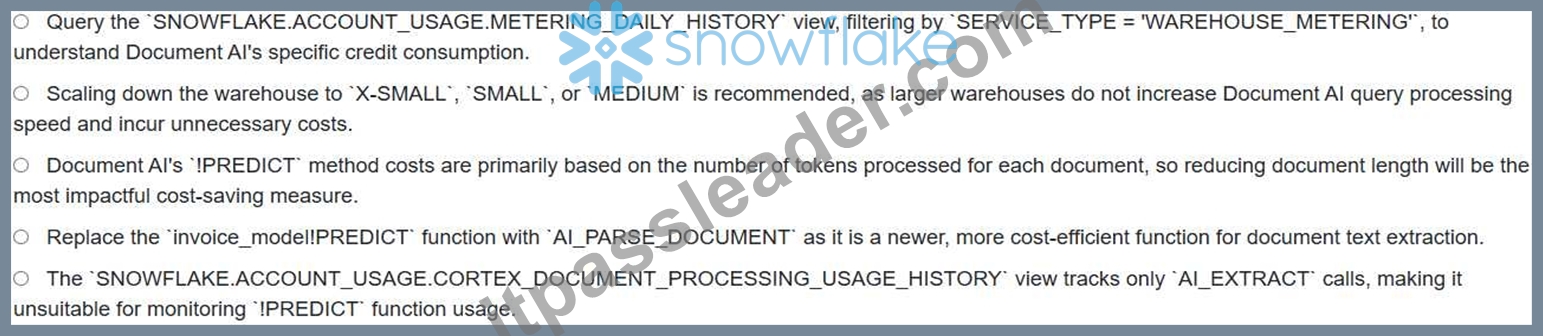
- A. Option B
- B. Option E
- C. Option C
- D. Option A
- E. Option D
Answer: A
Explanation:
Snowflake explicitly recommends using an X-Small, Small, or Medium warehouse for Document AI. Scaling up the warehouse does not increase the speed of query processing for Document AI but can lead to unnecessary costs. This directly addresses the scenario of a 'LARGE warehouse running continuously and contributing to high bills. Option A is incorrect because while 'METERING DAILY HISTORY is used for cost tracking, Document AI's service-side usage appears under 'AI_SERVICES , not 'WAREHOUSE_METERING' for the AI service component itself. 'WAREHOUSE METERING' would show general warehouse costs, not specifically tied to Document AI's compute portion. Option C is incorrect because Document AI (using ' !PREDICT) incurs 'AI Services compute' costs based on 'time spent actually using these resources' (8 Credits per hour of compute), not per token. Option D is not necessarily accurate guidance; SAI PARSE DOCUMENT is a separate Cortex AI SQL function for document processing, billed per page, while Document AI's '!PREDICT is part of a Document AI model build. Replacing it without a full re- evaluation of the workflow might not be optimal or directly cost-efficient for an established pipeline. Option E is incorrect because the view tracks Document AI processing activity, including '!PREDICT calls.
NEW QUESTION # 82
A data science team is fine-tuning a Snowflake Document AI model to improve the extraction accuracy of specific fields from a new type of complex legal document. They are consistently observing low confidence scores and inconsistent 'value' keys for extracted entities, even after initial training. Which two of the following best practices should the team follow to most effectively improve the model's extraction accuracy and confidence for this complex document type?
- A. Set the 'temperature' parameter to a higher value (e.g., 0.7) during '!PREDICT calls to encourage more creative and diverse interpretations by the model.
- B. Limit the fine-tuning training data exclusively to perfectly formatted and clean documents to ensure the model learns from ideal examples without noise.
- C. Actively involve subject matter experts (SMEs) or document owners throughout the iterative process to help define data values, provide annotations, and evaluate the model's effectiveness.
- D. Prioritize extensive prompt engineering by creating highly detailed and complex questions with intricate logic to guide the LLM's understanding of the extraction task.
- E. Ensure the training dataset used for fine-tuning includes diverse documents representing various layouts, data variations, and explicit examples of 'NULL' values or empty cells where appropriate.
Answer: C,E
Explanation:
To improve Document AI model training, it is crucial to ensure that the documents uploaded for training represent a real use case and that the dataset consists of diverse documents in terms of both layout and data. If all documents contain the same data or are always presented in the same form, the model might provide incorrect results. For table extraction, it is vital that enough data is used to train the model to include values and maintain order. Therefore, ensuring a diverse training dataset (Option B) is a key best practice. Additionally, Subject Matter Experts (SMEs) and document owners are crucial partners in understanding and evaluating the model's effectiveness in extracting the required information. Their involvement in defining data values, providing annotations, and evaluating results will significantly improve accuracy (Option C). Option A is not a best practice; it's recommended to keep questions as encompassing as possible and rely on training with annotations rather than complex prompt engineering, especially for document variability. Option D is incorrect; a higher 'temperature' value increases the randomness and diversity of the model's output, which is generally undesirable for accurate data extraction where deterministic results are preferred. For most consistent results, 'temperature' should be set to 0. Option E is incorrect because training on a restricted set of perfectly formatted documents can lead to a model that performs poorly on real-world, varied documents; diversity in training data is essential.
NEW QUESTION # 83
A data engineering team is setting up a pipeline to automatically process various document types using AI_PARSE_DOCUMENT from an internal stage. Before writing any SQL, they need to ensure their Snowflake environment and the role they will use have the necessary permissions and configurations. Which of the following statements correctly describe essential prerequisites or access control requirements for successfully using AI_PARSE_DOCUMENT in this setup?
- A. Option A
- B. Option B
- C. Option E
- D. Option C
- E. Option D
Answer: A,B,C
Explanation: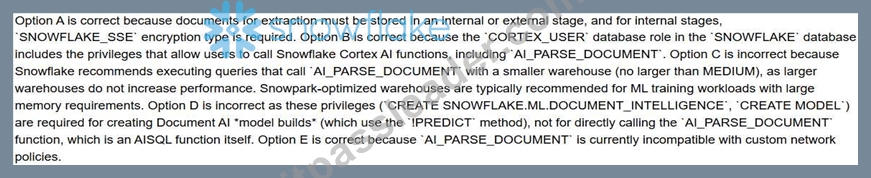
NEW QUESTION # 84
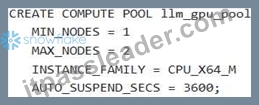
A Gen AI Specialist is setting up their Snowflake environment to deploy a high-performance open-source LLM for real-time inference using Snowpark Container Services (SPCS). They need to create a compute pool that can leverage NVIDIAAIOG GPUs to optimize model performance. Which of the following SQL statements correctly creates a compute pool capable of supporting an intensive GPU usage scenario, such as serving LLMs, while adhering to common configuration best practices for a new, small-scale deployment in Snowpark Container Services?
- A.
- B.
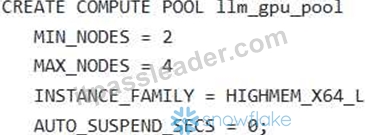
- C.
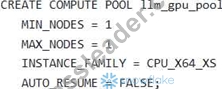
- D.
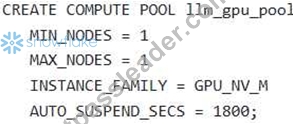
- E.
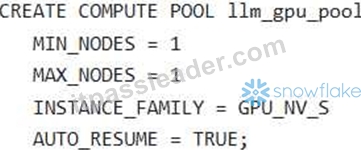
Answer: D
Explanation:
Option D is correct. The 'GPU NV_M' instance family is explicitly described as "Optimized for intensive GPU usage scenarios like Computer Vision or LLMsNLMs", providing 4 NVIDIAAIOG GPUs. Setting = 1' and 'MAX_NODES = 1' is appropriate for a small- scale deployment, and = 1800' (30 minutes) is a sound practice for cost management during inactivity. Option A is incorrect because is a generic CPU instance, not a GPU instance suitable for LLMs. Option B uses which is a GPU instance and the "smallest NVIDIA GPU size available for Snowpark Containers to get started". While functional, ' GPU is more directly aligned with "intensive GPU usage scenarios like LLMs" as stated in the question. 'AUTO RESUME = TRUE is the default behavior. Option C is incorrect because is a high-memory CPU instance, not a GPU instance. Setting = 0' means the compute pool will not suspend automatically, which is generally not a best practice for a new, small-scale deployment unless continuous availability is strictly required. Option E uses which is a CPU instance, making it unsuitable for GPU-accelerated workloads.
NEW QUESTION # 85
A data engineering team is setting up an automated pipeline to extract information from new invoices using Document AI. They've created a database and schema Cinvoice_db.invoice_schema') and a Document AI model build They then created an internal stage for documents. When they attempt to run the method on documents uploaded to 'invoice_stage' , they consistently receive the following error:
Given this error message, which 'corrective SQL command' addresses the most likely misconfiguration of the 'invoice_stage' to allow Document AI processing?
- A.

- B.

- C.

- D.

- E.

Answer: D
Explanation: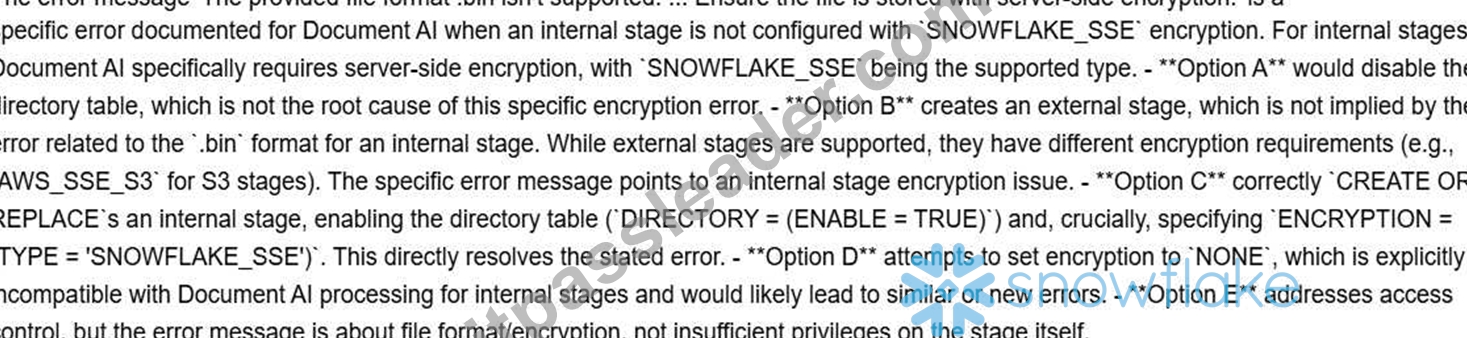
NEW QUESTION # 86
A data engineering team is designing a scalable data pipeline in Snowflake that involves processing large text inputs with Cortex AI LLM functions. They want to ensure cost efficiency and prevent queries from failing due to exceeding LLM context window limits. They plan to use SNOWFLAKE. CORTEX. COUNT_TOKENS for pre-validation. Which of the following statements are TRUE about the role and cost of COUNT_TOKENS in this scenario? (Select all that apply)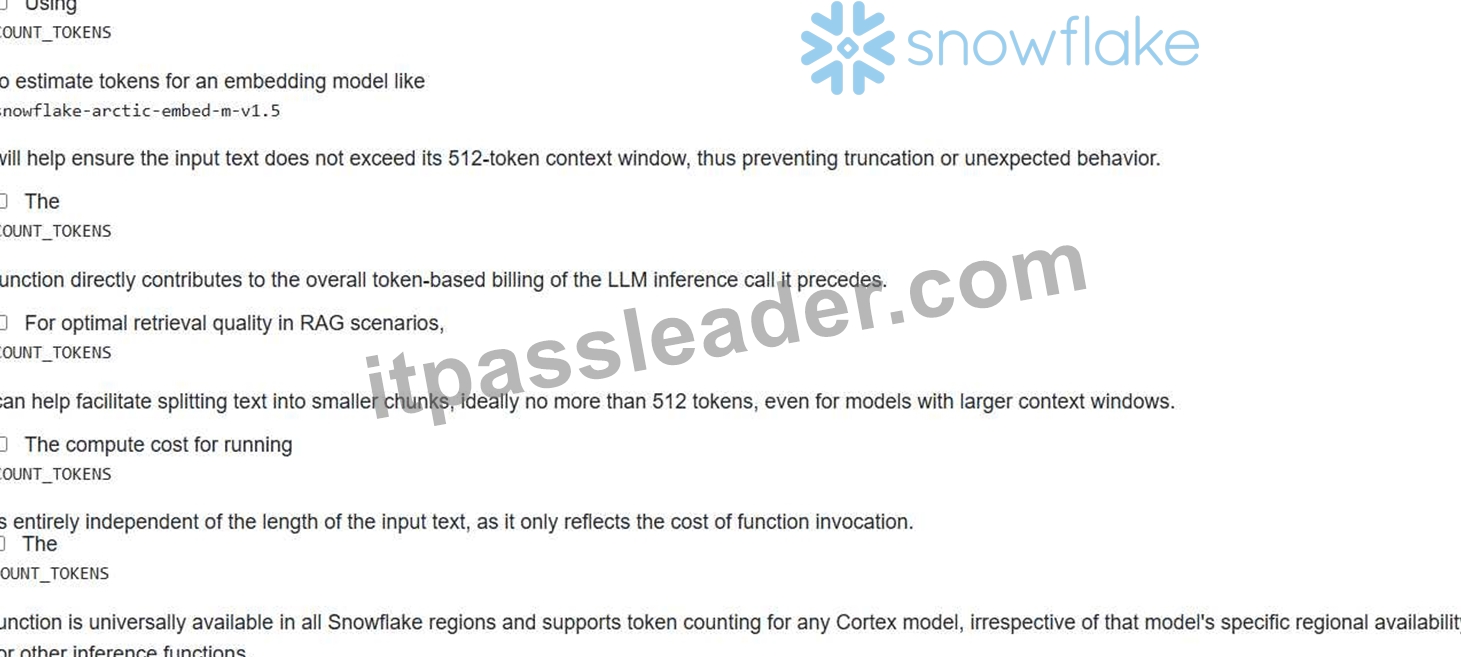
- A. Option A
- B. Option C
- C. Option E
- D. Option B
- E. Option D
Answer: A,B,C
Explanation:
Option A is correct. Embedding models like
have a fixed context window of 512 tokens. Using COUNT_TOKENS allows pre-checking if text fits within this limit, preventing truncation that can occur when the input exceeds the context window. Option B is incorrect because COUNT_TOKENS incurs only compute cost to run the function and does not incur additional token-based costs that would add to the billing of subsequent LLM inference calls. Option C is correct. For best search results, Snowflake recommends splitting text into chunks of no more than 512 tokens. This practice generally leads to higher retrieval and downstream LLM response quality in RAG scenarios, and COUNT_TOKENS is a valuable tool for managing these chunk sizes. Option D is incorrect. While COUNT_TOKENS incurs compute cost (not token-based cost), the amount of compute would generally scale with the size of the input text it processes, making the cost not entirely independent of input length, although it's not billed on a per-token basis for its own operation. Option E is correct. The COUNT_TOKENS function is available in all regions for any model, though the models themselves may have specific regional availabilities for other functions.
NEW QUESTION # 87
A data engineer is designing an automated pipeline to process customer feedback comments from a 'new_customer_reviews' table, which includes a 'review_text' column. The pipeline needs to classify each comment into one of three predefined categories: 'positive', 'negative', or 'neutral', and store the classification label in a new 'sentiment_label' column.
Which of the following statements correctly describe aspects of implementing this data transformation using 'SNOWFLAKE.CORTEX.CLASSIFY_TEXT' in a Snowflake pipeline?
- A. The argument must contain exactly three unique categories for sentiment classification.
- B. The classification can be achieved by integrating a 'SELECT statement with

- C. The cost for 'CLASSIFY _ TEXT is incurred based on the number of pages processed in the input document.
- D. Including an optional 'task_description' such as

- E. Both the input string to classify and the are case-sensitive, potentially yielding different results for variations in capitalization.
Answer: B,D,E
Explanation:
Option A is correct. 'SNOWFLAKE.CORTEX.CLASSIFY_TEXT classifies free-form text into categories and returns an 'OBJECT' value (VARIANT) where the 'label' field specifies the category. This can be extracted using '['labeI']' and seamlessly integrated into 'INSERT or 'UPDATE' statements within a pipeline task for data transformation.
Option B is correct. Adding a clear 'task_description' to the 'options' argument for 'CLASSIFY_TEXT' can significantly improve classification accuracy. This is particularly useful when the relationship between the input text and the provided categories is ambiguous or nuanced.
Option C is incorrect. incurs compute cost based on the number of tokens processed (both input and output tokens), not on the number of pages in a document. Functions like 'AI_PARSE_DOCUMENT bill based on pages.
Option D is incorrect. The argument for 'CLASSIFY_TEXT' must contain at least two and at most 100 unique categories. It is not strictly limited to three for any classification task, including sentiment.
Option E is correct. Both the 'input' string to classify and the are case-sensitive, meaning that differences in capitalization for either the input text or the category labels can lead to different classification results.
NEW QUESTION # 88
A Gen AI specialist is designing a RAG pipeline utilizing Cortex Search for an application that queries a large repository of unstructured text documents. To optimize the quality of retrieval and subsequent LLM responses, what are the critical best practices and understanding of Cortex Search's mechanisms that the specialist should consider regarding text processing and tokenization?
- A. Cortex Search operates solely on vector embeddings for semantic search; keyword-based retrieval is handled by a separate, less efficient mechanism outside the core search service.
- B. For best search results, text in the search column should be split into chunks of no more than 512 tokens, as smaller chunks generally lead to more precise retrieval and relevant LLM context.
- C. The SNOWFLAKE .CORTEX. COUNT TOKENS function is a helper function that can be used to accurately determine the token count for a given string based on a specified model, aiding in adherence to context window limits.
- D. Embedding models with larger context windows, such as snowflake-arctic-embed-1-v2.e-8k (8000 tokens), are always superior as they allow the RAG system to process the entire document as a single, highly relevant chunk.
- E. When text input exceeds an embedding model's context window, Cortex Search truncates the text for both semantic embedding and keyword-based retrieval, potentially losing critical information.
Answer: B,C
Explanation:
Option A is correct; Snowflake recommends splitting text into chunks of no more than 512 tokens for optimal search results and higher retrieval/LLM response quality, even with longer-context embedding models. Option B is incorrect because while Cortex Search truncates strings exceeding the context window for embedding, it uses the full body of text for keyword-based retrieval. Option C is incorrect as research shows smaller chunk sizes typically result in higher retrieval and downstream LLM response quality, despite the availability of longer-context models. Option D is correct, as COUNT _ TOKENS is a helper function used for this purpose. Option E is incorrect because Cortex Search is a hybrid (vector and keyword) search engine.
NEW QUESTION # 89
A Data Engineer is responsible for deploying machine learning models using Snowpark Container Services. They need to ensure that a specific role, model_deployer_role, has the appropriate permissions to create a Snowpark Container Service that uses an image from an existing image repository named my_inferenc_ images. Which of the following SQL commands grant the necessary privileges 'on the image repository' for this purpose?
- A.

- B.

- C.

- D.

- E.

Answer: B,C
Explanation:
Option D is correct because the privilege allows a role to read images from the repository, which is READ ON IMAGE REPOSITORY fundamental for creating a service that uses those images. Option E is correct because the privilege is SERVICE READ ON IMAGE REPOSITORY specifically identified as being for services that need to use images from the repository. Option A is incorrect as is a general USAGE ON DATABASE privilege for database access, not a specific privilege on the image repository for using its images. Option B is incorrect because CREATE SERVICE ON is required to create the service object in a schema, but it is a privilege on the 'schema' itself, not directly on the 'image repository' for SCHEMA accessing its content. Option C is incorrect because is used for pushing or uploading images to the repository, not for WRITE ON IPtAGE REPOSITORY consuming them when creating a service.
NEW QUESTION # 90
A financial data team is implementing a Snowflake Cortex AI solution to summarize regulatory documents using SNOWFLAKE.CORTEX.TRY_COMPLETE They aim for both cost efficiency and high reliability, especially when dealing with documents that might occasionally exceed model context limits or result in malformed output. Which of the following statements about the cost and operational behavior of TRY_COMPLETE are TRUE in this context? (Select all that apply)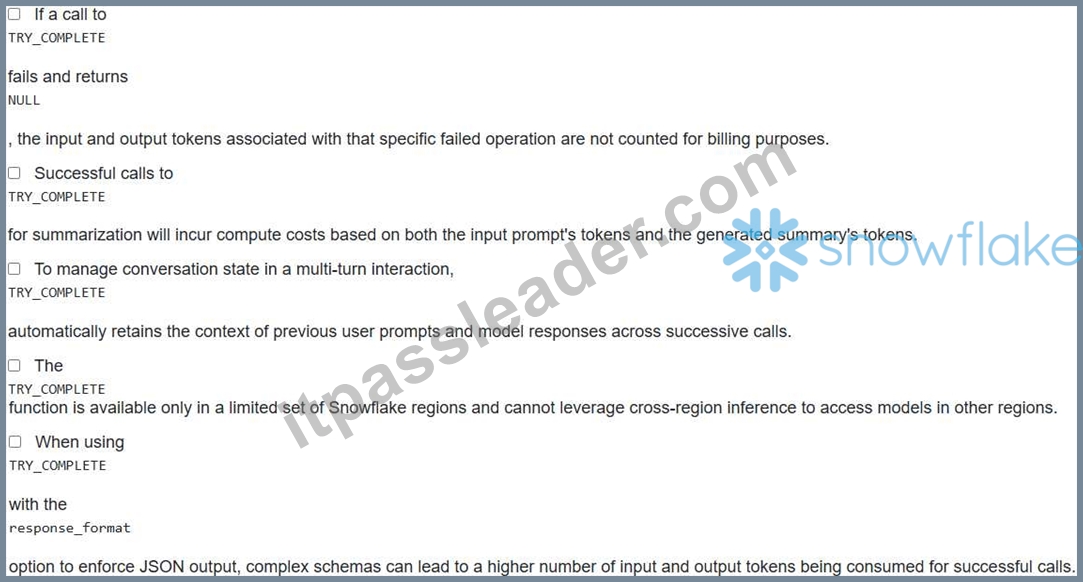
- A. Option A
- B. Option B
- C. Option E
- D. Option C
- E. Option D
Answer: A,B,C
Explanation:
Option A is correct because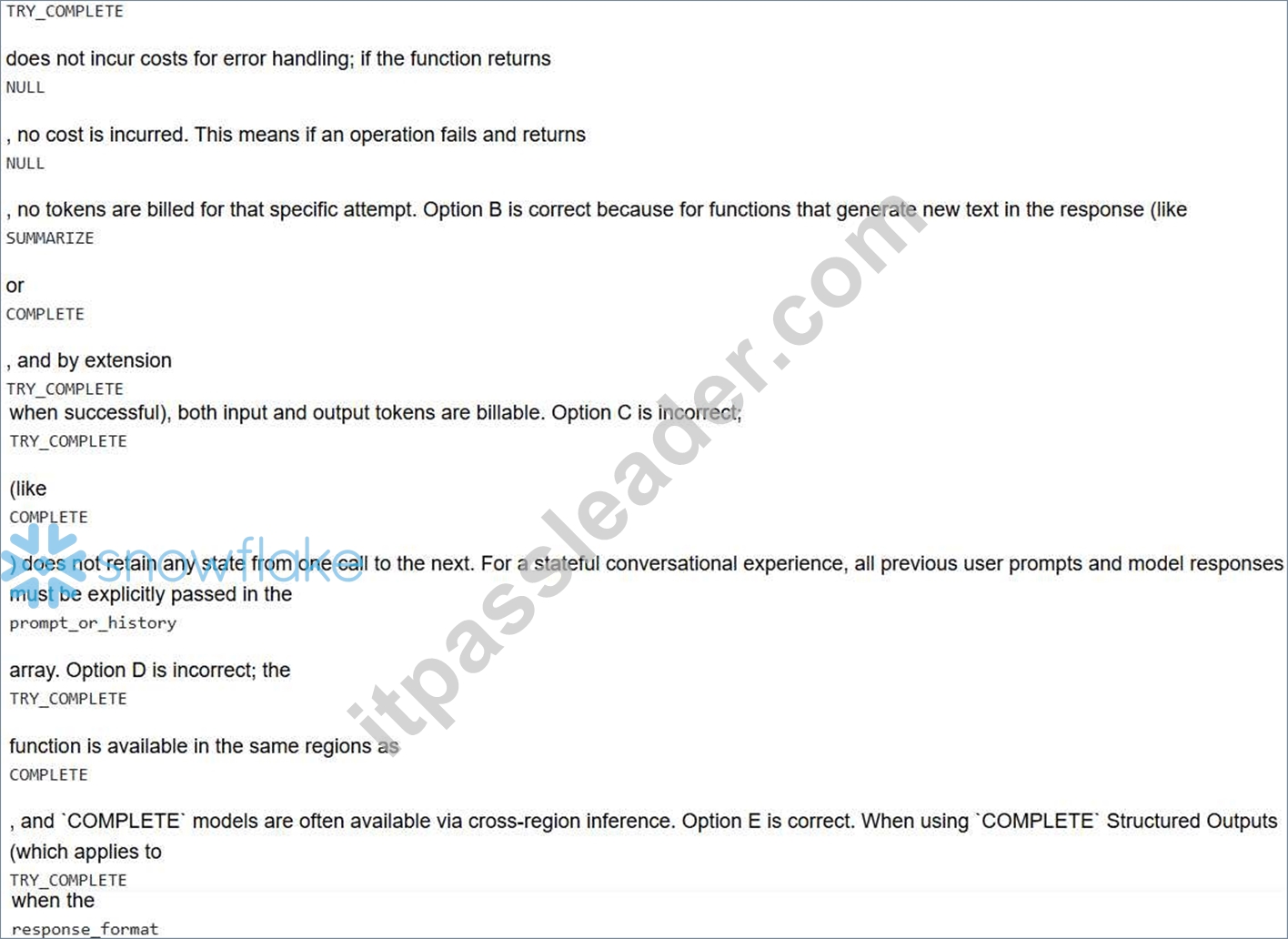
option is used), the number of tokens processed (and billed) increases with schema complexity. Larger and more complex schemas generally consume a larger number of input and output tokens.
NEW QUESTION # 91
A company is building a chatbot for internal support, powered by Snowflake Cortex LLMs. The primary goals are to provide answers that are accurate, grounded in proprietary documentation, and to minimize factual 'hallucinations'. They are considering various strategies to achieve this. Which of the following statements correctly describe effective methods or tools within Snowflake for addressing these concerns?
- A. For tasks requiring LLMs to generate SQL queries from natural language, using the can improve accuracy by Cortex Analyst Verified Query Repository (VQR) leveraging pre-verified SQL queries for similar questions.
- B. Using Cortex Search as a Retrieval Augmented Generation (RAG) engine can enhance LLM responses by providing relevant context from proprietary documentation, thereby reducing hallucinations.
- C. Enabling Cortex Guard with guardrails: true directly addresses model hallucinations by ensuring responses are always factually correct and aligned with the provided context.
- D. AI Observability can be leveraged to systematically evaluate applications, measuring metrics like 'factual correctnesS and 'groundedness' to detect and mitigate hallucinations, especially in summarization.
- E. Deploying a custom fine-tuned model using SNOWFLAKE. CORTEX. FINETUNE on proprietary documentation is the most effective approach to ensure factual accuracy for any LLM task.
Answer: A,B,D
Explanation:
Option B is correct: Cortex Search is explicitly designed as a RAG engine to enhance LLM responses with contextualized information from Snowflake data, which directly addresses factual accuracy and reduces hallucinations. Option C is correct: AI Observability's evaluation features, including 'factual correctness' and 'groundedness' scores, are specifically mentioned for detecting the truthfulness and relevance of responses based on retrieved context, and for avoiding LLMs with high hallucination frequencies, especially in summarization tasks. Option D is correct: The Cortex Analyst Verified Query Repository (VQR) provides a collection of pre-verified SQL queries for specific natural language questions, significantly improving the accuracy and trustworthiness of SQL generation and reducing errors that could be seen as 'hallucinations' in the text-to-SQL context. Option A is incorrect: While fine-tuning (using 'SNOWFLAKE.CORTEX.FINETUNE) can adapt a model to specific tasks and data, it is not a direct guarantee against 'all' factual inaccuracies or 'hallucinations' for 'any' LLM task, especially if the fine- tuning data itself is limited or the model generalizes poorly. RAG is generally preferred for grounding responses in up-to-date external knowledge. Option E is incorrect: Cortex Guard is designed to filter 'harmful or unsafe' LLM responses, not to directly ensure factual correctness or prevent hallucinations related to content accuracy or grounding.
NEW QUESTION # 92
A data engineer is constructing a Retrieval Augmented Generation (RAG) pipeline in Snowflake to allow users to query a large corpus of unstructured customer support transcripts using natural language. The goal is to retrieve relevant transcript snippets and then use a Large Language Model (LLM) to generate an answer. Which sequence of steps and Snowflake components would effectively implement this RAG pipeline?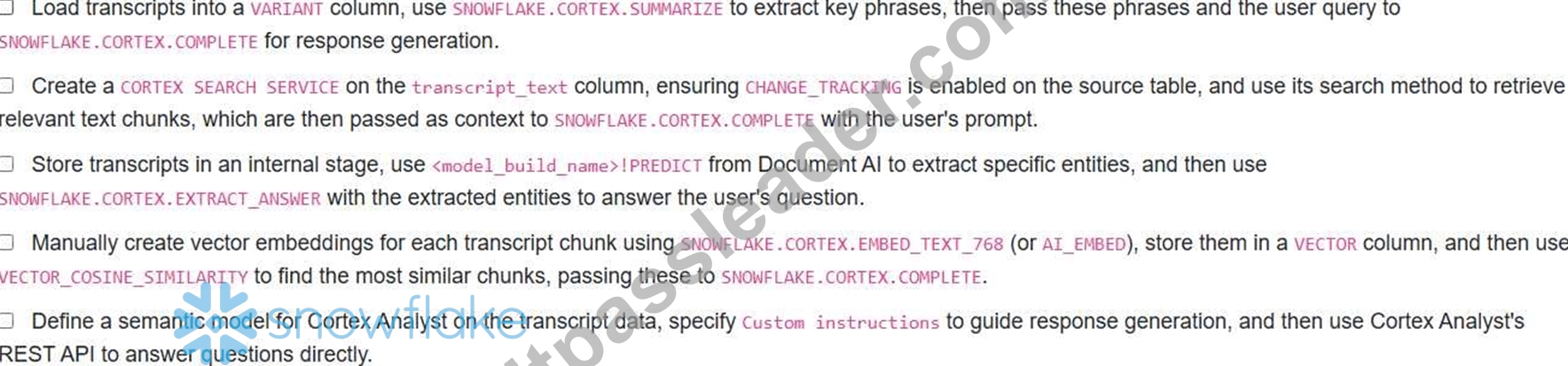
- A. Option B
- B. Option E
- C. Option C
- D. Option A
- E. Option D
Answer: A,E
Explanation:
Both options B and D describe valid and effective ways to implement a RAG pipeline in Snowflake. * *Option B is correct." Cortex Search is specifically designed to act as a RAG engine for LLM chatbots, enabling high-quality fuzzy search over text data. Creating a 'CORTEX SEARCH SERVICE on the text column (e.g., 'transcript_text') and enabling 'CHANGE_TRACKING' on the source table are fundamental steps for continuous updates and retrieval. The retrieved results then provide the necessary context for an LLM call using 'SNOWFLAKE.CORTEX.COMPLETE (or 'AI_COMPLETE). "Option D is correct." This option outlines a more manual, but equally effective, approach to RAG. It involves generating vector embeddings for text chunks using functions like (or the newer 'AI_EMBED), storing these embeddings in a 'VECTOR data type column, and then performing a similarity search (e.g., with *VECTOR COSINE_SIMILARITY) to retrieve relevant content based on a user's query. The retrieved text then serves as context for the LLM (SNOWFLAKE.CORTEX.COMPLETE or 'AI_COMPLETE) to generate a grounded response. Option A is incorrect. While 'SUMMARIZE can produce summaries, it doesn't provide a mechanism for retrieving *semantically similar* text chunks from a large corpus based on a user query, which is crucial for RAG. Storing data in a 'VARIANT' column is also generally not optimal for direct vector embedding or search service operations as described in RAG contexts. Option C is incorrect. Document AI ( ' !PREDICT) is primarily for extracting structured information (entities, tables) from documents, not for general semantic search or RAG over free-form text with LLMs. 'EXTRACT ANSWER is used to find answers within a given text, but it's not the primary orchestrator for a dynamic RAG pipeline that first needs to *retrieve* relevant documents. Option E is incorrect. Cortex Analyst is designed for text-to-SQL functionality over *structured data* and its semantic models, not directly for RAG over *unstructured text corpora'. While it can integrate with Cortex Search for improving literal values in SQL queries, its core purpose is not to act as a RAG engine for unstructured document chat.
NEW QUESTION # 93 
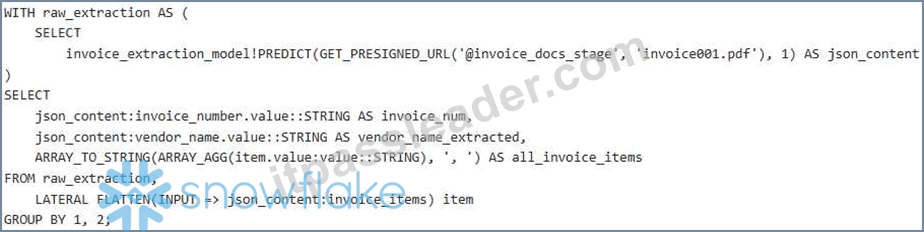
Which of the following SQL snippets, when executed against a single invoice file like "invoice001 .pdf", correctly extracts and transforms the desired data, assuming 'json_content' holds the raw Document AI output?
- A.
- B.

- C.

- D.

- E.

Answer: A
Explanation:
Option B correctly uses a Common Table Expression (CTE) to retrieve the raw JSON output from (which is a Document AI method for extracting information from documents in a stage), leveraging to access the document. It then accesses the 'invoice_number' and 'vendor_name' using .value' syntax, appropriate for values returned as an array containing a single object with a 'value' field, as shown in Document AI output examples. The 'LATERAL FLATTEN' clause is correctly applied to expand the array of line items, and 'ARRAY_AGG' combined with 'ARRAY _ TO STRING' converts these items into a comma-separated string. Finally, it groups by the single-value extracted fields.
Option A attempts to flatten the result multiple times or in an incorrect way within the SELECT statement without a proper FROM' clause for the flattened data, leading to inefficient or incorrect aggregation. Option C directly references a staged file path (@invoice_docs_stage/invoice001.pdf) without the necessary GET PRESIGNED URL' function, which is required when calling '!PREDICT' with a file from a stage. It also incorrectly assumes direct .value' access for array-wrapped single values and does not correctly transform the 'invoice_itemS array into a string. Option D's subquery for 'ARRAY AGG' is syntactically problematic for direct column access from the outer query without explicit 'LATERAL FLATTEN' at the top level. Option E only extracts the 'ocrScore' from the document metadata and does not perform the requested data transformations.
NEW QUESTION # 94
A Streamlit application developer wants to use AI_COMPLETE (the latest version of COMPLETE (SNOWFLAKE.CORTEX)) to process customer feedback. The goal is to extract structured information, such as the customer's sentiment, product mentioned, and any specific issues, into a predictable JSON format for immediate database ingestion. Which configuration of the AI_COMPLETE function call is essential for achieving this structured output requirement?
- A. Option C
- B. Option E
- C. Option A
- D. Option B
- E. Option D
Answer: A
Explanation:
'AI_COMPLETE Structured OutputS (and its predecessor 'COMPLETE Structured OutputS) specifically allows supplying a JSON schema as the 'response_format' argument to ensure completion responses follow a predefined structure. This significantly reduces the need for post-processing in AI data pipelines and enables seamless integration with systems requiring deterministic responses. The JSON schema object defines the structure, data types, and constraints, including required fields. For complex tasks, prompting the model to respond in JSON can improve accuracy, but the 'response_format' argument is the direct mechanism for enforcing the schema. Setting 'temperature to 0 provides more consistent results for structured output tasks. Option A is a form of prompt engineering, which can help but does not guarantee strict adherence as 'response_format does. Option B controls randomness and length, not output structure. Option D, while 'AI_EXTRACT (or EXTRACT ANSWER) can extract information, using it multiple times and then manually combining results is less efficient and less robust than a single 'AI_COMPLETE call with a structured output schema for multiple related fields. Option E's 'guardrails' are for filtering unsafe or harmful content, not for enforcing output format.
NEW QUESTION # 95
......
Dumps Real Snowflake GES-C01 Exam Questions [Updated 2026]: https://www.itpassleader.com/Snowflake/GES-C01-dumps-pass-exam.html
Free GES-C01 Exam Dumps to Pass Exam Easily: https://drive.google.com/open?id=1-rvViD_XFN5qd9f1Sy6PefbT8NFbwRUM