

[Jun 02, 2025] PMI-RMP Test Prep Training Practice Exam Questions Practice Tests
Exam Questions Answers Braindumps PMI-RMP Exam Dumps PDF Questions
NEW QUESTION # 118
Which statement describes the risk portrayed on the risk matrix heat map below?
- A. The risk has a high impact and probability of occurring.
- B. The risk has a probability of 40% of occurrence and a high impact rating.
- C. The risk has a low probability and high impact rating.
- D. The risk has a probability of 60% of occurrence and a medium impact rating.
Answer: B
Explanation:
The risk matrix heat map is a graphical tool that displays the probability and impact of risks in a project. The horizontal axis represents the probability of occurrence, and the vertical axis represents the impact rating. The colors indicate the level of risk exposure, from green (low) to red (high). The risk in question is located in the upper right quadrant of the matrix, which means it has a high impact rating. The probability of occurrence can be estimated by looking at the scale on the horizontal axis. The risk is slightly to the left of the 50% mark, which means it has a probability of occurrence of about 40%. Therefore, the correct statement that describes the risk is B. The risk has a probability of 40% of occurrence and a high impact rating. Reference: PMI, The Standard for Risk Management in Portfolios, Programs, and Projects, 2019, p. 104-105.
NEW QUESTION # 119
During the design phase the project team is exploring various architecture options. After reviewing the results of design pilot, two conflicting infrastructure pieces were identified.
What action should the project manager take?
- A. Confirm the results through a second pilot.
- B. Reassess the design for the two pieces.
- C. Escalate the situation and request approval to move forward.
- D. Update the assumptions log and assess the risk associated with it.
Answer: D
Explanation:
According to the PMBOK Guide, 6th edition, Section 11.2.1.2, Assumptions Log, an assumption is a factor that is considered to be true, real, or certain without proof or demonstration. Assumptions can affect the project planning and execution, and should be identified, documented, validated, and updated throughout the project life cycle. The assumptions log is an output of the Identify Risks process, and it records the project assumptions and their potential impact, validity, and priority. If the assumptions are found to be invalid or inaccurate, they may introduce new risks or change the existing risk exposure. Therefore, the project manager should update the assumptions log and assess the risk associated with the conflicting infrastructure pieces, and plan appropriate risk responses if needed. References: PMBOK Guide, 6th edition, Section 11.2.1.2, Assumptions Log When conflicting infrastructure pieces are identified, the project manager should update the assumptions log to reflect the new information and assess the risks associated with the conflicting pieces. This allows the project manager to make informed decisions about how to address potential issues and avoid future problems.
(Reference: Project Management Institute. A Guide to the Project Management Body of Knowledge (PMBOK Guide) - Sixth Edition, Section 11.3)
NEW QUESTION # 120
You work as a project manager for BlueWell Inc. There has been a delay in your project work that is adversely affecting the project schedule. You decided, with your stakeholders' approval, to fast track the project work to get the project done faster. When you fast track the project which of the following are likely to increase?
- A. Risks
- B. Costs
- C. Human resource needs
- D. Quality control concerns
Answer: A
NEW QUESTION # 121
You work as a project manager for BlueWell Inc. You are preparing to plan risk responses for your project with your team. How many risk response types are available for a negative risk event in the project?
- A. Four
- B. Three
- C. One
- D. Seven
Answer: A
NEW QUESTION # 122
Henry is the project manager of the QBG Project for his company. This project has a budget of $4,576,900 and is expected to last 18 months to complete. The CIO, a stakeholder in the project, has introduced a scope change request for additional deliverables as part of the project work. What component of the change control system would review the proposed changes' impact on the features and functions of the project's product?
- A. Cost change control system
- B. Scope change control system
- C. Configuration management system
- D. Integrated change control
Answer: C
NEW QUESTION # 123
A risk manager monitors risks on a medium-sized project by collecting inputs and data from individual project team members. What output is produced by the risk manager after analyzing the information they receive?
- A. Updated project schedule
- B. Updated risk register
- C. Updated probability and impact matrix
- D. Updated mitigation plans
Answer: B
NEW QUESTION # 124
Holly is the project manager of the GHH Project. During risk identification and the subsequent risk analysis process she has identified a risk with a high probability and high impact for her project. She and the stakeholder agree that the project management plan should be changed to eliminate the risk threat entirely.
What risk response has Holly used in this instance?
- A. This is the transference risk response.
- B. This is a scope change and not a risk response.
- C. This is the avoidance risk response.
- D. This is the risk mitigation response.
Answer: C
NEW QUESTION # 125
You are the project manager for your organization and you are working with Thomas, a project team member.
You and Thomas have been working on a specific risk response for a probable risk event in the project.
Thomas is empowered with a risk response and will control all aspects of the identified risk response in which a particular risk event will happen within the project. What title, in regard to risk, is bestowed on Thomas?
- A. Risk owner
- B. Risk expeditor
- C. Risk team leader
- D. Risk coordinator
Answer: A
NEW QUESTION # 126
You are the project manager of a large, high-profile project in your organization. You have realized that politics within your company may affect the true identification of risk events within the project. You decide that you'd like to use a method to identify risk events through an anonymous process. Which one of the following risk events will allow you to collect and distribute risk information without the stakeholders knowing what other stakeholders are communicating about the project risk events?
- A. Checklist analysis
- B. Surveys
- C. Monte Carlo Technique
- D. Delphi Technique
Answer: D
NEW QUESTION # 127
Gary is the project manager for his organization. He is working with the project stakeholders on the project requirements and how risks may affect their project. One of the stakeholders is confused about what constitutes risks in the project. Which of the following is the most accurate definition of a project risk?
- A. It is an uncertain event or condition within the project execution.
- B. It is an unknown event that can affect the project scope.
- C. It is an uncertain event that can affect the project costs.
- D. It is an uncertain event that can affect at least one project objective.
Answer: D
NEW QUESTION # 128
You are the project manager of the BJA Project for your company. Management is worried about one of the identified risks in your project. The risk event has a probability of 90 percent and a cost impact of
$85,000. Management and you discuss possible solutions to address the risk. You share with them that for
$75,000 you can reduce the probability of the risk event to 15 percent and the impact to $25,000. This solution will add three weeks to the project schedule. Management thinks this is a good idea and they would like you to add the time and cost additions to your project plan. What type of risk response is used?
- A. Acceptance
- B. Avoidance
- C. Mitigation
- D. Exploit
Answer: C
NEW QUESTION # 129
The project risk manager is in the process of identifying risks. The project sponsor has communicated that there is an influential stakeholder who has a senior management position. The other stakeholders do not feel comfortable speaking in front of this stakeholder.
What should the project risk manager do next to identify risks?
- A. Use expert judgment to remove ego or emotional conflict.
- B. Consider the Delphi technique to gather all stakeholder opinions.
- C. Review the risk breakdown structure to ensure project scope is covered.
- D. Use the brainstorming technique to remove personal bias.
Answer: B
Explanation:
Explanation
The Delphi technique allows the project risk manager to gather opinions from all stakeholdersanonymously.
This method would enable stakeholders to express their concerns without feeling uncomfortable in front of the influential stakeholder.
NEW QUESTION # 130
The company board is concerned about potential legal action from a high-risk project. What technique can be used to justify risk response decisions taken on this project?
- A. Interviews
- B. Decision tree analysis
- C. Brainstorming
- D. Nominal group technique
Answer: B
NEW QUESTION # 131
You are the project manager for your organization and you are working with Thomas, a project team member. You and Thomas have been working on a specific risk response for a probable risk event in the project. Thomas is empowered with a risk response and will control all aspects of the identified risk response in which a particular risk event will happen within the project. What title, in regard to risk, is bestowed on Thomas?
- A. Risk owner
- B. Risk expeditor
- C. Risk team leader
- D. Risk coordinator
Answer: A
NEW QUESTION # 132
How can the project manager rank competing stakeholder priorities for all the identified risks?
- A. Perform qualitative and quantitative risk analysis.
- B. Engage the project sponsor to decide.
- C. Perform a review of organizational process assets.
- D. Refer to stakeholder analysis prioritization tree.
Answer: A
NEW QUESTION # 133
There is a debate within the organization on whether projects need to be agile or waterfall. Some agile terms and principles are understood differently by the key stakeholders, and this delays the decision-making process.
- A. Allow stakeholders to discuss without the scrum master's intervention.
- B. Recommend an external facilitator as no one in the organization is able to eliminate this roadblock.
- C. Facilitate a face-to-face discussion and have stakeholders agree to shift to agile for future projects.
- D. Organize training sessions to create awareness around the agile values for stakeholders.
Answer: D
Explanation:
Comprehensive and Detailed In-Depth Explanation:
When there is confusion among stakeholders regarding agile concepts, thebest course of action is to provide trainingto ensure all stakeholders have a common understanding of agile principles and terminology.
Option A: Organize training sessions to create awareness around the agile values for stakeholders (Correct Answer).
* Training sessions help bridge knowledge gaps by ensuring that stakeholdersunderstand agile principles, frameworks (Scrum, Kanban, XP), and terminology.
* The PMI-RMP Guide highlights thateffective stakeholder engagement requires education and alignmenton risk management strategies, which applies here as well (PMI Risk Management in Portfolios, Programs, and Projects - A Practice Guide, 2022, p. 78).
* Educating stakeholdersreduces resistanceto change and promotesinformed decision-making.
* PMI'sAgile Practice Guideemphasizes that "a shared understanding of agile principles across all levels of an organization increases agility and reduces friction during decision-making" (PMI & Agile Alliance, 2017, p. 44).
Option B: Facilitate a face-to-face discussion and have stakeholders agree to shift to agile for future projects (Incorrect).
* Forcing a decisionbefore stakeholders fully understand agile methodologiescould lead to resistance and ineffective implementation.
* The decision should bebased on business needsrather than prematurely committing to agile.
Option C: Recommend an external facilitator as no one in the organization is able to eliminate this roadblock (Incorrect).
* While an external facilitatorcan helpin some situations, the Scrum Masteris already responsible for coaching the organization on Scrum and Agile methodologies(Scrum Guide, 2020).
* The Scrum Mastershould take the leadin educating stakeholders before escalating the issue externally.
Option D: Allow stakeholders to discuss without the Scrum Master's intervention (Incorrect).
* Without proper guidance, discussions could lead to furthermisinterpretations and delays.
* The Scrum Masteris responsible for educating and guiding stakeholdersin understanding agile ( Scrum Guide, 2020).
Final Verdict:The correct answer isA (Organize training sessions to create awareness around agile values for stakeholders)because trainingensures a common understanding, reduces resistance, and promotes effective decision-making.
References:
* PMI.Agile Practice Guide(2017). PMI & Agile Alliance.
* PMI.Risk Management in Portfolios, Programs, and Projects - A Practice Guide(2022).
* Scrum.org.The Scrum Guide(2020).
NEW QUESTION # 134
A project team identifies that there is a probability of missing a key milestone in a project. The team wants to move forward with the risk response planning.
What should the risk manager complete first?
- A. The risk simulation
- B. The full risk description
- C. The risk categorization
- D. The risk response plan
Answer: B
Explanation:
The full risk description is the first thing that the risk manager should complete before moving forward with the risk response planning. The full risk description is a detailed statement that describes the risk, its causes, its effects, and its context. It provides the basis for the risk analysis and the risk response planning. The risk categorization, the risk simulation, and the risk response plan are possible steps that the risk manager may take after completing the full risk description, but they are not the first thing to do. References: PMI Risk Management Professional (PMI-RMP)® Exam Content Outline1, PMI Practice Standard for Project Risk Management2, Risk Management Professional (PMI-RMP)® Cert Guide3
NEW QUESTION # 135 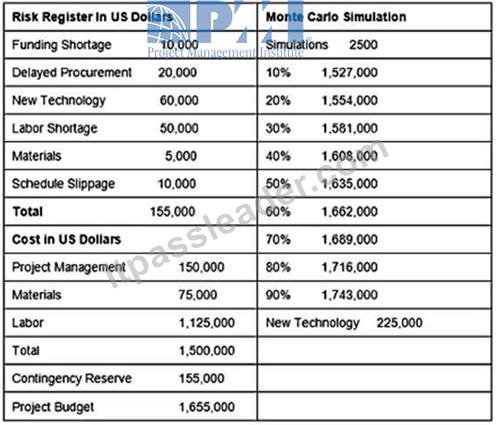
Given the output from the Monte Carlo simulation, what is the probability of a successful completion within the project budget?
- A. 30% probability of meeting project budget
- B. 60% probability of meeting project budget
- C. 46% probability of meeting project budget
- D. 56% probability of meeting project budget
Answer: D
NEW QUESTION # 136
......
Download Free PMI PMI-RMP Real Exam Questions: https://www.itpassleader.com/PMI/PMI-RMP-dumps-pass-exam.html
PMI-RMP Exam Dumps, PMI-RMP Practice Test Questions: https://drive.google.com/open?id=1CiEnf-yjDtoDBw8MG_nWEc7R_zLO7mju