

NSE6_WCS-7.0 PDF Pass Leader, NSE6_WCS-7.0 Latest Real Test
Valid NSE6_WCS-7.0 Test Answers & NSE6_WCS-7.0 Exam PDF
Fortinet NSE6_WCS-7.0 certification exam is designed to test your knowledge and skills in cloud security for Amazon Web Services (AWS). Fortinet NSE 6 - Cloud Security 7.0 for AWS certification is ideal for IT professionals who work with AWS and are responsible for securing cloud-based applications and data. NSE6_WCS-7.0 exam validates your understanding of cloud security concepts, AWS security services, and how to implement security controls to manage risks.
NEW QUESTION # 13
You want to deploy FortiGate for AWS to protect your production network in the cloud. but you do not need the 2417 support available in the enterprise bundle.
Which license model do you choose?
- A. Bring your own device (BYOD)
- B. Bring your own license (BYOL).
- C. Pay as a bundle (PAYB).
- D. pay as you go (PAYG).
Answer: D
NEW QUESTION # 14
An administrator is adding a web application to be protected by FortiWeb Cloud.
Which two steps are necessary to successfully onboard the application? (Choose two.) An administrator is adding a web application to be protected by FortiWeb Cloud.
Which two steps are necessary to successfully onboard the application? (Choose two.)
- A. Create DNS records in the domain server that hosts the application.
- B. Provide a web application name.
- C. Wait for the EC2 instance to be created.
- D. Enable a content delivery network (CDN) in the same region where your application is located.
Answer: A,B
Explanation:
* Web Application Name:
* When onboarding a web application to be protected by FortiWeb Cloud, you need to provide a name for the web application. This helps in identifying and managing the application within the FortiWeb Cloud console (Option B).
* DNS Records:
* To ensure that traffic to your web application is correctly routed through FortiWeb Cloud, you must create DNS records in the domain server that hosts your application. This ensures that requests are directed to FortiWeb Cloud for inspection and protection (Option C).
* Other Considerations:
* Option A (Waiting for the EC2 instance) is incorrect as it is not a necessary step for onboarding a web application to FortiWeb Cloud.
* Option D (Enabling a CDN) is not a mandatory step for onboarding but can be part of a broader strategy for improving performance and protection.
References:
* FortiWeb Cloud Documentation: FortiWeb Cloud
NEW QUESTION # 15
A global organization with cloud networks deployed in several AWS regions wants to set up next-generation firewall (NGFW) protection using FortiGate Cloud-Native Firewall (CNF).
What are two deployment considerations for the organization? (Choose two.)
- A. More than one AWS account can be associated with a CNF instance.
- B. A CNF instance is required for each AWS region that must be protected.
- C. Only one CNF instance is required to protect all AWS regions.
- D. They must choose AWS Firewall Manager to provision a CNF instance.
Answer: A,B
NEW QUESTION # 16
Refer to the exhibit.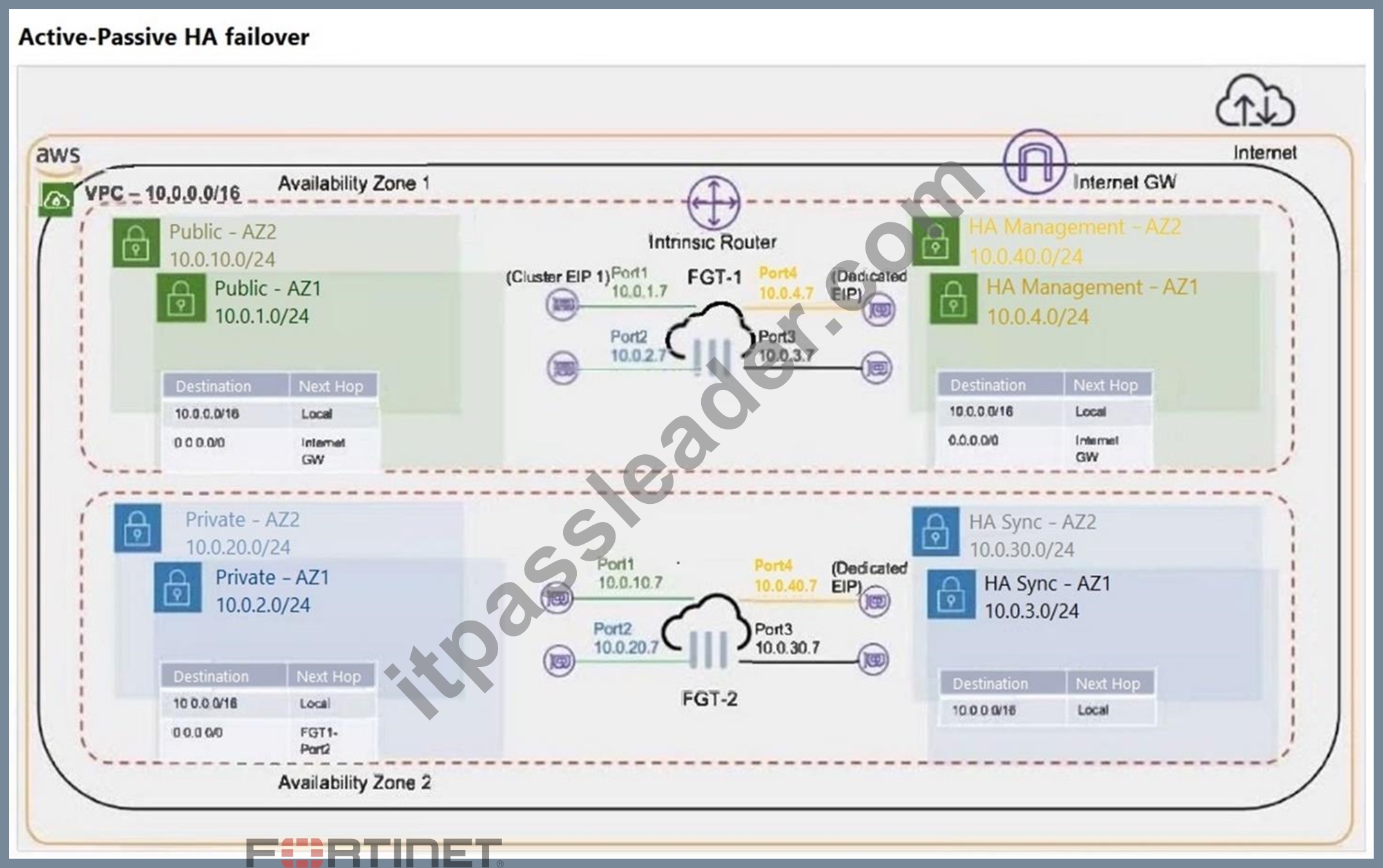
What occurs during a failover for an active-passive (A-P) cluster that is deployed in two different availability zones? (Choose two.)
- A. The secondary IP address of Port2 of FGT-1 is moved to Port2 of FGT-2.
- B. The cluster elastic IP address (EIP) is moved from Port1 of FGT-1 to Port1 of FGT-2.
- C. An additional route is added to the route table of the HA Sync AZ2 subnet to forward all traffic to the Internet GW.
- D. The default static route in the Private-AZ1 subnet route table is modified to forward all traffic to Port2 of FGT2.
Answer: A,B
Explanation:
* Cluster Elastic IP Address (EIP) Movement:
* During a failover in an active-passive (A-P) cluster, the Elastic IP (EIP) associated with the active FortiGate instance (FGT-1) needs to be moved to the passive instance (FGT-2), which becomes the new active instance. This ensures that the traffic directed to the EIP is now handled by FGT-2 (Option A).
* Secondary IP Address Movement:
* The secondary IP address on Port2 of the current active instance (FGT-1) is moved to the same port on the new active instance (FGT-2). This step is crucial to ensure seamless network traffic redirection and connectivity for the services relying on that IP address (Option B).
* Other Options Analysis:
* Option C is incorrect because the static route modification mentioned is not directly related to the failover process described.
* Option D is incorrect because no additional route needs to be added to the HA Sync AZ2 subnet route table to forward traffic to the Internet Gateway during a failover.
References:
* FortiGate HA Configuration Guide: FortiGate HA
* AWS Elastic IP Documentation: Elastic IP
NEW QUESTION # 17
Refer to the exhibit.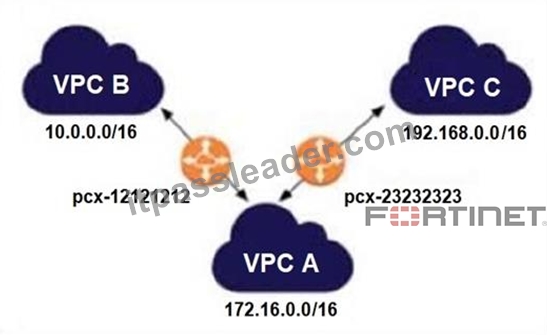
Which statement is correct about the VPC peering connections shown in the exhibit?
- A. You cannot route packets directly from VPC B to VPC C through VPC A.
- B. To route packets directly from VPC B to VPC C through VPC A, you must add a route for network
192.168.0.0/16 in the VPC A routing table. - C. You can associate VPC ID pcx-23232323 with VPC B to form a VPC peering connection between VPC B and VPC C.
- D. You cannot create a separate VPC peering connection between VPC B and VPC C to route packets directly.
Answer: A
Explanation:
* Understanding VPC Peering:
* VPC peering connections allow instances in one VPC to communicate with instances in another VPC. Peering is a one-to-one relationship between two VPCs.
* Transit Routing Limitation:
* AWS VPC peering connections do not support transitive peering. This means that a packet originating in VPC B cannot be routed through VPC A to reach VPC C. Each pair of VPCs must have its own peering connection.
* Routing Table Configuration:
* Even if you add a route in the VPC A routing table for the 192.168.0.0/16 network, it won't allow VPC B to communicate with VPC C because of the non-transitive nature of VPC peering.
* Comparison with Other Options:
* Option A is incorrect because adding a route in VPC A does not overcome the limitation of non- transitive peering.
* Option C is incorrect because associating pcx-23232323 with VPC B is not how VPC peering works.
* Option D is incorrect because you can create a separate peering connection between VPC B and VPC C, which is the required approach for communication between these VPCs.
References:
* AWS VPC Peering Guide: VPC Peering
* Limitations of VPC Peering: AWS VPC Peering Limitations
NEW QUESTION # 18
Refer to the exhibit.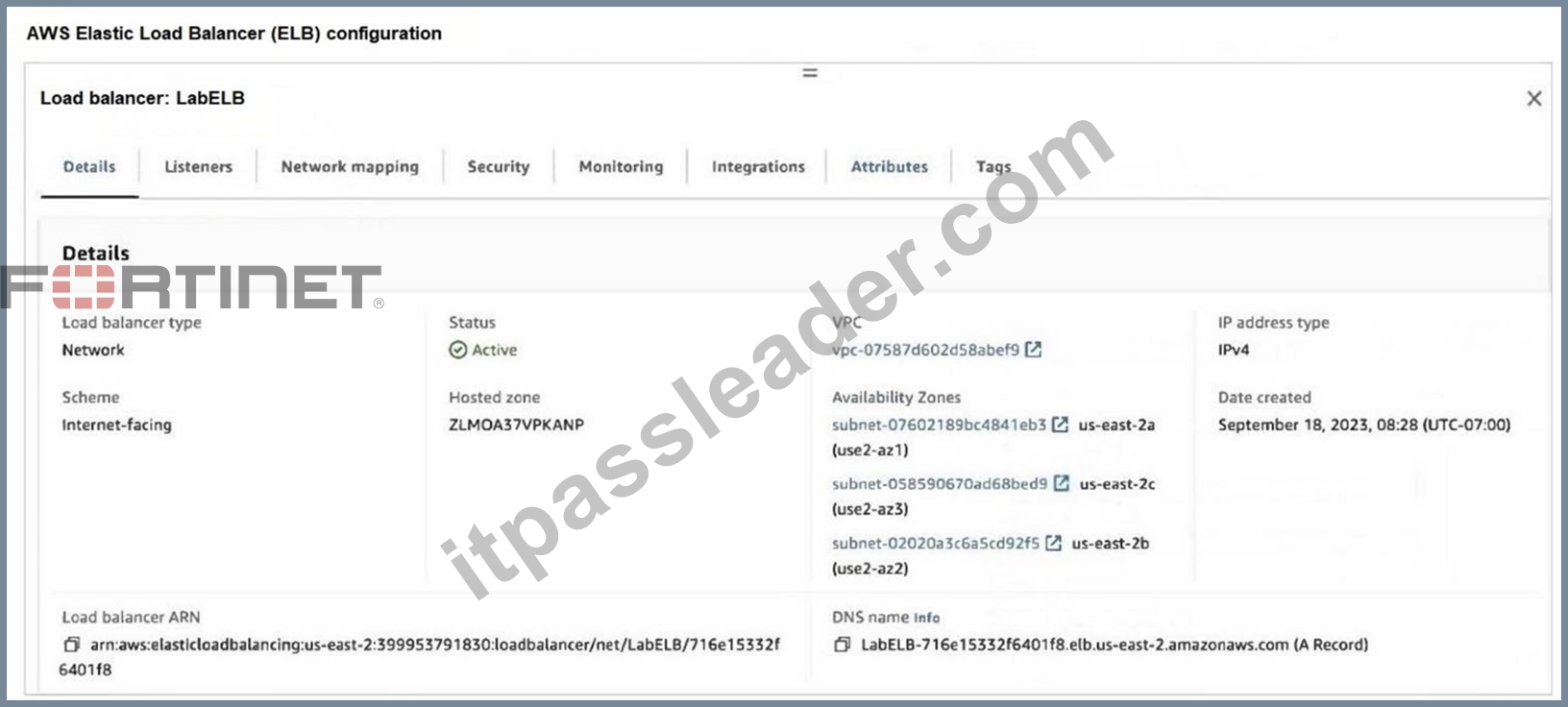
A customer is using the AWS Elastic Load Balancer (ELB).
Which two statements are correct about the ELB configuration? (Choose two.)
- A. The load balancer is configured for the internal traffic of the virtual public cloud (VPC).
- B. The Amazon Resource Name is used to access the load balancer node and targets.
- C. You can use the DNS name to reach the targets behind the ELB.
- D. The load balancer is configured to load balance traffic among multiple availability zones.
Answer: C,D
Explanation:
* Load Balancer Configuration Overview:
* The provided configuration indicates that the ELB is an internet-facing load balancer.
* Multi-AZ Load Balancing:
* The load balancer is configured to distribute traffic across multiple availability zones (A, B, and C), ensuring high availability and fault tolerance (Option A).
* Accessing Targets via DNS:
* The DNS name of the load balancer (LabELB-716e15332f6401f8.elb.us-east-2.amazonaws.com) can be used to reach the targets behind the ELB, facilitating traffic routing to the appropriate instances (Option C).
* Comparison with Other Options:
* Option B is incorrect as the ARN is not used to access the load balancer directly.
* Option D is incorrect because the load balancer is configured for internet-facing traffic, not just internal VPC traffic.
References:
* AWS Elastic Load Balancer Documentation: AWS ELB
* Understanding ELB DNS: AWS ELB DNS
NEW QUESTION # 19
You connected to the AWS Management Console at 10:00 AM and verified that there are two FortiGate VMS running, You receive a call from a user reporting about a temporary slow Internet connection that lasted only a few minutes. When you go back to the AWS portal. you notice there are now two additional FortiGate VMS that you did not create. Later that day, the number of VMS returns to two without your intervention. A similar situation occurs several times during the week.
What is the most likely reason for this to happen?
- A. The AWS portal is not refreshed automatically. and another administrator is creating and removing the VMS as needed.
- B. The VMS are in an availability group with dynamic membership.
- C. Autoscaling is configured to act as described in the scenario.
- D. The user ran a script to create the extra VMS to get faster connectivity.
Answer: C
NEW QUESTION # 20
A customer has implemented GWLB between the partner and application VPCs. FortiGate appliances are deployed in the partner VPC with multiple AZs to inspect traffic transparently.
Which two things will happen to application traffic based on the GWLB deployment? (Choose two.)
- A. Inbound and outbound traffic will go to multiple devices, which will perform load balancing.
- B. Inbound and outbound traffic will go to the same device, which will perform stateful processing.
- C. The original traffic exchanged between the GWLB and FortiGate will be hashed for data integrity.
- D. The content of the original traffic exchanged between the GWLB and FortiGate will be preserved.
Answer: A,B
Explanation:
* Understanding Gateway Load Balancer (GWLB):
* GWLB is designed to distribute traffic across multiple appliances for both inbound and outbound traffic, providing scalability and high availability.
* Traffic Load Balancing:
* GWLB can send traffic to multiple FortiGate appliances for load balancing purposes, ensuring efficient use of resources (Option A).
* Stateful Processing:
* For stateful processing, GWLB ensures that traffic flows (both inbound and outbound) for a given connection are directed to the same FortiGate appliance. This maintains session integrity (Option B).
* Preservation and Hashing of Traffic:
* Options C and D are incorrect as they suggest incorrect behavior regarding traffic content preservation and hashing for data integrity, which are not primary functions of GWLB.
References:
* AWS Gateway Load Balancer Documentation: AWS Gateway Load Balancer
* FortiGate Integration with GWLB: Fortinet Documentation
NEW QUESTION # 21
Which three Fortinet products are available in Amazon Web Services in both on-demand and bring your own license (BYOL) formats? (Choose three.)
- A. FortiSOAR
- B. FortiADC
- C. FortiSlEM
- D. FortiWeb
- E. FortiGate
Answer: B,D,E
NEW QUESTION # 22
An MSSP deployed 16 FortiGate VMS With the default AWS security groups and network access lists using an on-demand license from Amazon Web Services (AWS) Marketplace. They are using a third- party configuration backup application to back up and track changes for the FortiGate configurations. It can connect to the FortiGatedevices using only the SSH protocol, A customer is using the correct username and password configured on the FortiGate devices. but they are unable to log in using the SSH protocol.
What can be the reason Why this authentication is failing?
- A. AWS uses non-standard SSH port1025, and the default AWS security groups and NACL for FortiGate are not configured for the port.
- B. The AWS key is required to log in to FortiGate using SSH
- C. The default AWS network access list for FortiGate does not allow SSH.
- D. The default AWS Security group for FortiGate does not allow SSH.
Answer: B
NEW QUESTION # 23
Your company deployed a FortiSandb0X for AWS.
Which statement is correct about FortiSandbox for AWS?
- A. FortiSandbox for AWS comes as hybrid solution. The FortiSandb0X manager is installed on-premises and analyzes the results Of the sandboxing process received from AWS EC2 instances
- B. FortiSandbox for AWS does not need more resources because it performs only management and analysis tasks.
- C. The FortiSandbox manager is installed on AWS platform and analyzes the results of the sandboxing process received from on-premises Windows instances.
- D. FortiSandbox deploys new EC2 instances with the custom Windows and Linux VMS, then it sends malware, runs it, and captures the results for analysis.
Answer: B
NEW QUESTION # 24
You want to deploy the Fortinet HA cloud formation template to stage and bootstrap the FortiGate configuration in the same that you created your VPC, Which is Ohio US-East-2.
Based on this information, which statement is correct?
- A. You must create an S3 bucket to stage and bootstrap FortiGate with an FGCP unicast configuration in any region.
- B. You must create an S3 bucket to stage and bootstrap FortiGate with an FGCP unicast configuration in the Ohio US-East-2 region.
- C. You must create an S3 bucket to stage and bootstrap FortiGate with an FGCP multicast configuration in the Ohio US-East-2 region.
- D. The Fortinet HA cloud formation template automatically creates an S3 bucket.
Answer: D
NEW QUESTION # 25
Refer to the exhibit.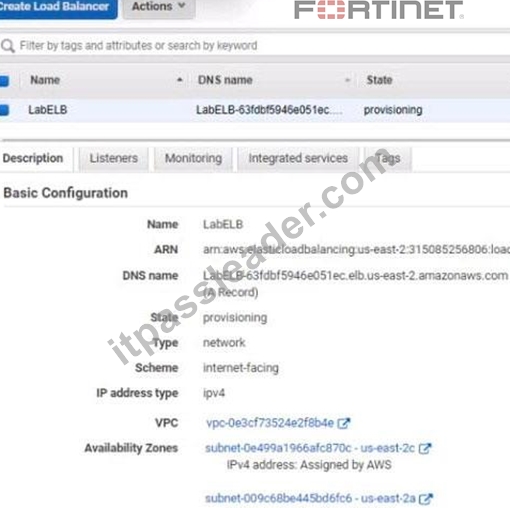
A customer is using the AWS Elastic Load Balancer.
Which two statements are correct about the Elastic LoadBalancer configuration? (Choose two.)
- A. The DNS name is used to access devices.
- B. The load balancer is configured to load balance traffic between devices in two AZS.
- C. The load balancer is configuredfor the internal traffic oftheVPC
- D. The Amazon resource name is used to access the load balancer node and targets.
Answer: A,B
NEW QUESTION # 26
Which product you Can use as AWS WAF web access control lists (web ACLS) to minimize the effects Of a DDOS attack?
- A. AWS Inspector
- B. AWS Shield
- C. AWS GuardDuty
- D. AWS Protector
Answer: B
NEW QUESTION # 27
Refer to the exhibit.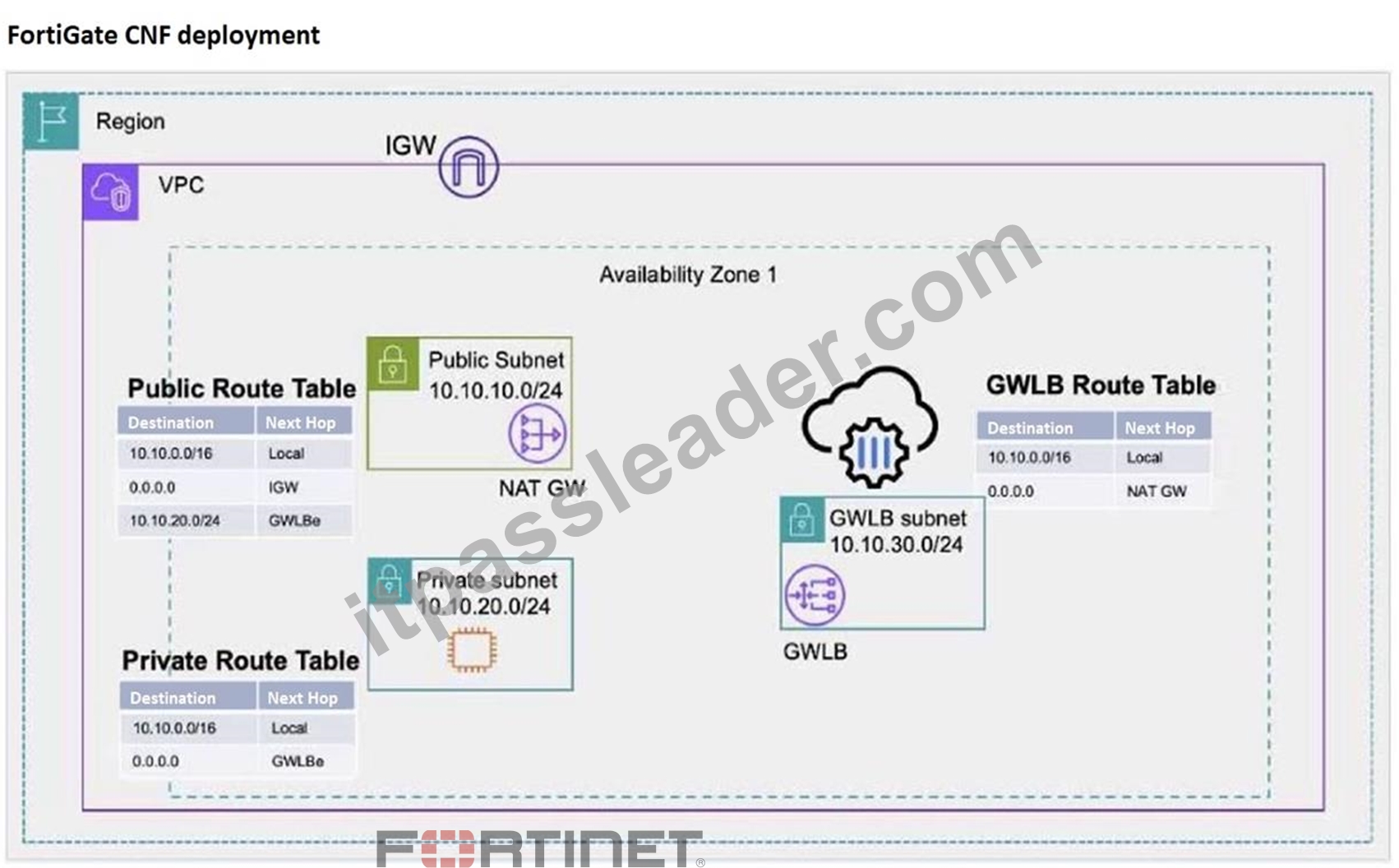
Traffic is initiated from the EC2 instance and is destined for the internet.
Which traffic flow is correct?
- A. EC2 instance > GWLBe > internet
- B. EC2 instance > NAT GW > IGW > internet
- C. There is no route to the internet in the Private Route Table. The traffic does not reach the internet.
- D. EC2 instance > GWLBe > NAT GW > IGW > internet
Answer: D
Explanation:
* Understanding the Architecture:
* The architecture includes an EC2 instance in a private subnet, a Gateway Load Balancer Endpoint (GWLBe), a NAT Gateway (NAT GW), and an Internet Gateway (IGW).
* Route Tables and Routing:
* The private route table for the subnet containing the EC2 instance has a route pointing to the GWLBe for internet-bound traffic.
* The public route table for the subnet containing the NAT Gateway has routes to the IGW.
* Traffic Flow Analysis:
* Traffic initiated from the EC2 instance destined for the internet will first be routed to the GWLBe as per the private route table.
* The GWLBe will forward the traffic to the NAT Gateway.
* The NAT Gateway will then route the traffic to the IGW, which finally sends the traffic to the internet.
* Comparison with Other Options:
* Option A suggests direct routing to the NAT GW from the EC2 instance, which is incorrect.
* Option B incorrectly states there is no route to the internet in the private route table.
* Option D suggests direct routing from GWLBe to the internet, which is not the case.
References:
* AWS Documentation on Route Tables: AWS Route Tables
* Gateway Load Balancer Overview: AWS Gateway Load Balancer
NEW QUESTION # 28
You need to deploy a new Windows server in AWS to offload web traffic from an existing web server in a different availability zone.
According to the AWS shared responsibility model, what three actions must you take to secure the new EC2 instance? (Choose three.)
- A. Change the existing elastic load balancer (ELB) to a gateway load balancer
- B. Move all web servers into the same availability zone.
- C. Update software on the instance.
- D. Manage the operating system on the instance.
- E. Configure security groups.
Answer: C,D,E
Explanation:
* Update Software:
* As part of the AWS shared responsibility model, it is the customer's responsibility to update and maintain the software running on the EC2 instance, including applying security patches and updates (Option A).
* Configure Security Groups:
* Security groups act as virtual firewalls for instances to control inbound and outbound traffic.
Configuring them correctly is essential for securing the EC2 instance and ensuring only legitimate traffic can reach the server (Option C).
* Manage Operating System:
* Managing the operating system, including user accounts, permissions, and operating system patches, is the responsibility of the customer under the shared responsibility model (Option D).
* Other Options Analysis:
* Option B is incorrect as changing the existing ELB to a gateway load balancer is not necessary for securing the new EC2 instance.
* Option E is incorrect because it is not required to move all web servers into the same availability zone for security purposes.
References:
* AWS Shared Responsibility Model: AWS Shared Responsibility
* EC2 Security Best Practices: AWS EC2 Security
NEW QUESTION # 29
......
Fortinet NSE6_WCS-7.0 exam is part of the Fortinet Network Security Expert (NSE) program, which is a comprehensive training and certification program that helps IT professionals gain advanced knowledge and skills in network security. The program is divided into several levels, with the NSE6 level focusing specifically on cloud security.
NSE6_WCS-7.0 Dumps Ensure Your Passing: https://www.itpassleader.com/Fortinet/NSE6_WCS-7.0-dumps-pass-exam.html