

100% Passing Guarantee - Brilliant Databricks-Machine-Learning-Associate Exam Questions PDF [Dec-2024]
Databricks-Machine-Learning-Associate Dumps 2024 - NewDatabricks Databricks-Machine-Learning-Associate Exam Questions
Databricks Databricks-Machine-Learning-Associate Exam Syllabus Topics:
| Topic | Details |
|---|---|
| Topic 1 |
|
| Topic 2 |
|
| Topic 3 |
|
| Topic 4 |
|
NEW QUESTION # 35
Which of the following approaches can be used to view the notebook that was run to create an MLflow run?
- A. Click the "Source" link in the row corresponding to the run in the MLflow experiment page
- B. Open the MLmodel artifact in the MLflow run paqe
- C. Click the "Start Time" link in the row corresponding to the run in the MLflow experiment page
- D. Click the "Models" link in the row corresponding to the run in the MLflow experiment paqe
Answer: A
Explanation:
To view the notebook that was run to create an MLflow run, you can click the "Source" link in the row corresponding to the run in the MLflow experiment page. The "Source" link provides a direct reference to the source notebook or script that initiated the run, allowing you to review the code and methodology used in the experiment. This feature is particularly useful for reproducibility and for understanding the context of the experiment.
Reference:
MLflow Documentation (Viewing Run Sources and Notebooks).
NEW QUESTION # 36
A data scientist has written a data cleaning notebook that utilizes the pandas library, but their colleague has suggested that they refactor their notebook to scale with big data.
Which of the following approaches can the data scientist take to spend the least amount of time refactoring their notebook to scale with big data?
- A. They can refactor their notebook to use the PySpark DataFrame API.
- B. They can refactor their notebook to utilize the pandas API on Spark.
- C. They can refactor their notebook to use the Scala Dataset API.
- D. They can refactor their notebook to use Spark SQL.
- E. They can refactor their notebook to process the data in parallel.
Answer: B
Explanation:
The data scientist can refactor their notebook to utilize the pandas API on Spark (now known as pandas on Spark, formerly Koalas). This allows for the least amount of changes to the existing pandas-based code while scaling to handle big data using Spark's distributed computing capabilities. pandas on Spark provides a similar API to pandas, making the transition smoother and faster compared to completely rewriting the code to use PySpark DataFrame API, Scala Dataset API, or Spark SQL.
Reference:
Databricks documentation on pandas API on Spark (formerly Koalas).
NEW QUESTION # 37
An organization is developing a feature repository and is electing to one-hot encode all categorical feature variables. A data scientist suggests that the categorical feature variables should not be one-hot encoded within the feature repository.
Which of the following explanations justifies this suggestion?
- A. One-hot encoding is not supported by most machine learning libraries.
- B. One-hot encoding is computationally intensive and should only be performed on small samples of training sets for individual machine learning problems.
- C. One-hot encoding is dependent on the target variable's values which differ for each application.
- D. One-hot encoding is a potentially problematic categorical variable strategy for some machine learning algorithms.
- E. One-hot encoding is not a common strategy for representing categorical feature variables numerically.
Answer: D
Explanation:
One-hot encoding transforms categorical variables into a format that can be provided to machine learning algorithms to better predict the output. However, when done prematurely or universally within a feature repository, it can be problematic:
Dimensionality Increase: One-hot encoding significantly increases the feature space, especially with high cardinality features, which can lead to high memory consumption and slower computation.
Model Specificity: Some models handle categorical variables natively (like decision trees and boosting algorithms), and premature one-hot encoding can lead to inefficiency and loss of information (e.g., ordinal relationships).
Sparse Matrix Issue: It often results in a sparse matrix where most values are zero, which can be inefficient in both storage and computation for some algorithms.
Generalization vs. Specificity: Encoding should ideally be tailored to specific models and use cases rather than applied generally in a feature repository.
Reference
"Feature Engineering and Selection: A Practical Approach for Predictive Models" by Max Kuhn and Kjell Johnson (CRC Press, 2019).
NEW QUESTION # 38
A data scientist has developed a machine learning pipeline with a static input data set using Spark ML, but the pipeline is taking too long to process. They increase the number of workers in the cluster to get the pipeline to run more efficiently. They notice that the number of rows in the training set after reconfiguring the cluster is different from the number of rows in the training set prior to reconfiguring the cluster.
Which of the following approaches will guarantee a reproducible training and test set for each model?
- A. Manually partition the input data
- B. Manually configure the cluster
- C. Set a speed in the data splitting operation
- D. Write out the split data sets to persistent storage
Answer: D
Explanation:
To ensure reproducible training and test sets, writing the split data sets to persistent storage is a reliable approach. This allows you to consistently load the same training and test data for each model run, regardless of cluster reconfiguration or other changes in the environment.
Correct approach:
Split the data.
Write the split data to persistent storage (e.g., HDFS, S3).
Load the data from storage for each model training session.
train_df, test_df = spark_df.randomSplit([0.8, 0.2], seed=42) train_df.write.parquet("path/to/train_df.parquet") test_df.write.parquet("path/to/test_df.parquet") # Later, load the data train_df = spark.read.parquet("path/to/train_df.parquet") test_df = spark.read.parquet("path/to/test_df.parquet") Reference:
Spark DataFrameWriter Documentation
NEW QUESTION # 39
A machine learning engineer wants to parallelize the inference of group-specific models using the Pandas Function API. They have developed the apply_model function that will look up and load the correct model for each group, and they want to apply it to each group of DataFrame df.
They have written the following incomplete code block:
Which piece of code can be used to fill in the above blank to complete the task?
- A. mapInPandas
- B. predict
- C. applyInPandas
- D. groupedApplyInPandas
Answer: C
Explanation:
To parallelize the inference of group-specific models using the Pandas Function API in PySpark, you can use the applyInPandas function. This function allows you to apply a Python function on each group of a DataFrame and return a DataFrame, leveraging the power of pandas UDFs (user-defined functions) for better performance.
prediction_df = ( df.groupby("device_id") .applyInPandas(apply_model, schema=apply_return_schema) ) In this code:
groupby("device_id"): Groups the DataFrame by the "device_id" column.
applyInPandas(apply_model, schema=apply_return_schema): Applies the apply_model function to each group and specifies the schema of the return DataFrame.
Reference:
PySpark Pandas UDFs Documentation
NEW QUESTION # 40
A machine learning engineer is using the following code block to scale the inference of a single-node model on a Spark DataFrame with one million records: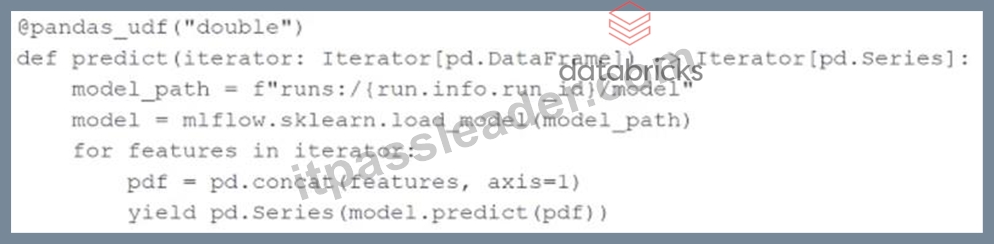
Assuming the default Spark configuration is in place, which of the following is a benefit of using an Iterator?
- A. The data will be distributed across multiple executors during the inference process
- B. The data will be limited to a single executor preventing the model from being loaded multiple times
- C. The model will be limited to a single executor preventing the data from being distributed
- D. The model only needs to be loaded once per executor rather than once per batch during the inference process
Answer: D
Explanation:
Using an iterator in the pandas_udf ensures that the model only needs to be loaded once per executor rather than once per batch. This approach reduces the overhead associated with repeatedly loading the model during the inference process, leading to more efficient and faster predictions. The data will be distributed across multiple executors, but each executor will load the model only once, optimizing the inference process.
Reference:
Databricks documentation on pandas UDFs: Pandas UDFs
NEW QUESTION # 41
A data scientist wants to efficiently tune the hyperparameters of a scikit-learn model in parallel. They elect to use the Hyperopt library to facilitate this process.
Which of the following Hyperopt tools provides the ability to optimize hyperparameters in parallel?
- A. search_space
- B. SparkTrials
- C. fmin
- D. objective_function
- E. quniform
Answer: B
Explanation:
The SparkTrials class in the Hyperopt library allows for parallel hyperparameter optimization on a Spark cluster. This enables efficient tuning of hyperparameters by distributing the optimization process across multiple nodes in a cluster.
from hyperopt import fmin, tpe, hp, SparkTrials search_space = { 'x': hp.uniform('x', 0, 1), 'y': hp.uniform('y', 0, 1) } def objective(params): return params['x'] ** 2 + params['y'] ** 2 spark_trials = SparkTrials(parallelism=4) best = fmin(fn=objective, space=search_space, algo=tpe.suggest, max_evals=100, trials=spark_trials) Reference:
Hyperopt Documentation
NEW QUESTION # 42
Which of the following is a benefit of using vectorized pandas UDFs instead of standard PySpark UDFs?
- A. The vectorized pandas UDFs work on distributed DataFrames
- B. The vectorized pandas UDFs allow for the use of type hints
- C. The vectorized pandas UDFs allow for pandas API use inside of the function
- D. The vectorized pandas UDFs process data in batches rather than one row at a time
- E. The vectorized pandas UDFs process data in memory rather than spilling to disk
Answer: D
Explanation:
Vectorized pandas UDFs, also known as Pandas UDFs, are a powerful feature in PySpark that allows for more efficient operations than standard UDFs. They operate by processing data in batches, utilizing vectorized operations that leverage pandas to perform operations on whole batches of data at once. This approach is much more efficient than processing data row by row as is typical with standard PySpark UDFs, which can significantly speed up the computation.
Reference
PySpark Documentation on UDFs: https://spark.apache.org/docs/latest/api/python/user_guide/sql/arrow_pandas.html#pandas-udfs-a-k-a-vectorized-udfs
NEW QUESTION # 43
A data scientist has a Spark DataFrame spark_df. They want to create a new Spark DataFrame that contains only the rows from spark_df where the value in column price is greater than 0.
Which of the following code blocks will accomplish this task?
- A. spark_df[spark_df["price"] > 0]
- B. spark_df.filter(col("price") > 0)
- C. spark_df.loc[spark_df["price"] > 0,:]
- D. spark_df.loc[:,spark_df["price"] > 0]
- E. SELECT * FROM spark_df WHERE price > 0
Answer: B
Explanation:
To filter rows in a Spark DataFrame based on a condition, you use the filter method along with a column condition. The correct syntax in PySpark to accomplish this task is spark_df.filter(col("price") > 0), which filters the DataFrame to include only those rows where the value in the "price" column is greater than 0. The col function is used to specify column-based operations. The other options provided either do not use correct Spark DataFrame syntax or are intended for different types of data manipulation frameworks like pandas.
Reference:
PySpark DataFrame API documentation (Filtering DataFrames).
NEW QUESTION # 44
A health organization is developing a classification model to determine whether or not a patient currently has a specific type of infection. The organization's leaders want to maximize the number of positive cases identified by the model.
Which of the following classification metrics should be used to evaluate the model?
- A. Area under the residual operating curve
- B. Accuracy
- C. RMSE
- D. Recall
- E. Precision
Answer: D
Explanation:
When the goal is to maximize the identification of positive cases in a classification task, the metric of interest is Recall. Recall, also known as sensitivity, measures the proportion of actual positives that are correctly identified by the model (i.e., the true positive rate). It is crucial for scenarios where missing a positive case (false negative) has serious implications, such as in medical diagnostics. The other metrics like Precision, RMSE, and Accuracy serve different aspects of performance measurement and are not specifically focused on maximizing the detection of positive cases alone.
Reference:
Classification Metrics in Machine Learning (Understanding Recall).
NEW QUESTION # 45
A machine learning engineer wants to parallelize the training of group-specific models using the Pandas Function API. They have developed the train_model function, and they want to apply it to each group of DataFrame df.
They have written the following incomplete code block: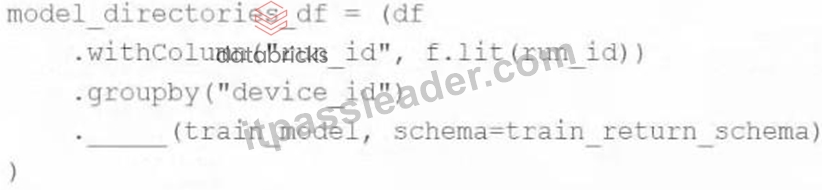
Which of the following pieces of code can be used to fill in the above blank to complete the task?
- A. predict
- B. train_model
- C. applyInPandas
- D. mapInPandas
- E. groupedApplyIn
Answer: D
Explanation:
The function mapInPandas in the PySpark DataFrame API allows for applying a function to each partition of the DataFrame. When working with grouped data, groupby followed by applyInPandas is the correct approach to apply a function to each group as a separate Pandas DataFrame. However, if the function should apply across each partition of the grouped data rather than on each individual group, mapInPandas would be utilized. Since the code snippet indicates the use of groupby, the intent seems to be to apply train_model on each group specifically, which aligns with applyInPandas. Thus, applyInPandas is a better fit to ensure that each group generated by groupby is processed through the train_model function, preserving the partitioning and grouping integrity.
Reference
PySpark Documentation on applying functions to grouped data: https://spark.apache.org/docs/latest/api/python/reference/api/pyspark.sql.GroupedData.applyInPandas.html
NEW QUESTION # 46
A data scientist has written a feature engineering notebook that utilizes the pandas library. As the size of the data processed by the notebook increases, the notebook's runtime is drastically increasing, but it is processing slowly as the size of the data included in the process increases.
Which of the following tools can the data scientist use to spend the least amount of time refactoring their notebook to scale with big data?
- A. Spark SQL
- B. Feature Store
- C. PySpark DataFrame API
- D. pandas API on Spark
Answer: D
Explanation:
The pandas API on Spark provides a way to scale pandas operations to big data while minimizing the need for refactoring existing pandas code. It allows users to run pandas operations on Spark DataFrames, leveraging Spark's distributed computing capabilities to handle large datasets more efficiently. This approach requires minimal changes to the existing code, making it a convenient option for scaling pandas-based feature engineering notebooks.
Reference:
Databricks documentation on pandas API on Spark: pandas API on Spark
NEW QUESTION # 47
A data scientist has created a linear regression model that uses log(price) as a label variable. Using this model, they have performed inference and the predictions and actual label values are in Spark DataFrame preds_df.
They are using the following code block to evaluate the model:
regression_evaluator.setMetricName("rmse").evaluate(preds_df)
Which of the following changes should the data scientist make to evaluate the RMSE in a way that is comparable with price?
- A. They should evaluate the MSE of the log predictions to compute the RMSE
- B. They should exponentiate the computed RMSE value
- C. They should take the log of the predictions before computing the RMSE
- D. They should exponentiate the predictions before computing the RMSE
Answer: D
Explanation:
When evaluating the RMSE for a model that predicts log-transformed prices, the predictions need to be transformed back to the original scale to obtain an RMSE that is comparable with the actual price values. This is done by exponentiating the predictions before computing the RMSE. The RMSE should be computed on the same scale as the original data to provide a meaningful measure of error.
Reference:
Databricks documentation on regression evaluation: Regression Evaluation
NEW QUESTION # 48
A team is developing guidelines on when to use various evaluation metrics for classification problems. The team needs to provide input on when to use the F1 score over accuracy.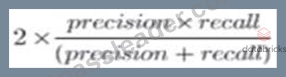
Which of the following suggestions should the team include in their guidelines?
- A. The F1 score should be utilized over accuracy when there is significant imbalance between positive and negative classes and avoiding false negatives is a priority.
- B. The F1 score should be utilized over accuracy when there are greater than two classes in the target variable.
- C. The F1 score should be utilized over accuracy when identifying true positives and true negatives are equally important to the business problem.
- D. The F1 score should be utilized over accuracy when the number of actual positive cases is identical to the number of actual negative cases.
Answer: A
Explanation:
The F1 score is the harmonic mean of precision and recall and is particularly useful in situations where there is a significant imbalance between positive and negative classes. When there is a class imbalance, accuracy can be misleading because a model can achieve high accuracy by simply predicting the majority class. The F1 score, however, provides a better measure of the test's accuracy in terms of both false positives and false negatives.
Specifically, the F1 score should be used over accuracy when:
There is a significant imbalance between positive and negative classes.
Avoiding false negatives is a priority, meaning recall (the ability to detect all positive instances) is crucial.
In this scenario, the F1 score balances both precision (the ability to avoid false positives) and recall, providing a more meaningful measure of a model's performance under these conditions.
Reference:
Databricks documentation on classification metrics: Classification Metrics
NEW QUESTION # 49
A data scientist is developing a machine learning pipeline using AutoML on Databricks Machine Learning.
Which of the following steps will the data scientist need to perform outside of their AutoML experiment?
- A. Model deployment
- B. Model evaluation
- C. Model tuning
- D. Exploratory data analysis
Answer: D
Explanation:
AutoML platforms, such as the one available in Databricks Machine Learning, streamline various stages of the machine learning pipeline including feature engineering, model selection, hyperparameter tuning, and model evaluation. However, exploratory data analysis (EDA) is typically performed outside the AutoML process. EDA involves understanding the dataset, visualizing distributions, identifying anomalies, and gaining insights into data before feeding it into a machine learning pipeline. This step is crucial for ensuring that the data is clean and suitable for model training but is generally done manually by the data scientist.
Reference
Databricks documentation on AutoML: https://docs.databricks.com/applications/machine-learning/automl.html
NEW QUESTION # 50
The implementation of linear regression in Spark ML first attempts to solve the linear regression problem using matrix decomposition, but this method does not scale well to large datasets with a large number of variables.
Which of the following approaches does Spark ML use to distribute the training of a linear regression model for large data?
- A. Singular value decomposition
- B. Logistic regression
- C. Iterative optimization
- D. Least-squares method
Answer: C
Explanation:
For large datasets, Spark ML uses iterative optimization methods to distribute the training of a linear regression model. Specifically, Spark MLlib employs techniques like Stochastic Gradient Descent (SGD) and Limited-memory Broyden-Fletcher-Goldfarb-Shanno (L-BFGS) optimization to iteratively update the model parameters. These methods are well-suited for distributed computing environments because they can handle large-scale data efficiently by processing mini-batches of data and updating the model incrementally.
Reference:
Databricks documentation on linear regression: Linear Regression in Spark ML
NEW QUESTION # 51
A data scientist is using Spark SQL to import their data into a machine learning pipeline. Once the data is imported, the data scientist performs machine learning tasks using Spark ML.
Which of the following compute tools is best suited for this use case?
- A. SQL Warehouse
- B. Standard cluster
- C. None of these compute tools support this task
- D. Single Node cluster
Answer: B
Explanation:
For a data scientist using Spark SQL to import data and then performing machine learning tasks using Spark ML, the best-suited compute tool is a Standard cluster. A Standard cluster in Databricks provides the necessary resources and scalability to handle large datasets and perform distributed computing tasks efficiently, making it ideal for running Spark SQL and Spark ML operations.
Reference:
Databricks documentation on clusters: Clusters in Databricks
NEW QUESTION # 52
A machine learning engineer is converting a decision tree from sklearn to Spark ML. They notice that they are receiving different results despite all of their data and manually specified hyperparameter values being identical.
Which of the following describes a reason that the single-node sklearn decision tree and the Spark ML decision tree can differ?
- A. Spark ML decision trees test a random sample of feature variables in the splitting algorithm
- B. Spark ML decision trees test every feature variable in the splitting algorithm
- C. Spark ML decision trees automatically prune overfit trees
- D. Spark ML decision trees test more split candidates in the splitting algorithm
- E. Spark ML decision trees test binned features values as representative split candidates
Answer: E
Explanation:
One reason that results can differ between sklearn and Spark ML decision trees, despite identical data and hyperparameters, is that Spark ML decision trees test binned feature values as representative split candidates. Spark ML uses a method called "quantile binning" to reduce the number of potential split points by grouping continuous features into bins. This binning process can lead to different splits compared to sklearn, which tests all possible split points directly. This difference in the splitting algorithm can cause variations in the resulting trees.
Reference:
Spark MLlib Documentation (Decision Trees and Quantile Binning).
NEW QUESTION # 53
A machine learning engineer has been notified that a new Staging version of a model registered to the MLflow Model Registry has passed all tests. As a result, the machine learning engineer wants to put this model into production by transitioning it to the Production stage in the Model Registry.
From which of the following pages in Databricks Machine Learning can the machine learning engineer accomplish this task?
- A. The model version page in the MLflow Model Registry
- B. The home page of the MLflow Model Registry
- C. The experiment page in the Experiments observatory
- D. The model page in the MLflow Model Registry
Answer: A
Explanation:
The machine learning engineer can transition a model version to the Production stage in the Model Registry from the model version page. This page provides detailed information about a specific version of a model, including its metrics, parameters, and current stage. From here, the engineer can perform stage transitions, moving the model from Staging to Production after it has passed all necessary tests.
Reference
Databricks documentation on MLflow Model Registry: https://docs.databricks.com/applications/mlflow/model-registry.html#model-version
NEW QUESTION # 54
Which of the following hyperparameter optimization methods automatically makes informed selections of hyperparameter values based on previous trials for each iterative model evaluation?
- A. Random Search
- B. Halving Random Search
- C. Grid Search
- D. Tree of Parzen Estimators
Answer: D
Explanation:
Tree of Parzen Estimators (TPE) is a sequential model-based optimization algorithm that selects hyperparameter values based on the outcomes of previous trials. It models the probability density of good and bad hyperparameter values and makes informed decisions about which hyperparameters to try next.
This approach contrasts with methods like random search and grid search, which do not use information from previous trials to guide the search process.
Reference:
Hyperopt and TPE
NEW QUESTION # 55
......
Free Databricks-Machine-Learning-Associate braindumps download: https://www.itpassleader.com/Databricks/Databricks-Machine-Learning-Associate-dumps-pass-exam.html