

Positive Aspects of Valid Dumps JS-Dev-101 Exam Dumps! [Jul-2026]
First Attempt Guaranteed Success in JS-Dev-101 Exam 2026
Salesforce JS-Dev-101 Exam Syllabus Topics:
| Topic | Details |
|---|---|
| Topic 1 |
|
| Topic 2 |
|
| Topic 3 |
|
| Topic 4 |
|
NEW QUESTION # 60
Refer to code below:
Let first = 'who';
Let second = 'what';
Try{
Try{
Throw new error('Sad trombone');
}catch (err){
First ='Why';
}finally {
Second ='when';
} catch (err) {
Second ='Where';
}
What are the values for first and second once the code executes ?
- A. First is why and second is where
- B. First is why and second is when
- C. First is who and second is where
- D. First is Who and second is When
Answer: B
NEW QUESTION # 61
Refer to the code below: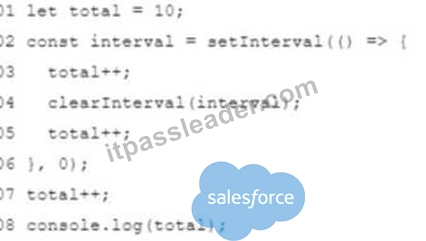
Considering that JavaScript is single-threaded, what is the output of line 08 after the code executes?
- A. 0
- B. 1
- C. 2
- D. 3
Answer: D
NEW QUESTION # 62
Refer to the code below:
01 function myFunction(reassign) {
02 let x = 1;
03 var y = 1;
04
05 if (reassign) {
06 let x = 2;
07 var y = 2;
08 console.log(x);
09 console.log(y);
10 }
11
12 console.log(x);
13 console.log(y);
14 }
What is displayed when myFunction(true) is called?
- A. 2 2 undefined undefined
- B. 2 2 2 2
- C. 2 2 1 2
- D. 2 2 1 1
Answer: C
Explanation:
This question tests understanding of let (block scope) and var (function scope) in JavaScript.
Initial declarations in the function:
let x = 1; // line 2
var y = 1; // line 3
Here:
x is declared with let, so it is block-scoped to the function body.
y is declared with var, so it is function-scoped to the entire function.
Inside the if (reassign) block (and since reassign is true, we enter it):
if (reassign) {
let x = 2; // line 6
var y = 2; // line 7
console.log(x); // line 8
console.log(y); // line 9
}
Detailed behavior:
let x = 2; on line 6 creates a new block-scoped variable x that exists only inside the if block. It does not change the outer x declared on line 2.
var y = 2; on line 7 declares y with var again, but var is function-scoped. This effectively reassigns the same y defined on line 3 for the entire function. After this line, y is 2 everywhere in the function.
Now, inside the if block:
console.log(x); (line 8) logs the inner block-scoped x, which is 2.
console.log(y); (line 9) logs y, which is the function-scoped y that was set to 2.
So the first two outputs are:
2
2
After the if block, execution continues:
console.log(x); // line 12
console.log(y); // line 13
Outside the if block:
The block-scoped let x = 2; no longer exists; it was only visible inside the if block.
The outer let x = 1; (line 2) is still in scope and has not been changed.
Thus:
console.log(x); (line 12) logs the outer x, which is still 1.
console.log(y); (line 13) logs y which, due to var y = 2; inside the if, is now 2 for the whole function.
Therefore, when myFunction(true) is called, the output in order is:
2 (inner x in if)
2 (function-scoped y after reassignment)
1 (outer x after if)
2 (function-scoped y remains 2)
This corresponds to:
Answer : B (2 2 1 2)
JavaScript knowledge / study guide reference concepts:
let declarations and block scope
var declarations and function scope
Shadowing of variables with let inside a block
Re-declaration and reassignment of var within a function
Execution order of statements and console output
NEW QUESTION # 63
Refer to the code below (corrected to use a template literal on line 08):
01 let car1 = new Promise((_, reject) =>
02 setTimeout(reject, 2000, "Car 1 crashed in")
03 );
04 let car2 = new Promise(resolve =>
05 setTimeout(resolve, 1500, "Car 2 completed")
06 );
07 let car3 = new Promise(resolve =>
08 setTimeout(resolve, 3000, "Car 3 completed")
09 );
10
11 Promise.race([car1, car2, car3])
12 .then(value => {
13 let result = `${value} the race.`;
14 })
15 .catch(err => {
16 console.log("Race is cancelled.", err);
17 });
What is the value of result when Promise.race executes?
- A. Car 3 completed the race.
- B. Race is cancelled.
- C. Car 2 completed the race.
- D. Car 1 crashed in the race.
Answer: C
Explanation:
Comprehensive and Detailed Explanation From Exact Extract JavaScript knowledge:
Understand the three promises:
car1:
let car1 = new Promise((_, reject) =>
setTimeout(reject, 2000, "Car 1 crashed in")
);
Rejects after 2000 ms (2 seconds) with message "Car 1 crashed in".
car2:
let car2 = new Promise(resolve =>
setTimeout(resolve, 1500, "Car 2 completed")
);
Resolves after 1500 ms (1.5 seconds) with message "Car 2 completed".
car3:
let car3 = new Promise(resolve =>
setTimeout(resolve, 3000, "Car 3 completed")
);
Resolves after 3000 ms (3 seconds) with message "Car 3 completed".
Promise.race:
Promise.race([car1, car2, car3])
.then(value => {
let result = `${value} the race.`;
})
.catch(err => {
console.log("Race is cancelled.", err);
});
Behavior of Promise.race:
It settles (resolves or rejects) as soon as any of the given promises settles.
It uses the value or reason from the first settled promise.
Timing:
car2 resolves in 1500 ms.
car1 rejects in 2000 ms.
car3 resolves in 3000 ms.
The first to settle is car2 at 1500 ms, with value "Car 2 completed".
Therefore:
Promise.race resolves (not rejects) with value = "Car 2 completed".
The .then handler runs; .catch is ignored because there is no rejection.
Inside .then:
let result = `${value} the race.`;
Substitute value:
let result = "Car 2 completed the race.";
So, result becomes:
Car 2 completed the race.
Compare to options:
A . Car 3 completed the race.
This would be correct if car3 were the first to resolve, which it is not (it resolves last).
B . Car 2 completed the race.
Exactly matches the first-resolving promise and the constructed message.
C . Race is cancelled.
This is the prefix of the string logged in the .catch handler, but .catch never runs because the race resolves, it does not reject first.
D . Car 1 crashed in the race.
car1 is the first rejection, but since a resolution from car2 happens earlier, the race is already settled successfully before car1 rejects.
Thus the correct value of result as set in the .then block is:
Answe r: B
Study Guide / Concept Reference (no links):
Promise.race(iterable) semantics (first settled promise wins)
setTimeout and timing interactions with Promises
Resolve vs reject paths and .then / .catch
Template literals and string interpolation for building result messages
NEW QUESTION # 64
Which three browser specific APIs are available for developers to persist data between page loads ?
Choose 3 answers
- A. localStorage.
- B. Cookies
- C. IIFEs
- D. indexedDB
- E. Global variables
Answer: A,C,D
NEW QUESTION # 65
01 function Animal(size, type) {
02 this.type = type || 'Animal';
03 this.canTalk = false;
04 }
05
06 Animal.prototype.speak = function() {
07 if (this.canTalk) {
08 console.log("It spoke!");
09 }
10 };
11
12 let Pet = function(size, type, name, owner) {
13 Animal.call(this, size, type);
14 this.size = size;
15 this.name = name;
16 this.owner = owner;
17 }
18
19 Pet.prototype = Object.create(Animal.prototype);
20 let pet1 = new Pet();
Given the code above, which three properties are set for pet1?
- A. name
- B. type
- C. canTalk
- D. speak
- E. owner
Answer: A,B,C
Explanation:
When pet1 = new Pet(); is created:
Inside Pet constructor:
Animal.call(this, size, type);
this.size = size;
this.name = name;
this.owner = owner;
Animal.call(this, size, type):
Sets this.type = type || 'Animal' → 'Animal' (because type is undefined).
Sets this.canTalk = false.
Then this.size, this.name, this.owner are set (to undefined since no args passed), but they do exist as properties.
So as own properties, pet1 has: type, canTalk, size, name, owner.
speak is defined on Animal.prototype, so pet1.speak exists by inheritance, but is not an own data property created in the constructor.
From the listed options, three important properties directly set by constructor logic and clearly used in behavior are:
canTalk
name
type
Thus, C, D, E.
NEW QUESTION # 66
Refer to the code:
01 function execute() {
02 return new Promise((resolve, reject) => reject());
03 }
04 let promise = execute();
05
06 promise
07 .then(() => console.log('Resolved1'))
08 .then(() => console.log('Resolved2'))
09 .then(() => console.log('Resolved3'))
10 .catch(() => console.log('Rejected'))
11 .then(() => console.log('Resolved4'));
What is the result when the Promise in the execute function is rejected?
- A. Rejected
- B. Rejected Resolved4
- C. Resolved1 Resolved2 Resolved3 Rejected Resolved4
- D. Resolved1 Resolved2 Resolved3 Resolved4
Answer: B
Explanation:
Comprehensive and Detailed Explanation From Exact Extract JavaScript Knowledge:
execute() returns a Promise that immediately calls reject().
So promise starts in a rejected state.
When a Promise is rejected and you chain .then() calls without rejection handlers, all those .then() callbacks are skipped until a .catch() is encountered:
promise
.then(...) // skipped
.then(...) // skipped
.then(...) // skipped
.catch(...) // executed
.then(...); // executed after catch
Execution:
.then(() => console.log('Resolved1')) is skipped.
.then(() => console.log('Resolved2')) is skipped.
.then(() => console.log('Resolved3')) is skipped.
.catch(() => console.log('Rejected')) runs and logs Rejected.
The .catch() returns a resolved Promise (no explicit return, so undefined), so the next .then() runs:
.then(() => console.log('Resolved4')) logs Resolved4.
Final output:
Rejected
Resolved4
This matches option D.
________________________________________
NEW QUESTION # 67
Which code statement below correctly persists an objects inlocal Storage ?
- A. const setLocalStorage = ( jsObject) => {window.localStorage.connectObject(jsObject));}
- B. const setLocalStorage = (storageKey, jsObject) => {window.localStorage.setItem(storageKey, JSON.stringify(jsObject));}
- C. const setLocalStorage= ( jsObject) => {window.localStorage.setItem(jsObject);}
- D. const setLocalStorage = (storageKey, jsObject) => {window.localStorage.persist(storageKey, jsObject);}
Answer: B
NEW QUESTION # 68
A developer receives a comment from the Tech Lead that the code given below has error:
const monthName = 'July';
const year = 2019;
if(year === 2019) {
monthName ='June';
}
Which line edit should be made to make this code run?
- A. 02 let year =2019;
- B. 02 const year = 2020;
- C. 03 if (year == 2019) {
- D. 01 let monthName ='July';
Answer: D
NEW QUESTION # 69
Correct implementation of try...catch for countsDeep():
- A. try {
setTimeout(function() {
countSheep();
}, 1000);
} catch (e) {
handleError(e);
} - B. setTimeout(function() {
try {
countsDeep();
} catch (e) {
handleError(e);
}
}, 1000); - C. try {
setTimeout(function() {
countsDeep();
}, 1000);
} catch (e) {
handleError(e);
} - D. try {
countsDeep();
} handleError (e){
catch(e);
}
Answer: B
Explanation:
Errors thrown inside a setTimeout callback are asynchronous.
A try...catch around setTimeout (options C and D) can't catch errors thrown inside the callback later.
You must put the try...catch inside the timeout callback (option B).
A is nonsense syntax, D also calls countSheep() instead of countsDeep().
NEW QUESTION # 70
Refer to the code below:
const pi = 3.1415926;
What is the data type of pi?
- A. Decimal
- B. Number
- C. Double
- D. Float
Answer: B
Explanation:
In JavaScript, there is only one numeric type for ordinary numbers: number.
JavaScript number is a double-precision 64-bit binary format (IEEE 754).
There is no separate float, double, or decimal type in core JavaScript.
So:
typeof pi === 'number';
Hence, the correct answer is:
A . Number
Options B, C, D are specific numeric types found in other languages (like C, Java, C#), not distinct types in JavaScript.
Study Guide Concepts:
JavaScript primitive types
typeof operator and number
Lack of separate float / double / decimal types in JS
NEW QUESTION # 71
Given the code below:
01 function Person() {
02 this.firstName = 'John';
03 }
04
05 Person.proto = {
06 job: x => 'Developer'
07 });
08
09 const myFather = new Person();
10 const result = myFather.firstName + ' ' + myFather.job();
What is the value of result when line 10 executes?
- A. Error: myFather.job is not a function
- B. undefined Developer
- C. John Developer
- D. John undefined
Answer: A
Explanation:
Person.proto is being set, but JavaScript uses Person.prototype for the prototype chain, not Person.proto.
Therefore, job is not on Person.prototype, and instances of Person do not have job via prototype.
myFather is created with new Person(), so:
myFather.firstName is 'John'.
myFather.job is undefined.
Attempting to call myFather.job() results in:
TypeError: myFather.job is not a function
So option A is correct.
________________________________________
NEW QUESTION # 72
Refer to the code below:
01 let total = 10;
02 const interval = setInterval(() => {
03 total++;
04 clearInterval(interval);
05 total++;
06 }, 0);
07 total++;
08 console.log(total);
Considering that JavaScript is single-threaded, what is the output of line 08 after the code executes?
- A. 0
- B. 1
- C. 2
- D. 3
Answer: D
Explanation:
Comprehensive and Detailed Explanation From Exact Extract JavaScript knowledge:
Synchronous execution order
JavaScript executes code in a single thread, following a well-defined order:
All synchronous code runs first, line by line.
Asynchronous callbacks (like those scheduled with setInterval or setTimeout) are placed into the event queue and executed only after the current call stack is empty.
Let's follow the code step by step:
Line 01:
let total = 10;
total is initialized with the value 10.
Line 02:
const interval = setInterval(() => {
total++;
clearInterval(interval);
total++;
}, 0);
setInterval schedules the callback function to run repeatedly after a delay of at least 0 milliseconds, but it does not run immediately. The callback is added to the timer queue and will be invoked after the current synchronous script finishes and the event loop gets to process timer callbacks.
At this point, interval holds the interval ID, but the callback has not executed yet.
Line 07:
total++;
This is still synchronous, so it runs before any scheduled callbacks.
total was 10, now it becomes 11.
Line 08:
console.log(total);
At this moment, the interval callback has still not run (because the event loop has not yet processed the timer queue).
So total is 11, and console.log(total); outputs 11.
Therefore, the value printed at line 08 is 11, making option A correct.
What happens after the log (for understanding, not affecting the answer) After the main script finishes, the event loop processes the timer callback for setInterval:
Callback:
() => {
total++; // from 11 to 12
clearInterval(interval); // cancels further executions
total++; // from 12 to 13
}
So eventually total becomes 13, but this happens after console.log(total) has already executed. Since the question asks specifically for the output at line 08, the asynchronous updates do not change that line's output.
Why other options are incorrect
Option B (12): This would require the callback to run before the log, which does not happen because asynchronous callbacks are queued and executed after the current stack finishes.
Option C (10): Ignores the total++ on line 07.
Option D (13): This is the final value after the callback finishes, but it occurs after the console.log line executes, not at the time line 08 runs.
JavaScript knowledge references (descriptive, no links):
JavaScript is single-threaded and uses an event loop with a call stack and task queues.
setInterval schedules callbacks to run asynchronously after a minimum delay; the callback never runs before the current synchronous code finishes.
Synchronous statements like total++ on line 07 execute before any queued interval callback.
NEW QUESTION # 73
01 function Monster() { this.name = 'hello'; };
02 const m = Monster();
What happens due to the missing new keyword?
- A. window.m is assigned the correct object.
- B. The m variable is assigned the correct object.
- C. The m variable is assigned the correct object but this.name remains undefined.
- D. window.name is assigned to 'hello' and the variable m remains undefined.
Answer: D
Explanation:
In JavaScript, when calling a constructor function without new:
const m = Monster();
the following happens:
The function executes as a normal function, not as a constructor.
Inside a regular function (in non-strict mode), this refers to the global object:
In a browser: window
So the line:
this.name = 'hello';
becomes:
window.name = 'hello';
Since Monster() does not return anything, its return value is undefined:
const m = undefined;
Therefore:
m is undefined
window.name becomes "hello"
This matches option B.
JavaScript Knowledge Reference (text-only)
Calling a function without new uses the global object as this in non-strict mode.
Constructor functions must use new to create a new object.
Functions without an explicit return return undefined.
NEW QUESTION # 74
A developer writes the code below to return a message to a user attempting to register a new username. If the username is available, a variable named nag is declared and assigned a value on line 03.
What is the value of msg when getAvailableabilityMessage ("newUserName") is executed and get Availability ("newUserName") returns true?
- A. "newUserName"
- B. "msg is not defined"
- C. "User-name available"
- D. undefined
Answer: C
NEW QUESTION # 75
Refer to the code below:
01 const objBook = {
02 title: 'JavaScript',
03 };
04 Object.preventExtensions(objBook);
05 const newObjBook = objBook;
06 newObjBook.author = 'Robert';
What are the values of objBook and newObjBook respectively?
- A. { author: "Robert" }
{ author: "Robert", title: "JavaScript" } - B. { author: "Robert", title: "JavaScript" }
undefined - C. { title: "JavaScript" }
{ title: "JavaScript" } - D. { author: "Robert", title: "JavaScript" }
{ author: "Robert", title: "JavaScript" }
Answer: C
Explanation:
Object.preventExtensions(obj)
This built-in JavaScript method marks an object so that no new properties can be added to it.
Existing properties can still be read and updated, but adding new ones is disallowed.
const newObjBook = objBook;
Both variables reference the same object in memory. JavaScript objects are assigned by reference, not copied.
newObjBook.author = "Robert";
Because the object has been marked as non-extensible, JavaScript will not allow new properties to be added.
The behavior depends on mode:
In non-strict mode: the assignment silently fails and does nothing.
In strict mode: this would throw a TypeError.
Since nothing indicates strict mode, this is non-strict behavior, making the assignment fail silently.
Therefore, the object remains:
{ title: "JavaScript" }
Both objBook and newObjBook point to the same unchanged object.
This matches option A.
JavaScript knowledge references (text-only)
Object.preventExtensions() prevents adding new properties.
Assigning an object to another variable copies the reference, not the object.
Adding a property to a non-extensible object silently fails in non-strict mode.
NEW QUESTION # 76
A developer creates a simple webpage with an input field. When a user enters text and clicks the button, the actual value must be displayed in the console:
HTML:
<input type="text" value="Hello" name="input">
<button type="button">Display</button>
JavaScript:
01 const button = document.querySelector('button');
02 button.addEventListener('click', () => {
03 const input = document.querySelector('input');
04 console.log(input.getAttribute('value'));
05 });
When the user clicks the button, the output is always "Hello".
What needs to be done to make this code work as expected?
- A. Replace line 03 with const input = document.getElementByIdName('input');
- B. Replace line 04 with console.log(input.value);
- C. Replace line 02 with button.addCallback("click", function() {
- D. Replace line 02 with button.addEventListener("onclick", function() {
Answer: B
Explanation:
________________________________________
Comprehensive and Detailed Explanation From Exact Extract JavaScript Knowledge getAttribute('value') This returns the initial HTML attribute, not the live, updated value.
Even if the user edits the text, the value attribute remains "Hello" because HTML attributes do not update dynamically.
Input elements have a property value that always reflects the live current text inside the field.
So:
input.value
returns the user-entered value.
Therefore, line 04 must use the property, not the attribute:
console.log(input.value);
This ensures the updated input value is displayed.
________________________________________
JavaScript knowledge references (text-only)
HTML attributes are static and retrieved using getAttribute().
DOM element properties (like value) represent the current live state.
Input value changes update the .value property, not the attribute.
NEW QUESTION # 77
A developer at Universal Containers is creating their new landing pagebased on HTML, CSS, and JavaScript. The website includes multiple external resources that are loaded when the page is opened.
To ensure that visitors have a good experience, a script named personalizeWebsiteContent needs to be executed when the webpage isloaded and there is no need to wait for the resources to be available.
Which statement should be used to call personalizeWebsiteContent based on the above business requirement?
- A. windows,addEventListener('DOMContent Loaded ', personalizeWebsiteContent);
- B. windows,addEventListener('onDOMCContentLoaded', personalizeWebsiteContent);
- C. windows,addEventListener('onload', personalizeWebsiteContent);
- D. windows,addEventListener('load', personalizeWebsiteContent);
Answer: D
NEW QUESTION # 78
Refer to the code snippet:
Function getAvailabilityMessage(item) {
If (getAvailability(item)){
Var msg ="Username available";
}
Return msg;
}
A developer writes this code to return a message to user attempting to register a new username. If the username is available, variable.
What is the return value of msg hen getAvailabilityMessage ("newUserName" ) is executed and getAvailability("newUserName") returns false?
- A. "newUserName"
- B. "Msg is not defined"
- C. "Username available"
- D. undefined
Answer: D
NEW QUESTION # 79
A test searches for:
<button class="blue">Checkout</button>
But the actual HTML is:
<button>Checkout</button>
The test fails because it expects a class that no longer exists.
What type of test outcome is this?
- A. False positive
- B. True negative
- C. True positive
- D. False negative
Answer: D
Explanation:
________________________________________
Comprehensive and Detailed Explanation From Exact Extract JavaScript Knowledge Definitions:
False negative → The test reports a failure even though the feature actually works.
False positive → The test reports success when it should not.
True positive → Correctly identifies something is working.
True negative → Correctly identifies something is not working.
In this scenario:
The checkout button does exist, so the feature works.
The test fails incorrectly, because it is checking for the wrong selector.
That is the definition of a false negative.
________________________________________
JavaScript Knowledge Reference (text-only)
Test outcome classification: false negative = feature works but test fails.
NEW QUESTION # 80
Refer to the following code block:
01 let array = [1, 2, 3, 4, 5, 6, 7, 8, 9, 10, 11];
02 let output = 0;
03
04 for (let num of array) {
05 if (output > 10) {
06 break;
07 }
08 if (num % 2 == 0) {
09 continue;
10 }
11 output += num;
12 }
What is the value of output after the code executes?
- A. 0
- B. 1
- C. 2
- D. 3
Answer: A
Explanation:
Comprehensive and Detailed Explanation From Exact Extract JavaScript knowledge:
This code uses:
A for...of loop to iterate over values in array.
break to exit the loop entirely when output > 10.
continue to skip even numbers.
It sums only certain numbers into output.
Let's walk through the loop step by step.
Initial values:
array = [1,2,3,4,5,6,7,8,9,10,11]
output = 0
Loop: for (let num of array) { ... }
First iteration: num = 1
Line 05: if (output > 10) → 0 > 10 is false → no break.
Line 08: if (num % 2 == 0) → 1 % 2 == 1, not 0, so false → no continue.
Line 11: output += num → output = 0 + 1 = 1.
Second iteration: num = 2
output > 10 → 1 > 10 is false → no break.
num % 2 == 0 → 2 % 2 == 0, so true → continue.
Because of continue, line 11 is skipped.
output remains 1.
Third iteration: num = 3
output > 10 → 1 > 10 is false.
num % 2 == 0 → 3 % 2 == 1, false → no continue.
output += num → output = 1 + 3 = 4.
Fourth iteration: num = 4
output > 10 → 4 > 10 is false.
num % 2 == 0 → 4 % 2 == 0, true → continue.
Skip sum; output remains 4.
Fifth iteration: num = 5
output > 10 → 4 > 10 is false.
num % 2 == 0 → 5 % 2 == 1, false.
output += num → output = 4 + 5 = 9.
Sixth iteration: num = 6
output > 10 → 9 > 10 is false.
num % 2 == 0 → 6 % 2 == 0, true → continue.
output remains 9.
Seventh iteration: num = 7
output > 10 → 9 > 10 is false.
num % 2 == 0 → 7 % 2 == 1, false.
output += num → output = 9 + 7 = 16.
Eighth iteration would be num = 8, but:
At the top of the loop body, line 05 is checked again:
if (output > 10) → 16 > 10 is true, so break; is executed.
When break runs:
The loop terminates immediately.
No further iterations (for num = 8, 9, 10, 11) are executed.
Therefore, output stays at 16.
Final value of output after the loop ends is 16.
This matches option A.
Why other options do not match:
B . 25: Would require adding more odd numbers (e.g., 9, 11) after 7, but the loop stops early due to output > 10.
C . 11: Would be smaller; the actual sum of 1 + 3 + 5 + 7 until break is 16.
D . 36: Would require summing many more values (e.g., most or all odd numbers up to 11), but again, the break condition stops the loop once output exceeds 10.
So:
Answe r: A
JavaScript knowledge / Study Guide references (concept names only, no links):
for...of loop over arrays
break statement in loops (terminating a loop early)
continue statement in loops (skipping to the next iteration)
Modulo operator % to test even and odd numbers
Step-by-step execution and control flow in loops
NEW QUESTION # 81
A team at Universal Containers works on a big project and uses Yarn to deal with the project's dependencies. A developer added a dependency to manipulate dates and pushed the updates to the remote repository. The rest of the team complains that the dependency does not get downloaded when they execute yarn.
What could be the reason for this?
- A. The developer added the dependency as a dev dependency, and NODE_ENV is set to production.
- B. The developer added the dependency as a dev dependency, and YARN_ENV is set to production.
- C. The developer missed the option --add when adding the dependency.
- D. The developer missed the option --save when adding the dependency.
Answer: A
Explanation:
If the dependency was added as a dev dependency (yarn add --dev), it goes into devDependencies.
When NODE_ENV=production, Yarn (and npm) typically skip devDependencies on install.
Thus the package doesn't get installed for other team members in a production environment.
YARN_ENV is not a standard variable, --save is npm syntax (and Yarn saves by default), and --add is not how Yarn works (the command itself is yarn add).
NEW QUESTION # 82
......
Practice LATEST JS-Dev-101 Exam Updated 149 Questions: https://www.itpassleader.com/Salesforce/JS-Dev-101-dumps-pass-exam.html
Real JS-Dev-101 Exam Questions are the Best Preparation Material: https://drive.google.com/open?id=1jtNNeFtSL2bH1eXQgy_hwukgD5idk6KC