

[2025] OGEA-101 Actual Exam Dumps, OGEA-101 Practice Test
ITPassLeader OGEA-101 dumps & Enterprise Architecture sure practice dumps
The Open Group OGEA-101 Exam Syllabus Topics:
| Topic | Details |
|---|---|
| Topic 1 |
|
| Topic 2 |
|
| Topic 3 |
|
| Topic 4 |
|
| Topic 5 |
|
| Topic 6 |
|
| Topic 7 |
|
NEW QUESTION # 54
Refer to the table below: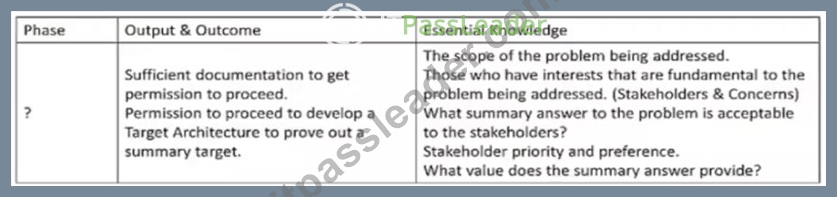
Which ADM Phase does this describe?
- A. Phase B
- B. Phase C
- C. Phase A
- D. Preliminary Phase
Answer: A
Explanation:
Phase B of the ADM cycle is the Business Architecture phase. It describes the development of a Business Architecture to support an agreed Architecture Vision. The objectives of this phase are to describe the baseline and target Business Architecture, identify candidate Architecture Roadmap components based on gaps between the baseline and target, and determine whether an incremental approach is required. Reference: The TOGAF Standard | The Open Group Website, Section 3.2.2 Phase B: Business Architecture.
NEW QUESTION # 55
What are the four dimensions used to scope an architecture?
- A. Breadth Depth Time Period Architecture Domains
- B. Business Data Application Technology
- C. Strategy Segment Capability Budget
- D. Strategy Portfolio Project Solution Delivery
Answer: A
Explanation:
* The four dimensions used to scope an architecture are Breadth, Depth, Time Period, and Architecture Domains1, p. 8.
* Breadth refers to the extent of the enterprise covered by the architecture, which can range from a specific business unit to the entire organization1, p. 8.
* Depth refers to the level of detail and completeness of the architecture, which can vary depending on the purpose, scope, and stakeholders of the architecture1, p. 8.
* Time Period refers to the temporal aspects of the architecture, such as the current state, the target state, and the transition plan1, p. 8.
* Architecture Domains refers to the classification of the architecture into four domains: Business, Data, Application, and Technology1, p. 8.
* These four dimensions help define the scope and boundaries of the architecture and ensure that it meets the needs and expectations of the stakeholders.
NEW QUESTION # 56
Exhibit: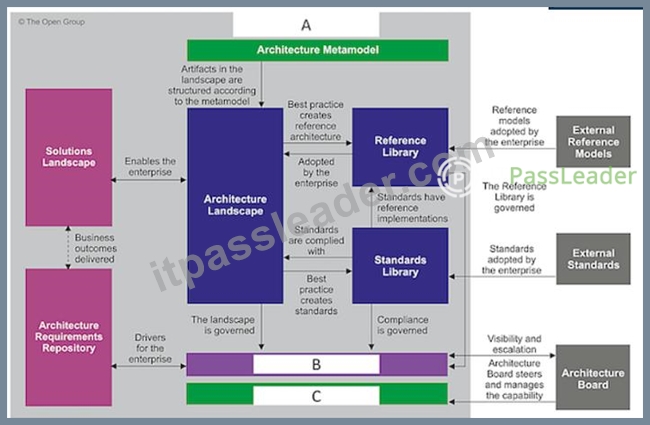
Consider the illustration. What are the items labelled A, B, and C?
- A. A-Architecture Repository, B-Governance Repository, C-Architecture Capability
- B. A-Architecture Repository, B-Governing Board, C-Enterprise Capability
- C. A-Enterprise Repository, B-Board repository, C-Enterprise Capability
- D. A-Enterprise Repository, B-Governance Repository, C-Board Repository
Answer: B
Explanation:
* A-Architecture Repository: This is a part of the Architecture Metamodel that contains artifacts structured according to the metamodel. It includes the Architecture Landscape which is adopted by the enterprise and governed by certain standards and practices.
* B-Governing Board: The Governing Board ensures visibility and escalation, meaning it oversees and manages the capability of the architecture landscape. It plays a crucial role in governance.
* C-Enterprise Capability: This refers to how well an enterprise can execute its mission, meet business objectives or satisfy its stakeholders' needs and expectations. It's influenced by both internal factors (like resources, processes) and external ones (like market trends).
NEW QUESTION # 57
In which phase(s) of the ADM would you deal with the actions resulting from a transformation readiness assessment?
- A. Phase F
- B. Phase G
- C. Phase A
- D. Phase E and F
Answer: D
Explanation:
According to the TOGAF Standard, 10th Edition, a transformation readiness assessment is a technique that evaluates the preparedness of the organization to undergo a change, and identifies the actions needed to increase the likelihood of a successful outcome. A transformation readiness assessment can be conducted in Phase E: Opportunities and Solutions, and the actions resulting from it can be dealt with in Phase F: Migration Planning 1. In Phase E, the transformation readiness assessment can help to identify the major implementation challenges and risks, and to define the critical success factors and key performance indicators for the architecture project. In Phase F, the actions resulting from the transformation readiness assessment can help to develop a detailed and realistic migration plan, and to address the gaps, issues, and dependencies that may affect the transition to the target architecture 1. References: 1: TOGAF Standard, 10th Edition, Part III: ADM Guidelines and Techniques, Chapter 29: Business Transformation Readiness Assessment.
NEW QUESTION # 58
Which section of the TOGAF template for Architecture Principles should highlight the business benefits of adhering to the principle?
- A. Rationale
- B. Statement
- C. Implications
- D. Name
Answer: A
Explanation:
According to the TOGAF Standard, 10th Edition, the rationale section of the architecture principles template should highlight the business benefits of adhering to the principle, as well as the business risks of not adhering to it 1. The rationale section should explain the reasoning behind the principle, and provide evidence or arguments to support it. The rationale section should also link the principle to the business drivers, goals, and objectives of the enterprise, and show how the principle contributes to the value and success of the enterprise. The other options are not correct, as they have different purposes in the architecture principles template. The name section should provide a short and memorable name for the principle, such as "Information is an Asset" or "Business Continuity" 1. The statement section should provide a concise and formal statement of the principle, such as "The enterprise's information is recognized as a core asset, and is managed accordingly" or "The enterprise's ability to provide critical services and products must be maintained in the event of a disaster" 1. The implications section should identify the impact of the principle on the enterprise, such as the changes, costs, benefits, and risks that may result from applying or violating the principle 1. Reference: 1: TOGAF Standard, 10th Edition, Part III: ADM Guidelines and Techniques, Chapter 23: Architecture Principles, Section 23.3 Developing Architecture Principles.
NEW QUESTION # 59
What is used to structure architectural information in an orderly way so that it can be processed to meet stakeholder needs?
- A. A Stakeholder Map
- B. An Architecture Framework
- C. Content Metamodel
- D. An EA Library
Answer: C
Explanation:
* A content metamodel is a formal structure that defines the types of entities and relationships that are used to capture, store, filter, query, and represent architectural information in a way that supports consistency, completeness, and traceability12.
* A stakeholder map is a tool that identifies and analyzes the key stakeholders and their interests, influence, and expectations in relation to the architecture3. It is not used to structure architectural information, but rather to understand the stakeholder needs and concerns.
* An architecture framework is a set of principles, guidelines, standards, and tools that provide a common structure and methodology for developing architectures4. It is not used to structure architectural information, but rather to guide the architecture development process and ensure alignment with the business strategy and objectives.
* An EA library is a repository that stores and manages the architecture artifacts, deliverables, and other relevant information produced and consumed during the architecture development and governance. It is not used to structure architectural information, but rather to provide access, security, and version control for the architecture content.
NEW QUESTION # 60
What is an objective of the ADM Implementation Governance Phase?
- A. To establish the resources for architecture governance
- B. To finalize the Implementation and Migration Plan
- C. To ensure conformance for the target architecture
- D. To provide continual monitoring of the governance framework
Answer: C
Explanation:
The objective of the ADM Implementation Governance Phase is to provide an architectural oversight of the implementation and to ensure conformance for the target architecture. This phase involves establishing procedures and processes to monitor and control the implementation projects and to verify that they comply with the defined architecture. Reference: The TOGAF Standard | The Open Group Website, Section 3.2.7 Phase G: Implementation Governance.
NEW QUESTION # 61
Which phase of the ADM has the purpose to develop an Enterprise Architecture Capability?
- A. Phase G
- B. Phase B
- C. Phase A
- D. Preliminary Phase
Answer: D
Explanation:
According to the TOGAF Standard, 10th Edition, the Preliminary Phase of the Architecture Development Method (ADM) has the purpose to develop an Enterprise Architecture Capability 1. An Enterprise Architecture Capability is the ability of the organization to perform the activities and tasks related to Enterprise Architecture, such as defining the scope, principles, vision, governance, and stakeholders of the architecture. The Preliminary Phase also establishes the architecture framework, the architecture repository, the architecture tools, and the architecture team 1. The other options are not correct, as they have different purposes in the ADM. Phase G: Implementation Governance has the purpose to ensure that the implementation projects conform to the target architecture 2. Phase A: Architecture Vision has the purpose to define the scope, stakeholders, business drivers, and objectives of the architecture project 3. Phase B:
Business Architecture has the purpose to describe the baseline and target business architecture, and to identify the gaps between them . References: 1: TOGAF Standard, 10th Edition, Part II: Architecture Development Method, Chapter 6: Preliminary Phase. 2: TOGAF Standard, 10th Edition, Part II: Architecture Development Method, Chapter 18: Phase G: Implementation Governance. 3: TOGAF Standard, 10th Edition, Part II:
Architecture Development Method, Chapter 12: Phase A: Architecture Vision. : TOGAF Standard, 10th Edition, Part II: Architecture Development Method, Chapter 13: Phase B: Business Architecture.
NEW QUESTION # 62
In which part of the ADM cycle do building block gaps become associated with work packages that will address the gaps?
- A. Phases G and H
- B. Phase E
- C. Phases B C and D
- D. Phases F
Answer: B
Explanation:
In Phase E of the ADM cycle, building block gaps become associated with work packages that will address the gaps. This phase involves creating an Implementation and Migration Plan that defines a set of work packages and Transition Architectures that will deliver the Target Architecture. Reference: The TOGAF Standard | The Open Group Website, Section 3.2.5 Phase E: Opportunities & Solutions.
NEW QUESTION # 63
Which of the following best summarizes the purpose of Enterprise Architecture?
- A. Controlling the bigger changes.
- B. Taking major improvement decisions.
- C. Governing the Stakeholders.
- D. Guiding effective change.
Answer: D
Explanation:
EA applies architecture principles and practices to analyze, design, plan, and implement enterprise analysis that supports digital transformation, IT growth, and the modernization of IT2. EA also helps organizations improve the efficiency, timeliness, and reliability of business information, as well as the alignment, agility, and adaptability of the architecture to the changing needs and requirements3. Therefore, the best summary of the purpose of EA is to guide effective change.
NEW QUESTION # 64
Consider the following statements
1 A whole corporation or a division of a corporation
2 A government agency or a single government department
3 Partnerships and alliances of businesses working together such as a consortium or supply chain What are those examples of according to the TOGAF Standard?
- A. Organizations
- B. Enterprises
- C. Architectures Scopes
- D. Business Units
Answer: B
Explanation:
Enterprises are examples of the scope of an architecture according to the TOGAF Standard. An enterprise is defined as any collection of organizations that has a common set of goals and/or a single bottom line.
Enterprises can be whole corporations or divisions of a corporation, government agencies or single government departments, partnerships and alliances of businesses working together, etc. Reference: The TOGAF Standard | The Open Group Website, Section 2.1 Core Concepts.
NEW QUESTION # 65
Complete the sentence. When considering agile development, Architecture to Support Portfolio will identify what products the Enterprise needs, the boundary of the products, and what constraints a product owner has; this defines the Enterprise's
- A. backlog
- B. risk tolerance
- C. operating model
- D. business continuity
Answer: A
Explanation:
When considering agile development, Architecture to Support Portfolio will identify the necessary products for the enterprise, define their boundaries, and outline the constraints for a product owner. This process directly relates to defining the enterprise's backlog, which in agile methodologies, is a prioritized list of work for the development team that is derived from the roadmap and its requirements.
NEW QUESTION # 66
Consider the following chart:
Which important concept for Enterprise Architecture Practitioners does it illustrate?
- A. An Enterprise Architecture must be developed in phases with a limited fixed duration.
- B. ADM phases must be run in a sequenced approach to produce the Architecture.
- C. ADM phases must be run simultaneously until the relevant information has been produced.
- D. Enterprise Architects must use Gantt charts to communicate with Stakeholders.
Answer: B
Explanation:
The chart shown is a Gantt chart, which is commonly used for project management to illustrate a project schedule. In the context of TOGAF (The Open Group Architecture Framework), which is a framework for enterprise architecture, this Gantt chart is demonstrating the sequenced approach to the Architecture Development Method (ADM). The ADM is the core process of TOGAF which provides a tested and repeatable process for developing architectures. The ADM is described as being iterative, over the whole process, between phases, and within phases. For each iteration of the ADM, a fresh decision must be taken about each of the parameters (scope, granularity, time period, and architecture assets).
The ADM consists of a number of phases that have to be followed in sequence:
* Preliminary Phase: Framework and principles
* Phase A: Architecture Vision
* Phase B: Business Architecture
* Phase C: Information Systems Architectures, including Data and Application Architectures
* Phase D: Technology Architecture
* Phase E: Opportunities and Solutions
* Phase F: Migration Planning
* Phase G: Implementation Governance
* Phase H: Architecture Change Management
* Requirements Management
Each phase is dependent on the outputs of the previous phase and the Requirements Management phase runs throughout. The Gantt chart clearly shows the dependency and sequence in which these phases occur, implying that a structured approach is followed to produce the enterprise architecture.
Reference:
* The TOGAF Standard, Version 9.2, a standard of The Open Group
* The TOGAF documentation available at https://publications.opengroup.org/standards/architecture and https://publications.opengroup.org/guides/architecture
NEW QUESTION # 67
What does the TOGAF ADM recommend for use in developing an Architecture Vision document?
- A. Business Scenarios
- B. Architecture Principles
- C. Gap Analysis
- D. Requirements Management
Answer: A
Explanation:
Business scenarios are a technique recommended by the TOGAF ADM for use in developing an Architecture Vision document12. Business scenarios are a means of capturing the business requirements and drivers, the processes and actors involved, and the desired outcomes and measures of success34. Business scenarios help to create a common vision and understanding among the stakeholders, and to identify and validate the architecture requirements . Business scenarios also provide a basis for analyzing the impact and value of the proposed architecture. Reference:
* The TOGAF Standard, Version 9.2 - Phase A: Architecture Vision - The Open Group
* TOGAF Standard - Introduction - Phase A: Architecture Vision
* The TOGAF Standard, Version 9.2 - Definitions - The Open Group
* Business Scenarios - The Open Group
* [The TOGAF Standard, Version 9.2 - Architecture Requirements Specification - The Open Group]
* [The TOGAF Standard, Version 9.2 - Architecture Vision - The Open Group]
* [The TOGAF Standard, Version 9.2 - Business Transformation Readiness Assessment - The Open Group]
NEW QUESTION # 68
What is presented as "striking a balance between positive and negative outcomes resulting from the realization of either opportunities or threats?
- A. Architecture Security
- B. Transition Management
- C. Risk Management
- D. Agile development
Answer: C
Explanation:
Risk Management is the process of identifying, assessing, and responding to risks that may affect the achievement of the enterprise's objectives. Risk Management involves balancing positive and negative outcomes resulting from the realization of either opportunities or threats. Reference: The TOGAF Standard | The Open Group Website, Section 3.3.3 Risk Management.
NEW QUESTION # 69
Complete the sentence When considering agile development Architecture to Support Project will identify what products the Enterprise needs the boundary of the products and what constraints a product owner has.
this defines the Enterprise's___________.
- A. backlog
- B. workflow management
- C. lifecycle economics
- D. operations
Answer: A
Explanation:
When considering agile development, Architecture to Support Project will identify what products the enterprise needs, the boundary of the products, and what constraints a product owner has. This defines the enterprise's backlog. A backlog is a list of features or tasks that need to be done to deliver a product or service. It is prioritized by the product owner based on the value and urgency of each item. Reference: The TOGAF Standard | The Open Group Website, Section 3.3.5 Architecture to Support Project.
NEW QUESTION # 70
Complete the sentence When considering agile development Architecture to Support Project will identify what products the Enterprise needs the boundary of the products and what constraints a product owner has. this defines the Enterprise's___________.
- A. backlog
- B. workflow management
- C. lifecycle economics
- D. operations
Answer: A
Explanation:
When considering agile development, Architecture to Support Project will identify what products the enterprise needs, the boundary of the products, and what constraints a product owner has. This defines the enterprise's backlog. A backlog is a list of features or tasks that need to be done to deliver a product or service. It is prioritized by the product owner based on the value and urgency of each item. Reference: The TOGAF Standard | The Open Group Website, Section 3.3.5 Architecture to Support Project.
NEW QUESTION # 71
Which of the following are the four purposes that typically frame the planning horizon, depth and breadth of an Architecture Project, and the contents of the EA Repository-?
- A. General Foundational Subordinate and Superior Architecture
- B. Strategy Portfolio Project Solution Delivery
- C. Segment, Capability. Enterprise and End-to-end Target Architecture
- D. Avant-Garde Big-Bang, Discreet and Cohesive
Answer: B
Explanation:
Strategy Portfolio Project Solution Delivery are the four purposes that typically frame the planning horizon, depth and breadth of an Architecture Project, and the contents of the EA Repository. They correspond to different levels of abstraction and granularity in the architecture development process. Reference: The TOGAF Standard, Version 9.2 - The Open Group, Section 2.4 Architecture Repository.
NEW QUESTION # 72
Consider the following statements.
1. All processes, decision-making, and mechanisms used will be established so as to minimize or avoid potential conflicts of interest.
2. More effective strategic decision-making will be made by C-Level executives and business leaders.
3. All actions implemented and their decision support will be available for inspection by authorized organization and provider parties.
4. Digital Transformation and operations will be more effective and efficient.
Which statements highlight the value and necessity for Architecture Governance to be adopted within organizations?
- A. 2& 3
- B. 1 & 3
- C. 1 & 4
- D. 2 & 4
Answer: B
Explanation:
Statements 1 and 3 highlight the value and necessity for Architecture Governance to be adopted within organizations. Architecture Governance is the practice and orientation by which Enterprise Architectures and other architectures are managed and controlled at an enterprise-wide level12. It ensures that architectural decisions are aligned with the organization's strategy, objectives, and standards. Architecture Governance also involves establishing and maintaining processes, decision-making, and mechanisms to avoid or minimize potential conflicts of interest, such as between different stakeholders, business units, or projects34. Moreover, Architecture Governance requires transparency and accountability for all actions implemented and their decision support, so that they can be inspected and evaluated by authorized parties, such as auditors, regulators, or customers5 . References:
*The TOGAF Standard, Version 9.2 - Architecture Governance - The Open Group
*Architecture Governance - The Open Group
*Tutorial: Governance in TOGAF's Architecture Development Method (ADM)
*Architecture Governance in TOGAF: Ensuring Effective Management and Compliance
*The TOGAF Standard, Version 9.2 - Definitions - The Open Group
*[Architecture Governance in TOGAF: Ensuring Alignment and Control]
NEW QUESTION # 73
Which of the following best describes the class of information known as the Reference Library within the Architecture Repository?
- A. Specifications to which architectures must conform
- B. Processes to support governance of the Architecture Repository
- C. Guidelines and templates used to create new architectures
- D. A record of the governance activity across the enterprise
Answer: C
Explanation:
The class of information known as the Reference Library within the Architecture Repository contains guidelines and templates used to create new architectures. The Reference Library provides a set of resources that can be leveraged or customized for specific architecture development purposes. It includes generic building blocks, patterns, models, standards, frameworks, methods, techniques, best practices, etc. Reference:
The TOGAF Standard | The Open Group Website, Section 2.4 Architecture Repository.
NEW QUESTION # 74
What should be put in place through organization structures, roles, responsibilities, skills and processes to carry out architectural activity effectively?
- A. An Enterprise Architecture
- B. An EA framework
- C. An EA repository
- D. An EA Capability
Answer: D
Explanation:
An EA Capability is the ability of an organization to perform enterprise architecture effectively and efficiently. It involves establishing and maintaining the appropriate organization structures, roles, responsibilities, skills, processes, tools, and governance mechanisms to support the development and use of enterprise architecture. An EA Capability enables the organization to align its business and IT strategies, deliver value from its investments, manage change and complexity, and improve its performance and agility12 References: 1: The TOGAF Standard, Version 9.2, Part VI: Architecture Capability Framework, Chapter 44: Introduction 2: The TOGAF Standard, Version 9.2, Part VI: Architecture Capability Framework, Chapter 45: Establishing and Maintaining an Enterprise Architecture Capability
NEW QUESTION # 75
Complete the sentence. The four purposes that typically frame the planning horizon, depth and breadth of an Architecture Project, and the contents of the EA Repository are Strategy, Portfolio,
- A. Subordinate, and Superior Architecture.
- B. Segment, and End-to-end Target Architecture.
- C. Project, and Solution Delivery.
- D. Discreet, and Cohesive.
Answer: B
Explanation:
The planning horizon, depth, and breadth of an Architecture Project, along with the contents of the EA Repository, are typically framed by Strategy, Portfolio, Segment, and End-to-end Target Architecture. The 'Segment' refers to a part of the organization, typically addressed in a Segment Architecture, while 'End-to-end Target Architecture' encompasses the complete view of the planned architecture across the entire organization.
NEW QUESTION # 76
Which of the following statements about architecture partitioning are correct*?
1 Partitions are used to simplify the management of the Enterprise Architecture
2 Partitions are equivalent to architecture levels
3 Partitions enable different teams to work on different element of the architecture at the same time.
4 Partitions reflect the organization's structure
- A. 2 & 3
- B. 1 & 3
- C. 1 & 4
- D. 2 & 4
Answer: B
Explanation:
Statements 1 and 3 about architecture partitioning are correct. Architecture partitioning is the technique of dividing an architecture into smaller and more manageable parts that can be developed, maintained, and governed independently. Partitions are used to simplify the management of the Enterprise Architecture and to enable different teams to work on different elements of the architecture at the same time. Partitions are not equivalent to architecture levels, which are different degrees of abstraction or detail in an architecture. Partitions do not necessarily reflect the organization's structure, which may change over time or differ from the architecture's scope and boundaries. Reference: The TOGAF Standard | The Open Group Website, Section 2.5 Architecture Partitioning.
NEW QUESTION # 77
Complete the following sentence. In the ADM documents which are under development and have not undergone any formal review and approval process are_______________.
- A. Known as ''Version 0.1''
- B. Invalid
- C. Called ''draft''
- D. In between phases
Answer: C
Explanation:
In the ADM documents which are under development and have not undergone any formal review and approval process are called "draft". This indicates that they are subject to change and refinement as the architecture development progresses. Reference: The TOGAF Standard | The Open Group Website, Section 4.2.5 Architecture Deliverables.
NEW QUESTION # 78
Consider the following ADM phases objectives.
Which phase does each objective match?
- A. 1G-2H-3H-4F
- B. 1F-2G-3H-4H
- C. 1F-2G-3G-4H
- D. 1H-2F-3F-4G
Answer: D
Explanation:
* According to the TOGAF Standard, Version 9.2, the ADM phases and their objectives are as follows1:
* Preliminary Phase: To prepare and initiate the architecture development cycle, including defining the architecture framework, principles, and governance.
* Phase A: Architecture Vision: To define the scope, vision, and stakeholders of the architecture initiative, and to obtain approval to proceed.
* Phase B: Business Architecture: To describe the baseline and target business architecture, and to identify the gaps between them.
* Phase C: Information Systems Architectures: To describe the baseline and target data and application architectures, and to identify the gaps between them.
* Phase D: Technology Architecture: To describe the baseline and target technology architecture, and to identify the gaps between them.
* Phase E: Opportunities and Solutions: To identify and evaluate the opportunities and solutions for implementing the target architecture, and to define the work packages and transition architectures.
* Phase F: Migration Planning: To finalize the implementation and migration plan, and to ensure alignment with the enterprise portfolio and project management.
* Phase G: Implementation Governance: To provide architecture oversight and guidance for the implementation projects, and to manage any architecture change requests.
* Phase H: Architecture Change Management: To monitor the changes in the business and technology environment, and to assess the impact and performance of the architecture.
* Requirements Management: To manage the architecture requirements throughout the ADM cycle, and to ensure alignment with the business requirements.
* Based on the above definitions, we can match each objective with the corresponding phase as follows:
* Objective 1: Ensure that the business value and cost of work packages and transition architectures is understood by key stakeholders. This objective is achieved in Phase H: Architecture Change Management, where the value realization and cost-benefit analysis of the architecture are performed2.
* Objective 2: Ensure conformance with the Target Architecture by implementation projects. This objective is achieved in Phase F: Migration Planning, where the conformance requirements and criteria for the implementation projects are defined3.
* Objective 3: Ensure that the architecture development cycle is maintained. This objective is achieved in Phase F: Migration Planning, where the architecture roadmap and iteration cycle are maintained3.
* Objective 4: Ensure that the Architecture Governance Framework is executed. This objective is achieved in Phase G: Implementation Governance, where the architecture governance processes and procedures are applied to the implementation projects4.
NEW QUESTION # 79
......
OGEA-101 Actual Questions and Braindumps: https://www.itpassleader.com/TheOpenGroup/OGEA-101-dumps-pass-exam.html
Pass OGEA-101 Exam with Updated OGEA-101 Exam Dumps PDF 2025: https://drive.google.com/open?id=1HncSjEMVTg17wSo6mCPBtRi9vB8mpzE6