

Exam Questions and Answers for Professional-Machine-Learning-Engineer Study Guide Questions and Answers!
Google Professional Machine Learning Engineer Certification Sample Questions and Practice Exam
NEW QUESTION 18
A financial services company is building a robust serverless data lake on Amazon S3. The data lake should be flexible and meet the following requirements:
* Support querying old and new data on Amazon S3 through Amazon Athena and Amazon Redshift Spectrum.
* Support event-driven ETL pipelines
* Provide a quick and easy way to understand metadata
Which approach meets these requirements?
- A. Use an AWS Glue crawler to crawl S3 data, an AWS Lambda function to trigger an AWS Glue ETL job, and an AWS Glue Data catalog to search and discover metadata.
- B. Use an AWS Glue crawler to crawl S3 data, an AWS Lambda function to trigger an AWS Batch job, and an external Apache Hive metastore to search and discover metadata.
- C. Use an AWS Glue crawler to crawl S3 data, an Amazon CloudWatch alarm to trigger an AWS Glue ETL job, and an external Apache Hive metastore to search and discover metadata.
- D. Use an AWS Glue crawler to crawl S3 data, an Amazon CloudWatch alarm to trigger an AWS Batch job, and an AWS Glue Data Catalog to search and discover metadata.
Answer: A
NEW QUESTION 19
You trained a text classification model. You have the following SignatureDefs: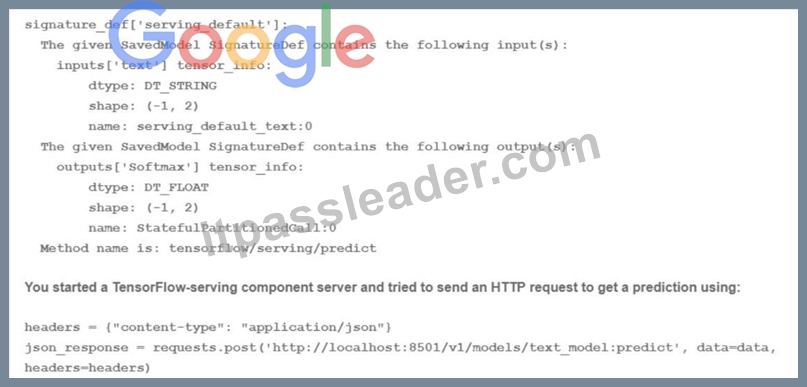
What is the correct way to write the predict request?
- A. data = json dumps({"signature_name": f,serving_default", "instances": [['a', 'b'], [c\ 'd'], ['e\ T]]})
- B. data = json dumps({"signature_name": "serving_default"! "instances": [['a', 'b', "c", 'd', 'e', 'f']]})
- C. data = json.dumps({"signature_name": "serving_default'\ "instances": [fab', 'be1, 'cd']]})
- D. data = json.dumps({"signature_name": "serving_default, "instances": [['a', 'b\ 'c'1, [d\ 'e\ T]]})
Answer: D
NEW QUESTION 20
You work for a large hotel chain and have been asked to assist the marketing team in gathering predictions for a targeted marketing strategy. You need to make predictions about user lifetime value (LTV) over the next 30 days so that marketing can be adjusted accordingly. The customer dataset is in BigQuery, and you are preparing the tabular data for training with AutoML Tables. This data has a time signal that is spread across multiple columns. How should you ensure that AutoML fits the best model to your data?
- A. Manually combine all columns that contain a time signal into an array Allow AutoML to interpret this array appropriately Choose an automatic data split across the training, validation, and testing sets
- B. Submit the data for training without performing any manual transformations Allow AutoML to handle the appropriate transformations Choose an automatic data split across the training, validation, and testing sets
- C. Submit the data for training without performing any manual transformations, and indicate an appropriate column as the Time column Allow AutoML to split your data based on the time signal provided, and reserve the more recent data for the validation and testing sets
- D. Submit the data for training without performing any manual transformations Use the columns that have a time signal to manually split your data Ensure that the data in your validation set is from 30 days after the data in your training set and that the data in your testing set is from 30 days after your validation set
Answer: D
NEW QUESTION 21
You developed an ML model with Al Platform, and you want to move it to production. You serve a few thousand queries per second and are experiencing latency issues. Incoming requests are served by a load balancer that distributes them across multiple Kubeflow CPU-only pods running on Google Kubernetes Engine (GKE). Your goal is to improve the serving latency without changing the underlying infrastructure. What should you do?
- A. Significantly increase the max_batch_size TensorFlow Serving parameter
- B. Switch to the tensorflow-model-server-universal version of TensorFlow Serving
- C. Significantly increase the max_enqueued_batches TensorFlow Serving parameter
- D. Recompile TensorFlow Serving using the source to support CPU-specific optimizations Instruct GKE to choose an appropriate baseline minimum CPU platform for serving nodes
Answer: A
NEW QUESTION 22
A Machine Learning Specialist receives customer data for an online shopping website. The data includes demographics, past visits, and locality information. The Specialist must develop a machine learning approach to identify the customer shopping patterns, preferences, and trends to enhance the website for better service and smart recommendations.
Which solution should the Specialist recommend?
- A. Random Cut Forest (RCF) over random subsamples to identify patterns in the customer database.
- B. A neural network with a minimum of three layers and random initial weights to identify patterns in the customer database.
- C. Latent Dirichlet Allocation (LDA) for the given collection of discrete data to identify patterns in the customer database.
- D. Collaborative filtering based on user interactions and correlations to identify patterns in the customer database.
Answer: D
Explanation:
Explanation
NEW QUESTION 23
Machine Learning Specialist is building a model to predict future employment rates based on a wide range of economic factors. While exploring the data, the Specialist notices that the magnitude of the input features vary greatly. The Specialist does not want variables with a larger magnitude to dominate the model.
What should the Specialist do to prepare the data for model training?
- A. Apply normalization to ensure each field will have a mean of 0 and a variance of 1 to remove any significant magnitude.
- B. Apply the Cartesian product transformation to create new combinations of fields that are independent of the magnitude.
- C. Apply quantile binning to group the data into categorical bins to keep any relationships in the data by replacing the magnitude with distribution.
- D. Apply the orthogonal sparse bigram (OSB) transformation to apply a fixed-size sliding window to generate new features of a similar magnitude.
Answer: A
Explanation:
Explanation/Reference: https://docs.aws.amazon.com/machine-learning/latest/dg/data-transformations-reference.html
NEW QUESTION 24
A technology startup is using complex deep neural networks and GPU compute to recommend the company's products to its existing customers based upon each customer's habits and interactions. The solution currently pulls each dataset from an Amazon S3 bucket before loading the data into a TensorFlow model pulled from the company's Git repository that runs locally. This job then runs for several hours while continually outputting its progress to the same S3 bucket. The job can be paused, restarted, and continued at any time in the event of a failure, and is run from a central queue.
Senior managers are concerned about the complexity of the solution's resource management and the costs involved in repeating the process regularly. They ask for the workload to be automated so it runs once a week, starting Monday and completing by the close of business Friday.
Which architecture should be used to scale the solution at the lowest cost?
- A. Implement the solution using AWS Deep Learning Containers, run the workload using AWS Fargate running on Spot Instances, and then schedule the task using the built-in task scheduler
- B. Implement the solution using a low-cost GPU-compatible Amazon EC2 instance and use the AWS Instance Scheduler to schedule the task
- C. Implement the solution using Amazon ECS running on Spot Instances and schedule the task using the ECS service scheduler
- D. Implement the solution using AWS Deep Learning Containers and run the container as a job using AWS Batch on a GPU-compatible Spot Instance
Answer: A
NEW QUESTION 25
Your team is building an application for a global bank that will be used by millions of customers. You built a forecasting model that predicts customers1 account balances 3 days in the future. Your team will use the results in a new feature that will notify users when their account balance is likely to drop below $25. How should you serve your predictions?
- A. 1. Build a notification system on Firebase
2. Register each user with a user ID on the Firebase Cloud Messaging server, which sends a notification when the average of all account balance predictions drops below the $25 threshold - B. 1. Create a Pub/Sub topic for each user
2. Deploy an application on the App Engine standard environment that sends a notification when your model predicts that a user's account balance will drop below the $25 threshold - C. 1. Create a Pub/Sub topic for each user
2 Deploy a Cloud Function that sends a notification when your model predicts that a user's account balance will drop below the $25 threshold. - D. 1 Build a notification system on Firebase
2. Register each user with a user ID on the Firebase Cloud Messaging server, which sends a notification when your model predicts that a user's account balance will drop below the $25 threshold
Answer: C
NEW QUESTION 26
You are developing a Kubeflow pipeline on Google Kubernetes Engine. The first step in the pipeline is to issue a query against BigQuery. You plan to use the results of that query as the input to the next step in your pipeline. You want to achieve this in the easiest way possible. What should you do?
- A. Write a Python script that uses the BigQuery API to execute queries against BigQuery Execute this script as the first step in your Kubeflow pipeline
- B. Use the BigQuery console to execute your query and then save the query results Into a new BigQuery table.
- C. Locate the Kubeflow Pipelines repository on GitHub Find the BigQuery Query Component, copy that component's URL, and use it to load the component into your pipeline. Use the component to execute queries against BigQuery
- D. Use the Kubeflow Pipelines domain-specific language to create a custom component that uses the Python BigQuery client library to execute queries
Answer: B
NEW QUESTION 27
You work for an advertising company and want to understand the effectiveness of your company's latest advertising campaign. You have streamed 500 MB of campaign data into BigQuery. You want to query the table, and then manipulate the results of that query with a pandas dataframe in an Al Platform notebook. What should you do?
- A. From a bash cell in your Al Platform notebook, use the bq extract command to export the table as a CSV file to Cloud Storage, and then use gsutii cp to copy the data into the notebook Use pandas. read_csv to ingest the file as a pandas dataframe
- B. Download your table from BigQuery as a local CSV file, and upload it to your Al Platform notebook instance Use pandas. read_csv to ingest the file as a pandas dataframe
- C. Use Al Platform Notebooks' BigQuery cell magic to query the data, and ingest the results as a pandas dataframe
- D. Export your table as a CSV file from BigQuery to Google Drive, and use the Google Drive API to ingest the file into your notebook instance
Answer: B
NEW QUESTION 28
A Data Scientist wants to gain real-time insights into a data stream of GZIP files.
Which solution would allow the use of SQL to query the stream with the LEAST latency?
- A. Amazon Kinesis Data Firehose to transform the data and put it into an Amazon S3 bucket.
- B. Amazon Kinesis Data Analytics with an AWS Lambda function to transform the data.
- C. AWS Glue with a custom ETL script to transform the data.
- D. An Amazon Kinesis Client Library to transform the data and save it to an Amazon ES cluster.
Answer: B
Explanation:
Explanation/Reference: https://aws.amazon.com/big-data/real-time-analytics-featured-partners/
NEW QUESTION 29
Your team is working on an NLP research project to predict political affiliation of authors based on articles they have written. You have a large training dataset that is structured like this: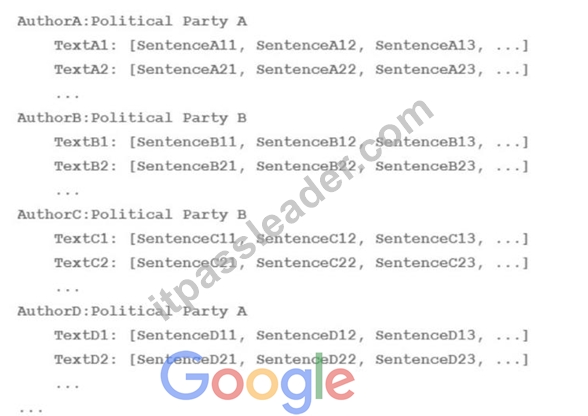
A)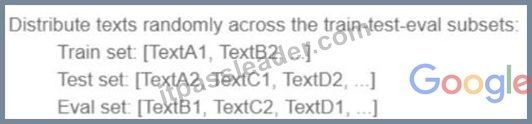
B)
C)
D)
- A. Option A
- B. Option D
- C. Option B
- D. Option C
Answer: B
NEW QUESTION 30
A Data Scientist needs to migrate an existing on-premises ETL process to the cloud. The current process runs at regular time intervals and uses PySpark to combine and format multiple large data sources into a single consolidated output for downstream processing.
The Data Scientist has been given the following requirements to the cloud solution:
* Combine multiple data sources.
* Reuse existing PySpark logic.
* Run the solution on the existing schedule.
* Minimize the number of servers that will need to be managed.
Which architecture should the Data Scientist use to build this solution?
- A. Write the raw data to Amazon S3. Create an AWS Glue ETL job to perform the ETL processing against the input data. Write the ETL job in PySpark to leverage the existing logic. Create a new AWS Glue trigger to trigger the ETL job based on the existing schedule. Configure the output target of the ETL job to write to a
"processed" location in Amazon S3 that is accessible for downstream use. - B. Write the raw data to Amazon S3. Schedule an AWS Lambda function to run on the existing schedule and process the input data from Amazon S3. Write the Lambda logic in Python and implement the existing PySpark logic to perform the ETL process. Have the Lambda function output the results to a "processed" location in Amazon S3 that is accessible for downstream use.
- C. Use Amazon Kinesis Data Analytics to stream the input data and perform real-time SQL queries against the stream to carry out the required transformations within the stream. Deliver the output results to a
"processed" location in Amazon S3 that is accessible for downstream use. - D. Write the raw data to Amazon S3. Schedule an AWS Lambda function to submit a Spark step to a persistent Amazon EMR cluster based on the existing schedule. Use the existing PySpark logic to run the ETL job on the EMR cluster. Output the results to a "processed" location in Amazon S3 that is accessible for downstream use.
Answer: C
Explanation:
Explanation
NEW QUESTION 31
Given the following confusion matrix for a movie classification model, what is the true class frequency for Romance and the predicted class frequency for Adventure?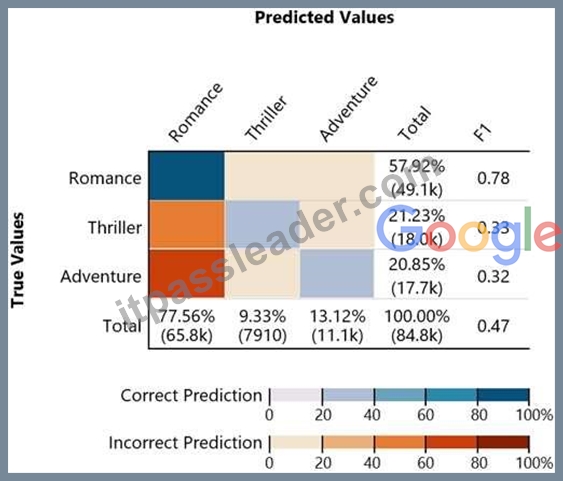
- A. The true class frequency for Romance is 77.56% * 0.78 and the predicted class frequency for Adventure is
20.85%*0.32 - B. The true class frequency for Romance is 0.78 and the predicted class frequency for Adventure is (0.47-
0.32) - C. The true class frequency for Romance is 57.92% and the predicted class frequency for Adventure is
13.12% - D. The true class frequency for Romance is 77.56% and the predicted class frequency for Adventure is
20.85%
Answer: C
NEW QUESTION 32
Your team is building an application for a global bank that will be used by millions of customers. You built a forecasting model that predicts customers1 account balances 3 days in the future. Your team will use the results in a new feature that will notify users when their account balance is likely to drop below $25. How should you serve your predictions?
- A. 1. Build a notification system on Firebase
2. Register each user with a user ID on the Firebase Cloud Messaging server, which sends a notification when the average of all account balance predictions drops below the $25 threshold - B. 1. Create a Pub/Sub topic for each user
2. Deploy an application on the App Engine standard environment that sends a notification when your model predicts that a user's account balance will drop below the $25 threshold - C. 1 Build a notification system on Firebase
2. Register each user with a user ID on the Firebase Cloud Messaging server, which sends a notification when your model predicts that a user's account balance will drop below the $25 threshold - D. 1. Create a Pub/Sub topic for each user
2 Deploy a Cloud Function that sends a notification when your model predicts that a user's account balance will drop below the $25 threshold.
Answer: B
NEW QUESTION 33
You are developing ML models with Al Platform for image segmentation on CT scans. You frequently update your model architectures based on the newest available research papers, and have to rerun training on the same dataset to benchmark their performance. You want to minimize computation costs and manual intervention while having version control for your code. What should you do?
- A. Use the gcloud command-line tool to submit training jobs on Al Platform when you update your code
- B. Use Cloud Build linked with Cloud Source Repositories to trigger retraining when new code is pushed to the repository
- C. Use Cloud Functions to identify changes to your code in Cloud Storage and trigger a retraining job
- D. Create an automated workflow in Cloud Composer that runs daily and looks for changes in code in Cloud Storage using a sensor.
Answer: A
NEW QUESTION 34
A Data Scientist is training a multilayer perception (MLP) on a dataset with multiple classes. The target class of interest is unique compared to the other classes within the dataset, but it does not achieve and acceptable recall metric. The Data Scientist has already tried varying the number and size of the MLP's hidden layers, which has not significantly improved the results. A solution to improve recall must be implemented as quickly as possible.
Which techniques should be used to meet these requirements?
- A. Add class weights to the MLP's loss function and then retrain
- B. Gather more data using Amazon Mechanical Turk and then retrain
- C. Train an XGBoost model instead of an MLP
- D. Train an anomaly detection model instead of an MLP
Answer: C
NEW QUESTION 35
You work for an online retail company that is creating a visual search engine. You have set up an end-to-end ML pipeline on Google Cloud to classify whether an image contains your company's product. Expecting the release of new products in the near future, you configured a retraining functionality in the pipeline so that new data can be fed into your ML models. You also want to use Al Platform's continuous evaluation service to ensure that the models have high accuracy on your test data set. What should you do?
- A. Update your test dataset with images of the newer products when your evaluation metrics drop below a pre-decided threshold.
- B. Replace your test dataset with images of the newer products when they are introduced to retraining.
- C. Keep the original test dataset unchanged even if newer products are incorporated into retraining
- D. Extend your test dataset with images of the newer products when they are introduced to retraining
Answer: B
NEW QUESTION 36
You work for a bank and are building a random forest model for fraud detection. You have a dataset that includes transactions, of which 1% are identified as fraudulent.
Which data transformation strategy would likely improve the performance of your classifier?
- A. Write your data in TFRecords.
- B. Z-normalize all the numeric features.
- C. Oversample the fraudulent transaction 10 times.
- D. Use one-hot encoding on all categorical features.
Answer: C
NEW QUESTION 37
A company is using Amazon Polly to translate plaintext documents to speech for automated company announcements. However, company acronyms are being mispronounced in the current documents.
How should a Machine Learning Specialist address this issue for future documents?
- A. Output speech marks to guide in pronunciation.
- B. Create an appropriate pronunciation lexicon.
- C. Use Amazon Lex to preprocess the text files for pronunciation
- D. Convert current documents to SSML with pronunciation tags.
Answer: D
Explanation:
Explanation/Reference: https://docs.aws.amazon.com/polly/latest/dg/ssml.html
NEW QUESTION 38
You need to build classification workflows over several structured datasets currently stored in BigQuery. Because you will be performing the classification several times, you want to complete the following steps without writing code: exploratory data analysis, feature selection, model building, training, and hyperparameter tuning and serving. What should you do?
- A. Use Al Platform to run the classification model job configured for hyperparameter tuning
- B. Configure AutoML Tables to perform the classification task
- C. Run a BigQuery ML task to perform logistic regression for the classification
- D. Use Al Platform Notebooks to run the classification model with pandas library
Answer: C
Explanation:
BigQuery ML supports supervised learning with the logistic regression model type.
NEW QUESTION 39
A large mobile network operating company is building a machine learning model to predict customers who are likely to unsubscribe from the service. The company plans to offer an incentive for these customers as the cost of churn is far greater than the cost of the incentive.
The model produces the following confusion matrix after evaluating on a test dataset of 100 customers:
Based on the model evaluation results, why is this a viable model for production?
- A. The precision of the model is 86%, which is less than the accuracy of the model.
- B. The precision of the model is 86%, which is greater than the accuracy of the model.
- C. The model is 86% accurate and the cost incurred by the company as a result of false positives is less than the false negatives.
- D. The model is 86% accurate and the cost incurred by the company as a result of false negatives is less than the false positives.
Answer: D
NEW QUESTION 40
......
Professional-Machine-Learning-Engineer certification dumps - Google Certification Professional-Machine-Learning-Engineer guides - 100% valid: https://www.itpassleader.com/Google/Professional-Machine-Learning-Engineer-dumps-pass-exam.html
100% Pass Your Professional-Machine-Learning-Engineer at First Attempt with ITPassLeader: https://drive.google.com/open?id=1jAGL1lrMbK2F-_c2u00YzirjGOUHgVLT