

Verified Professional-Machine-Learning-Engineer dumps Q&As - 2024 Latest Professional-Machine-Learning-Engineer Download
Dumps Questions [2024] Pass for Professional-Machine-Learning-Engineer Exam
The Google Professional-Machine-Learning-Engineer exam is designed to test a variety of skills and knowledge areas related to machine learning, including data analysis, model selection and evaluation, and deployment and monitoring of machine learning models. It is also designed to test candidates' ability to apply machine learning techniques to real-world problems and to demonstrate their ability to work effectively with data science teams.
Passing the Google Professional Machine Learning Engineer certification exam can bring several benefits to your career. Firstly, it demonstrates to potential employers that you have a deep understanding of machine learning concepts and can apply them to real-world problems. Secondly, it can open up new job opportunities and increase your earning potential. Finally, it can give you the confidence to take on more complex machine learning projects and advance your career to new heights.
NEW QUESTION # 14
You work at a bank You have a custom tabular ML model that was provided by the bank's vendor. The training data is not available due to its sensitivity. The model is packaged as a Vertex Al Model serving container which accepts a string as input for each prediction instance. In each string the feature values are separated by commas. You want to deploy this model to production for online predictions, and monitor the feature distribution over time with minimal effort What should you do?
- A. 1 Upload the model to Vertex Al Model Registry and deploy the model to a Vertex Ai endpoint.
2. Create a Vertex Al Model Monitoring job with feature drift detection as the monitoring objective, and provide an instance schema. - B. 1 Upload the model to Vertex Al Model Registry and deploy the model to a Vertex Al endpoint.
2 Create a Vertex Al Model Monitoring job with feature skew detection as the monitoring objective and provide an instance schema. - C. 1 Refactor the serving container to accept key-value pairs as input format.
2. Upload the model to Vertex Al Model Registry and deploy the model to a Vertex Al endpoint.
3. Create a Vertex Al Model Monitoring job with feature drift detection as the monitoring objective. - D. 1 Refactor the serving container to accept key-value pairs as input format.
2 Upload the model to Vertex Al Model Registry and deploy the model to a Vertex Al endpoint.
3. Create a Vertex Al Model Monitoring job with feature skew detection as the monitoring objective.
Answer: C
NEW QUESTION # 15
You are experimenting with a built-in distributed XGBoost model in Vertex AI Workbench user-managed notebooks. You use BigQuery to split your data into training and validation sets using the following queries:
CREATE OR REPLACE TABLE 'myproject.mydataset.training' AS
(SELECT * FROM 'myproject.mydataset.mytable' WHERE RAND() <= 0.8);
CREATE OR REPLACE TABLE 'myproject.mydataset.validation' AS
(SELECT * FROM 'myproject.mydataset.mytable' WHERE RAND() <= 0.2);
After training the model, you achieve an area under the receiver operating characteristic curve (AUC ROC) value of 0.8, but after deploying the model to production, you notice that your model performance has dropped to an AUC ROC value of 0.65. What problem is most likely occurring?
- A. The RAND() function generated a number that is less than 0.2 in both instances, so every record in the validation table will also be in the training table.
- B. There is not a sufficient amount of training data.
- C. There is training-serving skew in your production environment.
- D. The tables that you created to hold your training and validation records share some records, and you may not be using all the data in your initial table.
Answer: C
NEW QUESTION # 16
You are an ML engineer responsible for designing and implementing training pipelines for ML models. You need to create an end-to-end training pipeline for a TensorFlow model. The TensorFlow model will be trained on several terabytes of structured dat a. You need the pipeline to include data quality checks before training and model quality checks after training but prior to deployment. You want to minimize development time and the need for infrastructure maintenance. How should you build and orchestrate your training pipeline?
- A. Create the pipeline using TensorFlow Extended (TFX) and standard TFX components. Orchestrate the pipeline using Kubeflow Pipelines deployed on Google Kubernetes Engine.
- B. Create the pipeline using Kubeflow Pipelines domain-specific language (DSL) and predefined Google Cloud components. Orchestrate the pipeline using Vertex AI Pipelines.
- C. Create the pipeline using Kubeflow Pipelines domain-specific language (DSL) and predefined Google Cloud components. Orchestrate the pipeline using Kubeflow Pipelines deployed on Google Kubernetes Engine.
- D. Create the pipeline using TensorFlow Extended (TFX) and standard TFX components. Orchestrate the pipeline using Vertex AI Pipelines.
Answer: D
NEW QUESTION # 17
Your company manages an ecommerce website. You developed an ML model that recommends additional products to users in near real time based on items currently in the user's cart. The workflow will include the following processes.
1 The website will send a Pub/Sub message with the relevant data and then receive a message with the prediction from Pub/Sub.
2 Predictions will be stored in BigQuery
3. The model will be stored in a Cloud Storage bucket and will be updated frequently You want to minimize prediction latency and the effort required to update the model How should you reconfigure the architecture?
- A. Create a pipeline in Vertex Al Pipelines that performs preprocessing, prediction and postprocessing Configure the pipeline to be triggered by a Cloud Function when messages are sent to Pub/Sub.
- B. Use the Runlnference API with watchFilePatterr. in a Dataflow job that wraps around the model and serves predictions.
- C. Write a Cloud Function that loads the model into memory for prediction Configure the function to be triggered when messages are sent to Pub/Sub.
- D. Expose the model as a Vertex Al endpoint Write a custom DoFn in a Dataflow job that calls the endpoint for prediction.
Answer: C
NEW QUESTION # 18
You work for a company that is developing a new video streaming platform. You have been asked to create a recommendation system that will suggest the next video for a user to watch. After a review by an AI Ethics team, you are approved to start development. Each video asset in your company's catalog has useful metadata (e.g., content type, release date, country), but you do not have any historical user event dat a. How should you build the recommendation system for the first version of the product?
- A. Launch the product with machine learning. Generate embeddings for each video by training an autoencoder on the content metadata using TensorFlow. Cluster content based on the similarity of these embeddings, and then recommend videos from the same cluster.
- B. Launch the product without machine learning. Present videos to users alphabetically, and start collecting user event data so you can develop a recommender model in the future.
- C. Launch the product with machine learning. Use a publicly available dataset such as MovieLens to train a model using the Recommendations AI, and then apply this trained model to your data.
- D. Launch the product without machine learning. Use simple heuristics based on content metadata to recommend similar videos to users, and start collecting user event data so you can develop a recommender model in the future.
Answer: C
NEW QUESTION # 19
You work for a pet food company that manages an online forum Customers upload photos of their pets on the forum to share with others About 20 photos are uploaded daily You want to automatically and in near real time detect whether each uploaded photo has an animal You want to prioritize time and minimize cost of your application development and deployment What should you do?
- A. Send user-submitted images to the Cloud Vision API Use object localization to identify all objects in the image and compare the results against a list of animals.
- B. Manually label previously submitted images as having animals or not Create an image dataset on Vertex Al Train a classification model by using Vertex AutoML to distinguish the two classes Deploy the model to a Vertex Al endpoint Send new user-submitted images to your model endpoint to classify whether each photo has an animal.
- C. Manually label previously submitted images with bounding boxes around any animals Build an AutoML object detection model by using Vertex Al Deploy the model to a Vertex Al endpoint Send new user-submitted images to your model endpoint to detect whether each photo has an animal.
- D. Download an object detection model from TensorFlow Hub. Deploy the model to a Vertex Al endpoint. Send new user-submitted images to the model endpoint to classify whether each photo has an animal.
Answer: D
NEW QUESTION # 20
You are training an object detection machine learning model on a dataset that consists of three million X-ray images, each roughly 2 GB in size. You are using Vertex AI Training to run a custom training application on a Compute Engine instance with 32-cores, 128 GB of RAM, and 1 NVIDIA P100 GPU. You notice that model training is taking a very long time. You want to decrease training time without sacrificing model performance. What should you do?
- A. Increase the instance memory to 512 GB and increase the batch size.
- B. Replace the NVIDIA P100 GPU with a v3-32 TPU in the training job.
- C. Enable early stopping in your Vertex AI Training job.
- D. Use the tf.distribute.Strategy API and run a distributed training job.
Answer: C
NEW QUESTION # 21
You are developing a model to help your company create more targeted online advertising campaigns. You need to create a dataset that you will use to train the model. You want to avoid creating or reinforcing unfair bias in the model. What should you do?
Choose 2 answers
- A. Include a comprehensive set of demographic features.
- B. Collect a stratified sample of production traffic to build the training dataset.
- C. include only the demographic groups that most frequently interact with advertisements.
- D. Collect a random sample of production traffic to build the training dataset.
- E. Conduct fairness tests across sensitive categories and demographics on the trained model.
Answer: B,D
NEW QUESTION # 22
You have built a model that is trained on data stored in Parquet files. You access the data through a Hive table hosted on Google Cloud. You preprocessed these data with PySpark and exported it as a CSV file into Cloud Storage. After preprocessing, you execute additional steps to train and evaluate your model. You want to parametrize this model training in Kubeflow Pipelines. What should you do?
- A. Deploy Apache Spark at a separate node pool in a Google Kubernetes Engine cluster. Add a ContainerOp to your pipeline that invokes a corresponding transformation job for this Spark instance.
- B. Remove the data transformation step from your pipeline.
- C. Add a ContainerOp to your pipeline that spins a Dataproc cluster, runs a transformation, and then saves the transformed data in Cloud Storage.
- D. Containerize the PySpark transformation step, and add it to your pipeline.
Answer: C
Explanation:
The best option for parametrizing the model training in Kubeflow Pipelines is to add a ContainerOp to the pipeline that spins a Dataproc cluster, runs a transformation, and then saves the transformed data in Cloud Storage. This option has the following advantages:
* It allows the data transformation to be performed as part of the Kubeflow Pipeline, which can ensure the consistency and reproducibility of the data processing and the model training. By adding a ContainerOp to the pipeline, you can define the parameters and the logic of the data transformation step, and integrate it with the other steps of the pipeline, such as the model training and evaluation.
* It leverages the scalability and performance of Dataproc, which is a fully managed service that runs Apache Spark and Apache Hadoop clusters on Google Cloud. By spinning a Dataproc cluster, you can run the PySpark transformation on the Parquet files stored in the Hive table, and take advantage of the parallelism and speed of Spark. Dataproc also supports various features and integrations, such as autoscaling, preemptible VMs, and connectors to other Google Cloud services, that can optimize the data processing and reduce the cost.
* It simplifies the data storage and access, as the transformed data is saved in Cloud Storage, which is a scalable, durable, and secure object storage service. By saving the transformed data in Cloud Storage, you can avoid the overhead and complexity of managing the data in the Hive table or the Parquet files.
Moreover, you can easily access the transformed data from Cloud Storage, using various tools and frameworks, such as TensorFlow, BigQuery, or Vertex AI.
The other options are less optimal for the following reasons:
* Option A: Removing the data transformation step from the pipeline eliminates the parametrization of the
* model training, as the data processing and the model training are decoupled and independent. This option requires running the PySpark transformation separately from the Kubeflow Pipeline, which can introduce inconsistency and unreproducibility in the data processing and the model training. Moreover, this option requires managing the data in the Hive table or the Parquet files, which can be cumbersome and inefficient.
* Option B: Containerizing the PySpark transformation step, and adding it to the pipeline introduces additional complexity and overhead. This option requires creating and maintaining a Docker image that can run the PySpark transformation, which can be challenging and time-consuming. Moreover, this option requires running the PySpark transformation on a single container, which can be slow and inefficient, as it does not leverage the parallelism and performance of Spark.
* Option D: Deploying Apache Spark at a separate node pool in a Google Kubernetes Engine cluster, and adding a ContainerOp to the pipeline that invokes a corresponding transformation job for this Spark instance introduces additional complexity and cost. This option requires creating and managing a separate node pool in a Google Kubernetes Engine cluster, which is a fully managed service that runs Kubernetes clusters on Google Cloud. Moreover, this option requires deploying and running Apache Spark on the node pool, which can be tedious and costly, as it requires configuring and maintaining the Spark cluster, and paying for the node pool usage.
NEW QUESTION # 23
You are training an LSTM-based model on Al Platform to summarize text using the following job submission script: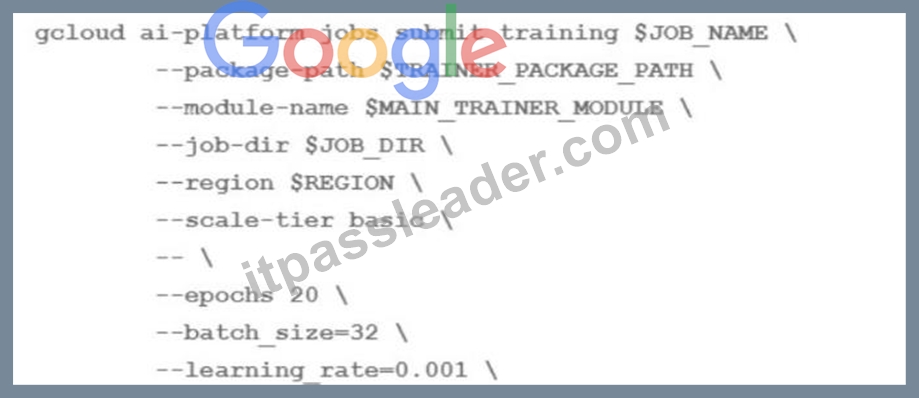
You want to ensure that training time is minimized without significantly compromising the accuracy of your model. What should you do?
- A. Modify the 'scale-tier' parameter
- B. Modify the 'learning rate' parameter
- C. Modify the 'epochs' parameter
- D. Modify the batch size' parameter
Answer: C
NEW QUESTION # 24
You developed a Transformer model in TensorFlow to translate text Your training data includes millions of documents in a Cloud Storage bucket. You plan to use distributed training to reduce training time. You need to configure the training job while minimizing the effort required to modify code and to manage the clusters configuration. What should you do?
- A. Create a Vertex Al custom training job with GPU accelerators for the second worker pool Use tf
.distribute.MultiWorkerMirroredStrategy for distribution. - B. Create a training job that uses Cloud TPU VMs Use tf.distribute.TPUStrategy for distribution.
- C. Create a Vertex Al custom distributed training job with Reduction Server Use N1 high-memory machine type instances for the first and second pools, and use N1 high-CPU machine type instances for the third worker pool.
- D. Create a Vertex Al custom training job with a single worker pool of A2 GPU machine type instances Use tf .distribute.MirroredStraregy for distribution.
Answer: B
Explanation:
According to the official exam guide1, one of the skills assessed in the exam is to "configure and optimize model training jobs". Cloud TPU VMs2 are a new way to access Cloud TPUs directly on the TPU host machines, offering a simpler and more flexible user experience. Cloud TPU VMs are optimized for ML model training and can reduce training time and cost. You can use Cloud TPU VMs to train Transformer models in TensorFlow by using the tf.distribute.TPUStrategy3, which handles the distribution of computations across the TPU cores. The other options are not relevant or optimal for this scenario. References:
* Professional ML Engineer Exam Guide
* Cloud TPU VMs
* Distributed training with TPUStrategy
* Google Professional Machine Learning Certification Exam 2023
* Latest Google Professional Machine Learning Engineer Actual Free Exam Questions
NEW QUESTION # 25
A Machine Learning team runs its own training algorithm on Amazon SageMaker. The training algorithm requires external assets. The team needs to submit both its own algorithm code and algorithm-specific parameters to Amazon SageMaker.
What combination of services should the team use to build a custom algorithm in Amazon SageMaker?
(Choose two.)
- A. Amazon ECS
- B. Amazon S3
- C. AWS CodeStar
- D. AWS Secrets Manager
- E. Amazon ECR
Answer: B,E
NEW QUESTION # 26
You work at a large organization that recently decided to move their ML and data workloads to Google Cloud. The data engineering team has exported the structured data to a Cloud Storage bucket in Avro format. You need to propose a workflow that performs analytics, creates features, and hosts the features that your ML models use for online prediction How should you configure the pipeline?
- A. Ingest the Avro files into BigQuery to perform analytics Use a Dataflow pipeline to create the features, and store them in Vertex Al Feature Store for online prediction.
- B. Ingest the Avro files into BigQuery to perform analytics Use BigQuery SQL to create features and store them in a separate BigQuery table for online prediction.
- C. Ingest the Avro files into Cloud Spanner to perform analytics. Use a Dataflow pipeline to create the features. and store them in Vertex Al Feature Store for online prediction.
- D. Ingest the Avro files into Cloud Spanner to perform analytics Use a Dataflow pipeline to create the features and store them in BigQuery for online prediction.
Answer: A
NEW QUESTION # 27
You have trained a model on a dataset that required computationally expensive preprocessing operations. You need to execute the same preprocessing at prediction time. You deployed the model on Al Platform for high-throughput online prediction. Which architecture should you use?
- A. * Stream incoming prediction request data into Cloud Spanner
* Create a view to abstract your preprocessing logic.
* Query the view every second for new records
* Submit a prediction request to Al Platform using the transformed data
* Write the predictions to an outbound Pub/Sub queue. - B. * Send incoming prediction requests to a Pub/Sub topic
* Transform the incoming data using a Dataflow job
* Submit a prediction request to Al Platform using the transformed data
* Write the predictions to an outbound Pub/Sub queue - C. * Send incoming prediction requests to a Pub/Sub topic
* Set up a Cloud Function that is triggered when messages are published to the Pub/Sub topic.
* Implement your preprocessing logic in the Cloud Function
* Submit a prediction request to Al Platform using the transformed data
* Write the predictions to an outbound Pub/Sub queue - D. * Validate the accuracy of the model that you trained on preprocessed data
* Create a new model that uses the raw data and is available in real time
* Deploy the new model onto Al Platform for online prediction
Answer: B
Explanation:
https://cloud.google.com/architecture/data-preprocessing-for-ml-with-tf-transform-pt1#where_to_do_preprocessing
NEW QUESTION # 28
You work at an ecommerce startup. You need to create a customer churn prediction model Your company's recent sales records are stored in a BigQuery table You want to understand how your initial model is making predictions. You also want to iterate on the model as quickly as possible while minimizing cost How should you build your first model?
- A. Export the data to a Cloud Storage Bucket Create tf. data. Dataset to read the data from Cloud Storage Implement a deep neural network in TensorFlow.
- B. Create a tf.data.Dataset by using the TensorFlow BigQueryChent Implement a deep neural network in TensorFlow.
- C. Export the data to a Cloud Storage Bucket Load the data into a pandas DataFrame on Vertex Al Workbench and train a logistic regression model with scikit-learn.
- D. Prepare the data in BigQuery and associate the data with a Vertex Al dataset Create an AutoMLTabuiarTrainmgJob to train a classification model.
Answer: D
Explanation:
BigQuery is a service that allows you to store and query large amounts of data in a scalable and cost-effective way. You can use BigQuery to prepare the data for your customer churn prediction model, such as filtering, aggregating, and transforming the data. You can then associate the data with a Vertex AI dataset, which is a service that allows you to store and manage your ML data on Google Cloud. By using a Vertex AI dataset, you can easily access the data from other Vertex AI services, such as AutoML. AutoML is a service that allows you to create and train ML models without writing code. You can use AutoML to create an AutoMLTabularTrainingJob, which is a type of job that trains a classification model for tabular data, such as customer churn. By using an AutoMLTabularTrainingJob, you can benefit from the automated feature engineering, model selection, and hyperparameter tuning that AutoML provides. You can also use Vertex Explainable AI to understand how your model is making predictions, such as which features are most important and how they affect the prediction outcome. By using BigQuery, Vertex AI dataset, and AutoMLTabularTrainingJob, you can build your first model as quickly as possible while minimizing cost and complexity. References:
* BigQuery documentation
* Vertex AI dataset documentation
* AutoMLTabularTrainingJob documentation
* Vertex Explainable AI documentation
* Preparing for Google Cloud Certification: Machine Learning Engineer Professional Certificate
NEW QUESTION # 29
You are developing a process for training and running your custom model in production. You need to be able to show lineage for your model and predictions. What should you do?
- A. 1 Use Vertex Al Experiments to train your model.
2 Register your model in Vertex Al Model Registry
3. Generate batch predictions in Vertex Al - B. 1 Use a Vertex Al Pipelines custom training job component to train your model
2. Generate predictions by using a Vertex Al Pipelines model batch predict component - C. 1 Upload your dataset to BigQuery
2. Use a Vertex Al custom training job to train your model
3 Generate predictions by using Vertex Al SDK custom prediction routines - D. 1 Create a Vertex Al managed dataset
2 Use a Vertex Ai training pipeline to train your model
3 Generate batch predictions in Vertex Al
Answer: A
Explanation:
According to the official exam guide1, one of the skills assessed in the exam is to "track the lineage of pipeline artifacts". Vertex AI Experiments2 is a service that allows you to track and compare the results of your model training runs. Vertex AI Experiments automatically logs metadata such as hyperparameters, metrics, and artifacts for each training run. You can use Vertex AI Experiments to train your custom model using TensorFlow, PyTorch, XGBoost, or scikit-learn. Vertex AI Model Registry3 is a service that allows you to manage your trained models in a central location. You can use Vertex AI Model Registry to register your model, add labels and descriptions, and view the model's lineage graph. The lineage graph shows the artifacts and executions that are part of the model's creation, such as the dataset, the training pipeline, and the evaluation metrics. The other options are not relevant or optimal for this scenario. References:
* Professional ML Engineer Exam Guide
* Vertex AI Experiments
* Vertex AI Model Registry
* Google Professional Machine Learning Certification Exam 2023
* Latest Google Professional Machine Learning Engineer Actual Free Exam Questions
NEW QUESTION # 30
You work for a retail company. You have a managed tabular dataset in Vertex Al that contains sales data from three different stores. The dataset includes several features such as store name and sale timestamp. You want to use the data to train a model that makes sales predictions for a new store that will open soon You need to split the data between the training, validation, and test sets What approach should you use to split the data?
- A. Use Vertex Al manual split, using the store name feature to assign one store for each set.
- B. Use Vertex Al default data split.
- C. Use Vertex Al random split assigning 70% of the rows to the training set, 10% to the validation set, and 20% to the test set.
- D. Use Vertex Al chronological split and specify the sales timestamp feature as the time vanable.
Answer: A
NEW QUESTION # 31
You have been asked to develop an input pipeline for an ML training model that processes images from disparate sources at a low latency. You discover that your input data does not fit in memory. How should you create a dataset following Google-recommended best practices?
- A. Convert the images Into TFRecords, store the images in Cloud Storage, and then use the tf. data API to read the images for training
- B. Create a tf.data.Dataset.prefetch transformation
- C. Convert the images to tf .Tensor Objects, and then run tf. data. Dataset. from_tensors ().
- D. Convert the images to tf .Tensor Objects, and then run Dataset. from_tensor_slices{).
Answer: A
Explanation:
An input pipeline is a way to prepare and feed data to a machine learning model for training or inference. An input pipeline typically consists of several steps, such as reading, parsing, transforming, batching, and prefetching the data. An input pipeline can improve the performance and efficiency of the model, as it can handle large and complex datasets, optimize the data processing, and reduce the latency and memory usage1.
For the use case of developing an input pipeline for an ML training model that processes images from disparate sources at a low latency, the best option is to convert the images into TFRecords, store the images in Cloud Storage, and then use the tf.data API to read the images for training. This option involves using the following components and techniques:
* TFRecords: TFRecords is a binary file format that can store a sequence of data records, such as images, text, or audio. TFRecords can help to compress, serialize, and store the data efficiently, and reduce the data loading and parsing time. TFRecords can also support data sharding and interleaving, which can improve the data throughput and parallelism2.
* Cloud Storage: Cloud Storage is a service that allows you to store and access data on Google Cloud.
Cloud Storage can help to store and manage large and distributed datasets, such as images from different sources, and provide high availability, durability, and scalability. Cloud Storage can also integrate with other Google Cloud services, such as Compute Engine, AI Platform, and Dataflow3.
* tf.data API: tf.data API is a set of tools and methods that allow you to create and manipulate data pipelines in TensorFlow. tf.data API can help to read, transform, batch, and prefetch the data efficiently, and optimize the data processing for performance and memory. tf.data APIcan also support various data sources and formats, such as TFRecords, CSV, JSON, and images.
By using these components and techniques, the input pipeline can process large datasets of images from disparate sources that do not fit in memory, and provide low latency and high performance for the ML training model. Therefore, converting the images into TFRecords, storing the images in Cloud Storage, and using the tf.data API to read the images for training is the best option for this use case.
References:
* Build TensorFlow input pipelines | TensorFlow Core
* TFRecord and tf.Example | TensorFlow Core
* Cloud Storage documentation | Google Cloud
* [tf.data: Build TensorFlow input pipelines | TensorFlow Core]
NEW QUESTION # 32
You developed an ML model with Al Platform, and you want to move it to production. You serve a few thousand queries per second and are experiencing latency issues. Incoming requests are served by a load balancer that distributes them across multiple Kubeflow CPU-only pods running on Google Kubernetes Engine (GKE). Your goal is to improve the serving latency without changing the underlying infrastructure. What should you do?
- A. Recompile TensorFlow Serving using the source to support CPU-specific optimizations Instruct GKE to choose an appropriate baseline minimum CPU platform for serving nodes
- B. Significantly increase the max_batch_size TensorFlow Serving parameter
- C. Switch to the tensorflow-model-server-universal version of TensorFlow Serving
- D. Significantly increase the max_enqueued_batches TensorFlow Serving parameter
Answer: A
Explanation:
https://www.tensorflow.org/tfx/serving/performance
NEW QUESTION # 33
You work for an organization that operates a streaming music service. You have a custom production model that is serving a "next song" recommendation based on a user's recent listening history. Your model is deployed on a Vertex Al endpoint. You recently retrained the same model by using fresh dat a. The model received positive test results offline. You now want to test the new model in production while minimizing complexity. What should you do?
- A. Create a new Vertex Al endpoint for the new model and deploy the new model to that new endpoint Build a service to randomly send 5% of production traffic to the new endpoint Monitor end-user metrics such as listening time If end-user metrics improve between models over time gradually increase the percentage of production traffic sent to the new endpoint.
- B. Configure a model monitoring job for the existing Vertex Al endpoint. Configure the monitoring job to detect prediction drift, and set a threshold for alerts Update the model on the endpoint from the previous model to the new model If you receive an alert of prediction drift, revert to the previous model.
- C. Deploy the new model to the existing Vertex Al endpoint Use traffic splitting to send 5% of production traffic to the new model Monitor end-user metrics, such as listening time If end-user metrics improve between models over time, gradually increase the percentage of production traffic sent to the new model.
- D. Capture incoming prediction requests in BigQuery Create an experiment in Vertex Al Experiments Run batch predictions for both models using the captured data Use the user's selected song to compare the models performance side by side If the new models performance metrics are better than the previous model deploy the new model to production.
Answer: C
NEW QUESTION # 34
You are training and deploying updated versions of a regression model with tabular data by using Vertex Al Pipelines. Vertex Al Training Vertex Al Experiments and Vertex Al Endpoints. The model is deployed in a Vertex Al endpoint and your users call the model by using the Vertex Al endpoint. You want to receive an email when the feature data distribution changes significantly, so you can retrigger the training pipeline and deploy an updated version of your model What should you do?
- A. Use Vertex Al Model Monitoring Enable prediction drift monitoring on the endpoint. and specify a notification email.
- B. In Cloud Logging, create a logs-based alert using the logs in the Vertex Al endpoint. Configure Cloud Logging to send an email when the alert is triggered.
- C. In Cloud Monitoring create a logs-based metric and a threshold alert for the metric. Configure Cloud Monitoring to send an email when the alert is triggered.
- D. Export the container logs of the endpoint to BigQuery Create a Cloud Function to run a SQL query over the exported logs and send an email. Use Cloud Scheduler to trigger the Cloud Function.
Answer: A
NEW QUESTION # 35
You are developing a custom image classification model in Python. You plan to run your training application on Vertex Al Your input dataset contains several hundred thousand small images You need to determine how to store and access the images for training. You want to maximize data throughput and minimize training time while reducing the amount of additional code. What should you do?
- A. Store image files in Cloud Storage and access them by using serialized records.
- B. Store image files in Cloud Storage and access them directly.
- C. Store image files in Cloud Filestore, and access them by using serialized records.
- D. Store image files in Cloud Filestore and access them directly by using an NFS mount point.
Answer: A
NEW QUESTION # 36
You work for a retail company. You have been asked to develop a model to predict whether a customer will purchase a product on a given day. Your team has processed the company's sales data, and created a table with the following rows:
* Customer_id
* Product_id
* Date
* Days_since_last_purchase (measured in days)
* Average_purchase_frequency (measured in 1/days)
* Purchase (binary class, if customer purchased product on the Date)
You need to interpret your models results for each individual prediction. What should you do?
- A. Create a BigQuery table Use BigQuery ML to build a logistic regression classification model Use the values of the coefficients of the model to interpret the feature importance with higher values corresponding to more importance.
- B. Create a Vertex Al tabular dataset Train an AutoML model to predict customer purchases Deploy the model to a Vertex Al endpoint and enable feature attributions Use the "explain" method to get feature attribution values for each individual prediction.
- C. Create a Vertex Al tabular dataset Train an AutoML model to predict customer purchases Deploy the model to a Vertex Al endpoint. At each prediction enable L1 regularization to detect non-informative features.
- D. Create a BigQuery table Use BigQuery ML to build a boosted tree classifier Inspect the partition rules of the trees to understand how each prediction flows through the trees.
Answer: B
NEW QUESTION # 37
You are creating a model training pipeline to predict sentiment scores from text-based product reviews. You want to have control over how the model parameters are tuned, and you will deploy the model to an endpoint after it has been trained You will use Vertex Al Pipelines to run the pipeline You need to decide which Google Cloud pipeline components to use What components should you choose?
- A.

- B.

- C.

- D.

Answer: C
NEW QUESTION # 38
You have recently created a proof-of-concept (POC) deep learning model. You are satisfied with the overall architecture, but you need to determine the value for a couple of hyperparameters. You want to perform hyperparameter tuning on Vertex AI to determine both the appropriate embedding dimension for a categorical feature used by your model and the optimal learning rate. You configure the following settings:
For the embedding dimension, you set the type to INTEGER with a minValue of 16 and maxValue of 64.
For the learning rate, you set the type to DOUBLE with a minValue of 10e-05 and maxValue of 10e-02.
You are using the default Bayesian optimization tuning algorithm, and you want to maximize model accuracy.
Training time is not a concern. How should you set the hyperparameter scaling for each hyperparameter and the maxParallelTrials?
- A. Use UNIT_LOG_SCALE for the embedding dimension, UNIT_LINEAR_SCALE for the learning rate, and a large number of parallel trials.
- B. Use UNIT_LINEAR_SCALE for the embedding dimension, UNIT_LOG_SCALE for the learning rate, and a small number of parallel trials.
- C. Use UNIT_LOG_SCALE for the embedding dimension, UNIT_LINEAR_SCALE for the learning rate, and a small number of parallel trials.
- D. Use UNIT_LINEAR_SCALE for the embedding dimension, UNIT_LOG_SCALE for the learning rate, and a large number of parallel trials.
Answer: D
Explanation:
The best option for performing hyperparameter tuning on Vertex AI to determine the appropriate embedding dimension and the optimal learning rate is to use UNIT_LINEAR_SCALE for the embedding dimension, UNIT_LOG_SCALE for the learning rate, and a large number of parallel trials. This option has the following advantages:
* It matches the appropriate scaling type for each hyperparameter, based on their range and distribution.
The embedding dimension is an integer hyperparameter that varies linearly between 16 and 64, so using UNIT_LINEAR_SCALE makes sense. The learning rate is a double hyperparameter that varies exponentially between 10e-05 and 10e-02, so using UNIT_LOG_SCALE is more suitable.
* It maximizes the exploration of the hyperparameter space, by using a large number of parallel trials.
Since training time is not a concern, using more trials can help find the best combination of hyperparameters that maximizes model accuracy. The default Bayesian optimization tuning algorithm can efficiently sample the hyperparameter space and converge to the optimal values.
The other options are less optimal for the following reasons:
* Option B: Using UNIT_LINEAR_SCALE for the embedding dimension, UNIT_LOG_SCALE for the learning rate, and a small number of parallel trials, reduces the exploration of the hyperparameter space, by using a small number of parallel trials. Since training time is not a concern, using fewer trials can miss some potentially good combinations of hyperparameters that maximize model accuracy. The default Bayesian optimization tuning algorithm can benefit from more trials to sample the hyperparameter space and converge to the optimal values.
* Option C: Using UNIT_LOG_SCALE for the embedding dimension, UNIT_LINEAR_SCALE for the learning rate, and a large number of parallel trials, mismatches the appropriate scaling type for each hyperparameter, based on their range and distribution. The embedding dimension is an integer hyperparameter that varies linearly between 16 and 64, so using UNIT_LOG_SCALE is not suitable.
The learning rate is a double hyperparameter that varies exponentially between 10e-05 and 10e-02, so using UNIT_LINEAR_SCALE makes less sense.
* Option D: Using UNIT_LOG_SCALE for the embedding dimension, UNIT_LINEAR_SCALE for the learning rate, and a small number of parallel trials, combines the drawbacks of option B and option C. It mismatches the appropriate scaling type for each hyperparameter, based ontheir range and distribution, and reduces the exploration of the hyperparameter space, by using a small number of parallel trials.
References:
* [Vertex AI: Hyperparameter tuning overview]
* [Vertex AI: Configuring the hyperparameter tuning job]
NEW QUESTION # 39
......
Google Professional Machine Learning Engineer exam is an excellent way for experienced machine learning professionals to demonstrate their expertise in this field and to enhance their career prospects. Whether you are looking to advance your career or to simply stay up-to-date with the latest trends and technologies in machine learning, this certification program is a valuable investment in your professional development.
Updated Google Study Guide Professional-Machine-Learning-Engineer Dumps Questions: https://www.itpassleader.com/Google/Professional-Machine-Learning-Engineer-dumps-pass-exam.html
Valid Professional-Machine-Learning-Engineer exam with Google Real Exam Questions: https://drive.google.com/open?id=1jAGL1lrMbK2F-_c2u00YzirjGOUHgVLT