

Unique Top-selling QSDA2019 Exams - New 2021 Qlik Pratice Exam
Qlik Sense Data Architect Dumps QSDA2019 Exam for Full Questions - Exam Study Guide
NEW QUESTION 19
A customer has a dataset that contains latitude and longitude data for service points around the country. The data is retrieved using the following statement:
It must be clear to the end user that this is geographic dat
a. Drag and drop, map-based visualization of this data is required. Which two steps should the data architect take to support this data? (Select two.)
- A. Add the following to the end of the script:
TAG FIELD LocationName With 'Sgeoname', *@relates_Pt';
TAG FIELD Point With 'Sgeopoint*f 'Srelates Location', '$hidden'; - B. Add GeoProject{' Point' , Lat&Long) AS Point to the preceding load
- C. Define Location as a master item, and set the tag to Sgeodata
- D. Add GeoKakePoint (Lat, Long} as Point to Location's preceding load
- E. Add the following to the end of the script:
TAG FIELD LocationName With 'Sgeodata1, 'Srelated'; TAG FIELD Point With 'Sgeodata', 'Srelated1;
Answer: E
NEW QUESTION 20
A data architect needs to create an app that combines employee data from the Sales system and the Human Resources (HR) system.
These systems identify employees differently. Employees in the HR system are identified with an alpha-numeric key. Employees in the Sales system are identified using an integer key The Human Resources manager creates a table which maps these keys to one another, called Associations.
The resultant data model must meet the following requirements:
* Associations must be valid
* The model must be optimized for performance
* The option must support multiple tables added from both systems now and in the future Which function should the data architect use to meet these requirements?
- A. RENAME FIELDS USING Associations;
- B. APPLYMAP { 'Associations' , EmployeeKey) AS EmployeeKey;
- C. MAP EmployeeKey USING Associations;
- D. MapSubString('Associations', EmployeeKey) AS EmployeeKey;
Answer: B
NEW QUESTION 21
Users of a published app report incomplete visualizations. The data architect checks the app multiple times and cannot replicate the error. The error affects only one team What is the most likely cause?
- A. Section access restricts too many records
- B. A security rule has been applied to the sheet object
- C. The affected users were NOT added to the Section Access table
- D. An Omit field has been applied
Answer: D
NEW QUESTION 22
A data architect needs to efficiently prepare a data model for a meeting in an hour.
The data source to be used contains five date fields. The app needs to display sales trends and compare the current year to date (CYTD) to last year to date (LYTD). The app is NOT going to be published. It will only be used for this meeting and a single user's ad-hoc analysis.
What should the data architect do to meet these requirements?
- A. Use the data manager
- B. Create five master calendars
- C. Load a calendar island
- D. Create a canonical calendar
Answer: A
NEW QUESTION 23
Refer to the exhibit.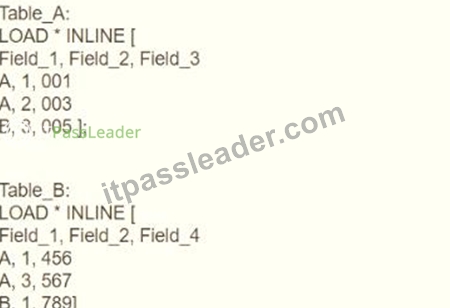
A data architect needs to modify the script to ONLY load rows from Table_B when Field_1 and Field_2 are the same as in Table_A.
(For example, only the row containing A. 1. 456 should be loaded from Table_B ) Which script should the data architect use?
A)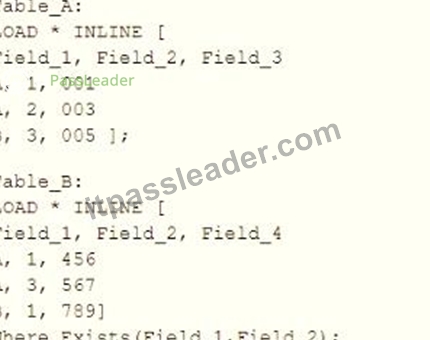
B)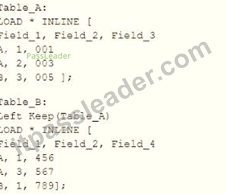
C)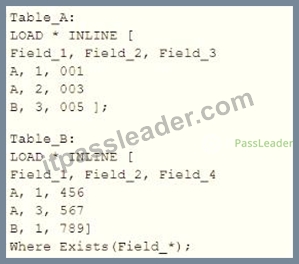
D)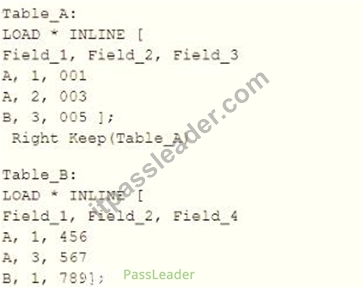
- A. Option B
- B. Option C
- C. Option A
- D. Option D
Answer: D
NEW QUESTION 24
A data architect needs to write the expression for a measure on a KPI to show the sales person with the highest sales. The sort order of the values of the fields is unknown. When two or more sales people have sold the same amount, the expression should return all of those sales people.
Which expression should the data architect use?
- A. FirstSortedValue {Salesperson, -Aggr (Sum{Sales), Salesperson))
- B. Concat(DISTINCT IF{Aggr{Rank{Sum(Sales),4),Salesperson)=1,Salesperson),' ')
- C. FirstSortedValue{DISTINCT Salesperson,-Aggr{Sum(Sales),Salesperson))
- D. Concat(DISTINCT IF{Aggr{Rank{Sum(Sales),1),Salesperson)=1, Salesperson) , ' ')
Answer: B
NEW QUESTION 25
A company decides to migrate all apps from QlikView to Qlik Sense. After converting an apps: there are several unconverted objects What should the data architect do?
- A. Re-create the unconverted objects
- B. Save the unconverted objects as extensions and import them into Qlik Sense
- C. Save the unconverted objects as master items
- D. Remove the set analysis statements from the unconverted objects
Answer: B
NEW QUESTION 26
Refer to the exhibit.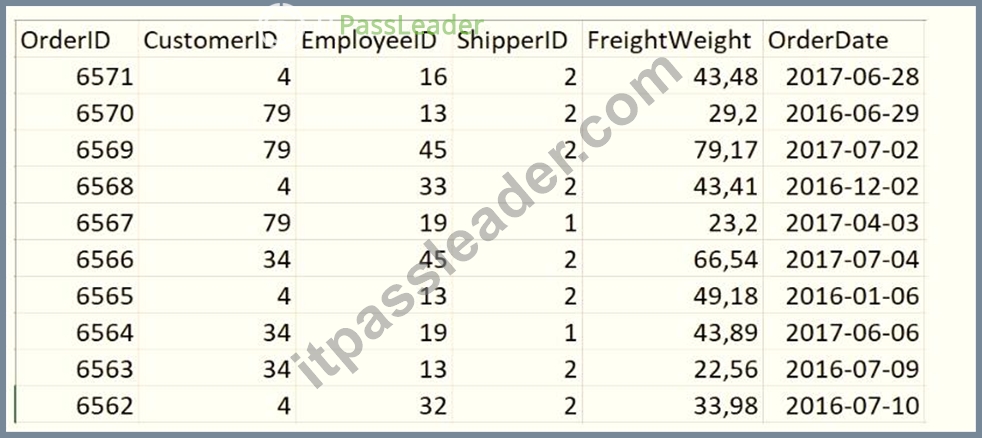
The data architect needs to create a KPI that displays the average amount of orders per customer. This aggregated field should be added to the existing orders table Which script should the data architect use?
A)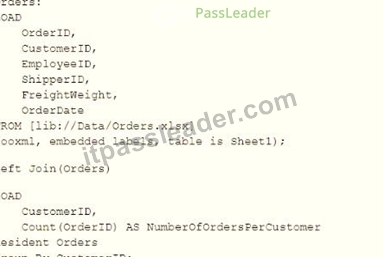
B)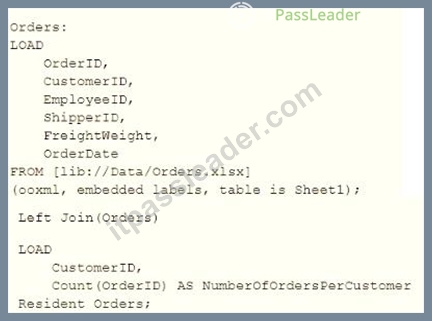
C)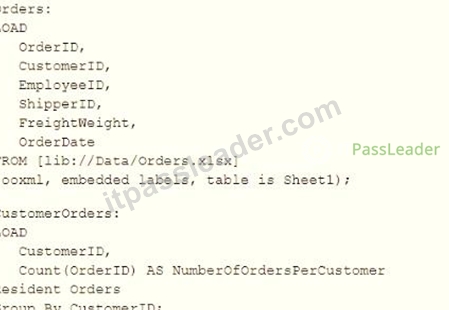
D)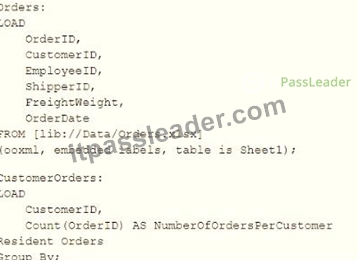
- A. Option C
- B. Option B
- C. Option D
- D. Option A
Answer: A
NEW QUESTION 27
Refer to the exhibit.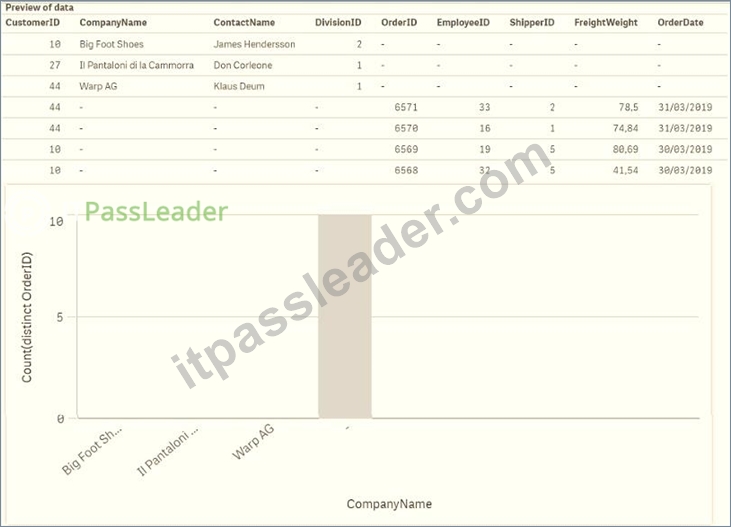
A data architect needs to analyze the number of orders by customer. The data is stored in two Excel files: Orders and Customers The data architect creates a bar chart, but the data is obviously incorrect. What should the data architect do to resolve this issue?
- A. Open the data manager split the Customers table, and associate on CustomerlD
- B. Open the data load editor, rename the CustomerlD field, and concatenate Orders and Customers
- C. Open the data load editor, use CONCATENATE to concatenate Orders and Customers
- D. Open the data manager, split the Customers table, and Concatenate Orders and Customers on the CustomerlD field
Answer: D
NEW QUESTION 28
Refer to the exhibit.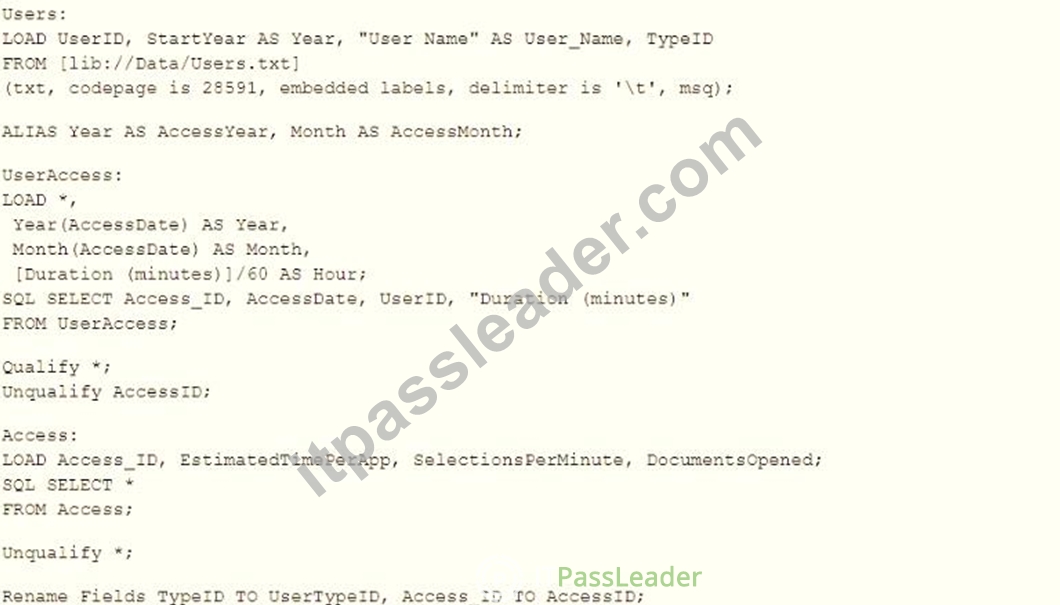
- A. * The UserAccess table contains seven fields AccessYear, AccessMonth, Hour AccesslD, AccessDate, UserlD, and Duration (minutes)
* The table is only linked to Users on the UserlD field - B. * The UserAccess table contains seven fields AccessYear. AccessMonth. Hour. AccesslD, AccessDate. UserlD. and Duration (minutes)
* The table is linked to the Access table on the AccesslD field and linked to Users on the UserlD field - C. * The UserAccess table contains seven fields Year Month, Hourr AccesslD. AccessDate. UserlD, and Duration (minutes)
* The table is only linked to Users on the UserlD field - D. * The UserAccess Table contains seven fields: Year, Month. Hour. AccessID, AccessDate. UserlD, and Duration (minutes)
* The table is linked to the Access table with the AccessID field and linked to Users on the UserlD field
Answer: B
NEW QUESTION 29
Refer to the exhibit.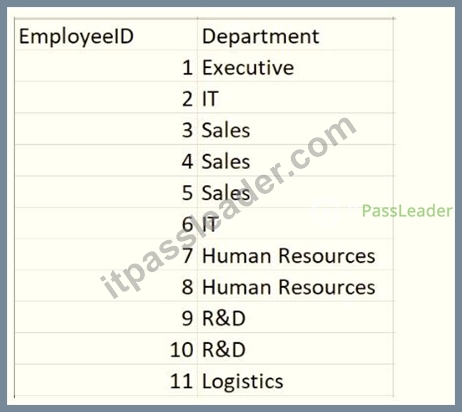
A company has different departments Executive and Sales should always be the first values in a Department filter pane Which script must the data architect use to meet this requirement^ A)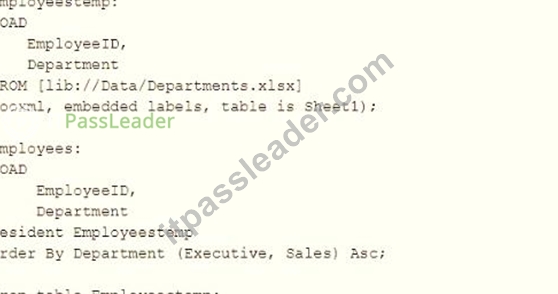
B)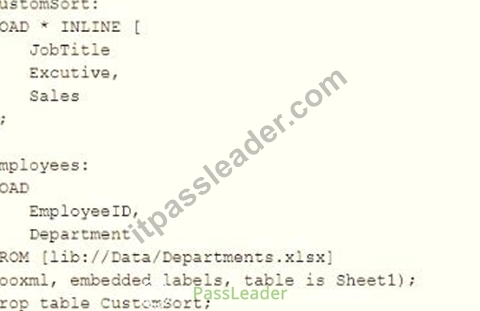
C)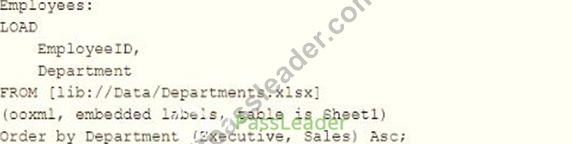
D)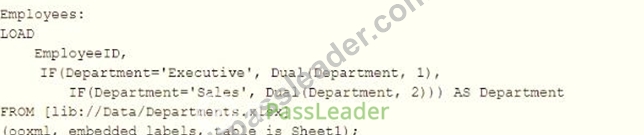
- A. Option C
- B. Option B
- C. Option D
- D. Option A
Answer: A
NEW QUESTION 30
A data architect wants to combine data on present and historic sales performance. The historic data is stored in a de-normalized archive, and the present data is maintained in a database. The output must be contained in a single table.
Which script should the data architect use?
A)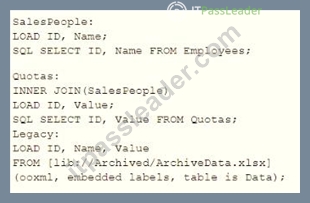
B)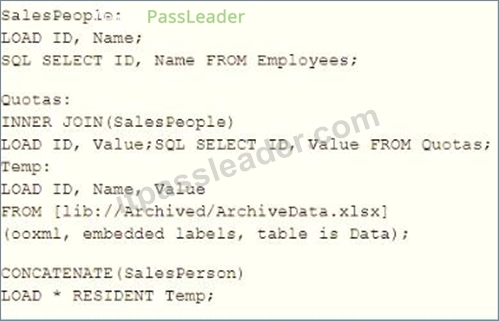
C)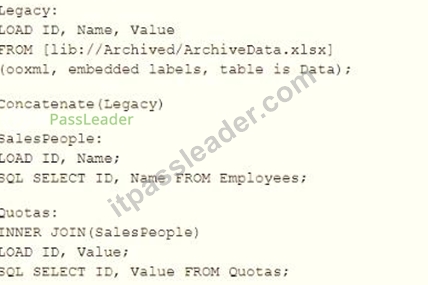
D)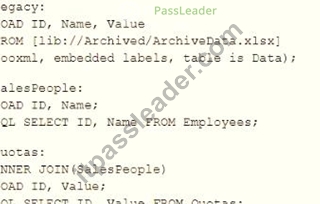
- A. Option A
- B. Option B
- C. Option D
- D. Option C
Answer: A
NEW QUESTION 31
Refer to the exhibit.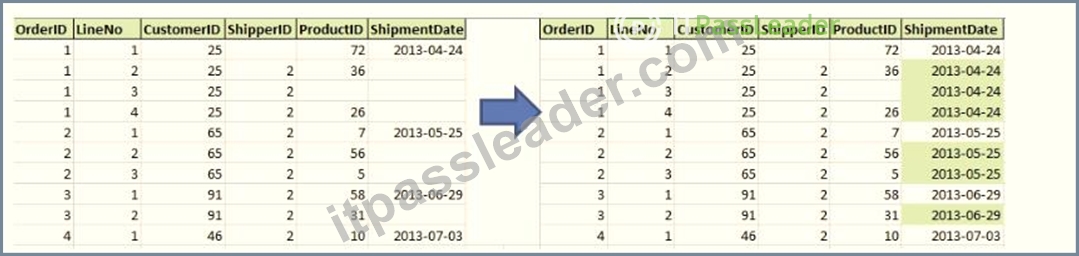
A shipping company needs to track its shipments using Qlik Sense A data architect has the data in Excel as shown on the left Business rules state that if the ShipmentDate field is empty, it should be populated with the first valid previous date as shown on the right. Which script should the data architect use to meet this requirement?
A)
B)
C)
D)
- A. Option A
- B. Option B
- C. Option D
- D. Option C
Answer: A
NEW QUESTION 32
A data architect completes development of a new app with two data sources Both data sources will also be used by other apps in the future The sources have different data refresh frequencies
* Source 1 Contains frequently updated data and must be refreshed hourly
* Source 2 Contains data that is transferred from a partner and must be refreshed weekly Tasks must be created to load the data sources and make sure that the new app uses the most current data The data will be stored in two QVDs Which tasks should be created to meet these requirements'?
- A. 1 Schedule Task 1 to run hourly and refresh data from Source 1
2 Schedule Task 2 to run weekly and refresh data from Source 2
3. Schedule a task for the app that is dependent on completion of Task 2 that loads the two QVDs - B. 1. Schedule Task 1 to run hourly and refresh data from Source 1
2 Schedule Task 2 that is dependent on Task 1 to refresh data from Source 2
3 Schedule a task for the app that is dependent on completion of Tasks 1 and 2 that loads the two QVDs - C. 1 Schedule Task 1 to run hourly and refresh data from Source 1
2 Schedule Task 2 to run weekly and refresh data from Source 2
3. Schedule a task for the app that is dependent on completion of Tasks 1 or 2 that loads the two QVDs - D. 1. Schedule Task 1 to run hourly and refresh data from Source 1
2 Schedule Task 2 that is dependent on Task 1 to refresh data from Source 2
3. Schedule a task for the app that is dependent on completion of Task 2 that loads the two QVDs
Answer: A
NEW QUESTION 33
A data architect builds a data model for a large user group. Some sheets will be published, and the app will allow users to create their own visualizations and analyze dat a. Some fields must NOT appear in any field list.
How should a data architect meet these requirements?
- A. Add fields to master items
- B. Use HidePrefix variable
- C. Use HideField variable
- D. Use security rules
Answer: B
NEW QUESTION 34
Refer to the exhibits.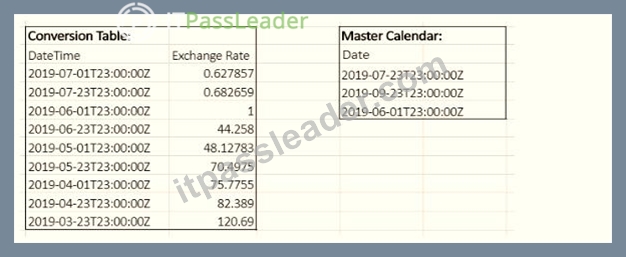
A business analyst needs to see the currency conversion rate for any given date in a chart The currency conversion rate data comes from Qlik DataMarket and only contains a record when the rate changes An existing master calendar exists in the data model which contains a full set of dates Which technique should the data architect use to meet this requirement?
- A. Use IntervalMatch to load the currency conversion rate between dates the conversion changed Inner Join the resultant table back into the master calendar
- B. Outer Join the calendar with the currency conversion table Order by the date and use the Peek function to fill in blank values
- C. Use a FOR loop between the start date and end date of the master calendar Use the Match function to add the currency conversion rates to the master calendar
- D. Use IterNo and AutoGenerate to create a new calendar from max and mm dates of the currency conversion table Force concatenate with the master calendar
Answer: B
NEW QUESTION 35
A company generates 1 GB of ticketing data daily. The data is stored in multiple tables Business users need to see trends of tickets processed for the past two years. Users very rarely access the transaction-level data for a specific date. Only the past two years of data must be loaded which is 720 GB of data Which method should a data architect use to meet these requirements?
- A. Load only two years of data and use best practices in scripting and visualization to calculate and display aggregated data
- B. Load only aggregated data for two years and use ODAG for transaction data
- C. Load only aggregated data for two years and use Direct Discovery for transaction data
- D. Load only two years of data in an aggregated app and create a separate transaction app for occasional use
Answer: B
NEW QUESTION 36
Multiple department fields in a dataset require a description.
A data architect needs to add the department descriptions or a default value when the department does NOT have a description.
Which strategy should the data architect use to meet these requirements?
- A. ApplyMap with three parameters after the Mapping load
- B. Left Join between tables and Description.xlsx in every Department table
- C. Enter "Missing description" in the blank rows for Description.xlsx, then use Mapping Load
- D. ApplyMap with two parameters after the Mapping load
Answer: D
NEW QUESTION 37
A data architect is developing an app that will generate QVDs for multiple business analysts. The field naming conventions on the source data are NOT business friendly. For every table loaded, multiple fields will require a name change.
An Excel file is maintained centrally that lists all source data field names and the appropriate names as they should appear in the QVDs Which strategy should the data architect use to meet these requirements?
- A. Use the Alias function and a mapping load
- B. Create master items using business-friendly names
- C. Use the Rename function and a mapping load
- D. Load in the Excel file as a data island and use the Peek function
Answer: C
NEW QUESTION 38
Refer to the exhibits.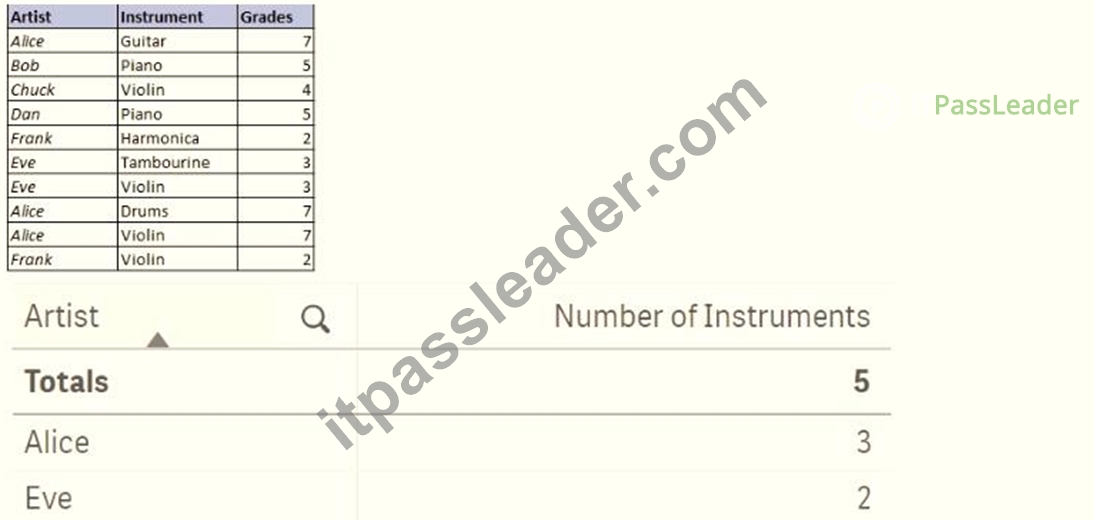
A music teacher needs to know which artists are eligible to enter this year's competition.
The teacher needs to find only the artists who have a music grade rank above two and play more than one instrument.
Which expression is needed for the Number of Instruments measure in the table?
- A. Count ({S<Artist={"=Count(Instrument)>=2M}, Grades={">2"}>}Instrument)
- B. Count({$<Artist={"=Count(Instrument)>=2"}, Artist={"=Grade>2"}>}Instrument)
- C. Count({$<Instrument={">=2"}, Artist={"=Grade>2"}>}Instrument)
- D. Count({S<Count(Instrument)={">=2"}, Grades={">2"}>}Instrument)
Answer: B
NEW QUESTION 39
A data architect needs to load large amounts of data from a database which is continuously updated New records are added, and existing records get updated and deleted. Each record has a LastModified field All existing records are exported into a QVD file. The data architect wants to load the records into Qlik Sense efficiently.
Which steps should the data architect take to meet these requirements?
- A. 1. Load the existing data from the QVD.
2. Load the new and updated data from the database without the rows that have just been loaded from the QVD. Concatenate with data from the QVD.
3. Load all records from the key field from the database and use an Inner Join on the previous table. - B. 1. Load the new and updated data from the database
2. Load the existing data from the QVD without the updated rows that have just been loaded from the database. Concatenate with the new and updated records.
3. Load all records from the key field from the database and use an Inner Join on the previous table. - C. 1. Load the existing data from the QVD.
2. Load new and updated data from the database. Concatenate with the table loaded from the QVD.
3. Create a separate table for the deleted rows and use a WHERE NOT EXISTS to remove these records. - D. 1. Use a partial load to load new and updated data from the database.
2. Load the existing data from the QVD without the updated rows that have just been loaded from the database. Concatenate with the new and updated records.
3. Use the Peek function to remove the deleted rows.
Answer: D
NEW QUESTION 40
......
Qlik QSDA2019 Exam Syllabus Topics:
| Topic | Details |
|---|---|
| Topic 1 |
|
| Topic 2 |
|
| Topic 3 |
|
| Topic 4 |
|
| Topic 5 |
|
| Topic 6 |
|
| Topic 7 |
|
Best way to practice test for Qlik QSDA2019: https://www.itpassleader.com/Qlik/QSDA2019-dumps-pass-exam.html
QSDA2019 Dump Ready - Exam Questions and Answers: https://drive.google.com/open?id=1a_AOMBRkXTUdah3y8C2I08MjHtAqOspQ